Clear Sky Science · en
Study on the effect of solid particle proppant on fracture support and flow conductivity in coal seam
Why keeping tiny cracks open matters
Deep underground, many coal seams are packed with methane gas that can fuel power plants or leak into mine tunnels as a deadly hazard and a greenhouse gas. Engineers use high-pressure water to crack the coal and let this gas escape, but those new cracks tend to snap shut again under the enormous weight of the overlying rock. This study asks a deceptively simple question with big consequences for safety and efficiency: what kind of tiny solid beads are best at keeping those cracks propped open so gas can keep flowing for years, not just weeks?
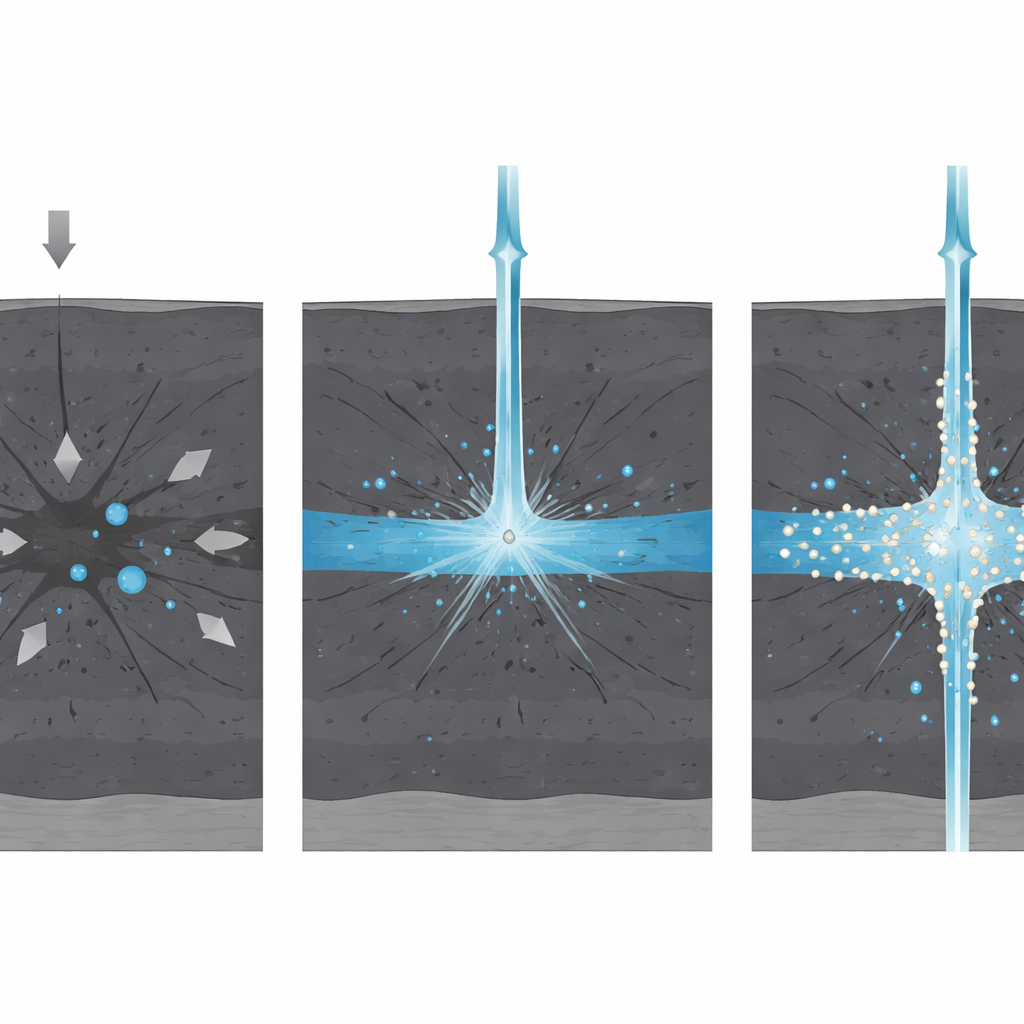
How engineers hold rock apart
To understand the problem, imagine forcing open a hairline crack in a heavy door and then slipping in a row of marbles so it cannot close. In underground coal seams, the "marbles" are called proppants: hard grains such as quartz sand or manufactured ceramic pellets that are pumped into water-driven fractures. Once the pumping stops and natural ground pressure pushes back, these grains act like miniature pillars that hold the crack open just enough to let gas and water move through. The team focused on a Chinese mine with especially tight, low-permeability coal, using specialized hydraulic fracturing software to simulate how different proppants behave as the fractures form and slowly close.
Comparing two kinds of tiny pillars
The researchers first compared common quartz sand grains with stronger, denser ceramic beads called ceramsite, using the same grain size in each case. Their simulations showed that after the initial fracture narrowed under ground stress, both materials still prevented the crack from fully closing, shrinking its width by about 90 percent but preserving its ability to carry flow. Crucially, fractures filled with ceramsite allowed, on average, about 1.7 times more flow than those filled with quartz sand. The reason lies in basic rock mechanics: quartz sand grains crush and press into the coal more easily, thinning the open pathway, while tougher ceramsite particles keep their shape and build a sturdier internal skeleton that better resists squeezing.
Why grain size makes a big difference
Next, the team explored how big those supporting grains should be. They modeled three ceramsite sizes, from relatively large beads down to much finer grains. Larger grains created a slightly wider final crack and, more importantly, much higher flow. The largest size delivered an average fracture flow capacity nearly three times that of medium grains and about eleven times that of the finest grains. Field measurements in the mine, which tracked how easily gas and water moved out of the coal as the fracture gradually closed, confirmed this pattern: seams supported by larger beads consistently showed better and more stable flow over time than those held open by smaller ones.
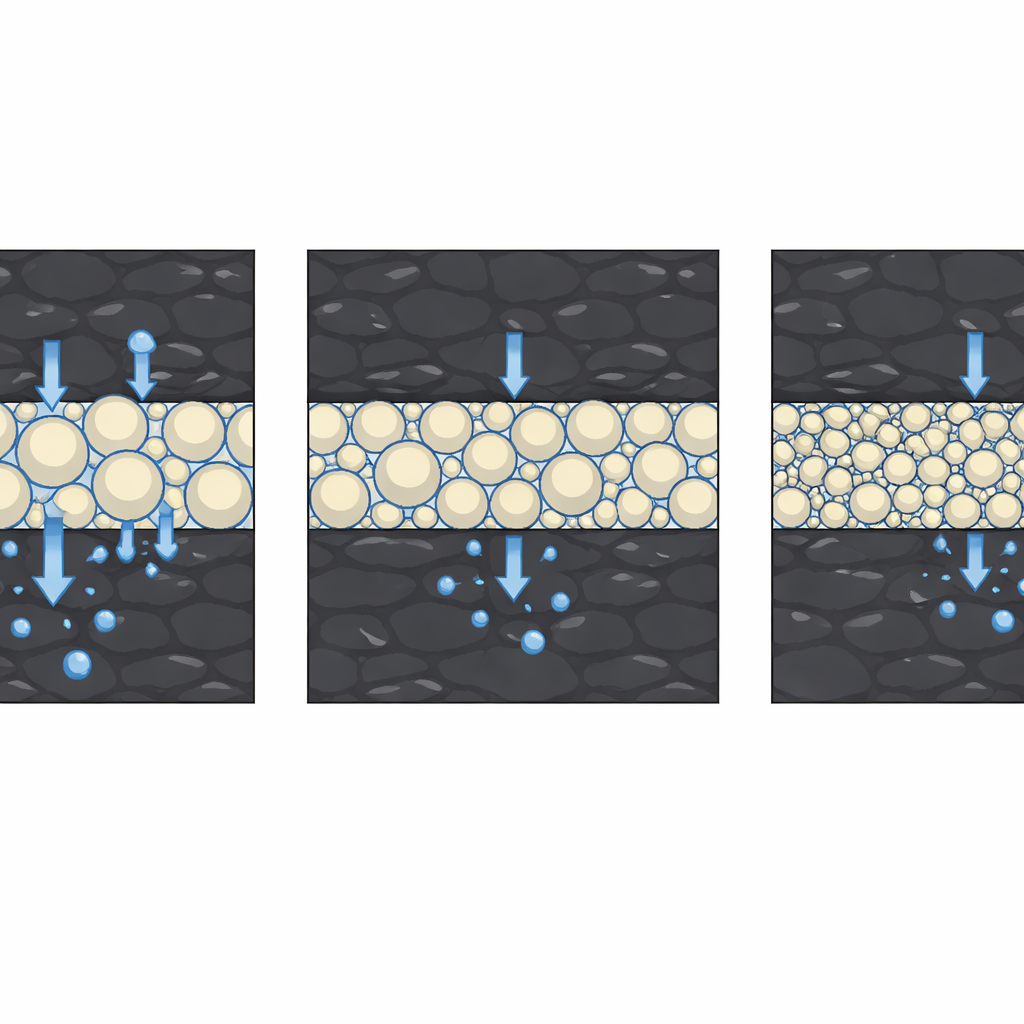
What happens when grains crumble
Of course, those grains do not always stay perfect. Under rising underground pressure, some crack and grind into smaller fragments. The researchers simulated a range of crushing levels, from intact beads to complete breakage. As more particles were crushed, the once-clear channels between them clogged and the open gap between the coal faces shrank. Flow capacity and overall permeability dropped almost linearly with the crushing rate, eventually approaching zero when the proppant was completely broken. The study also linked this damage to ground stress: within the mine’s typical stress range, every step up in stress sharply increased the fraction of crushed grains, matching the decline in simulated fracture performance.
What this means for safer, cleaner coal
In plain terms, the work shows that not all tiny beads are created equal. Using strong, relatively large ceramic proppants helps coal seam fractures stay open longer and carry more gas, reducing the number of wells and fracturing operations needed. At the same time, understanding how easily these grains crush under stress lets engineers better predict when and where cracks will fade and plan around that risk. For mines with similar depths and rock conditions, the authors argue that carefully chosen, well-graded ceramic proppants can boost gas drainage, cut the danger of gas build-up in tunnels, and limit methane leaks into the atmosphere, turning a subtle choice of grain type and size into a powerful lever for safety and environmental protection.
Citation: Zhang, C., Chen, Z., Zhang, Z. et al. Study on the effect of solid particle proppant on fracture support and flow conductivity in coal seam. Sci Rep 16, 11809 (2026). https://doi.org/10.1038/s41598-026-42338-w
Keywords: coal seam gas, hydraulic fracturing, proppant selection, methane drainage, mine safety