Clear Sky Science · en
Haptic perception of 2.5D surface feature height
Why tiny bumps on flat screens matter
Imagine reading a map or a message on your phone without looking at the screen at all—just by feeling tiny bumps that rise and fall under your fingertip. As touchscreens and digital Braille devices evolve, engineers need to know how small and how tall those bumps must be for people to reliably feel them. This study asks a very down-to-earth question: how sensitive are our fingertips to the height of small, rounded bumps, and does the material they are made from change what we can feel?
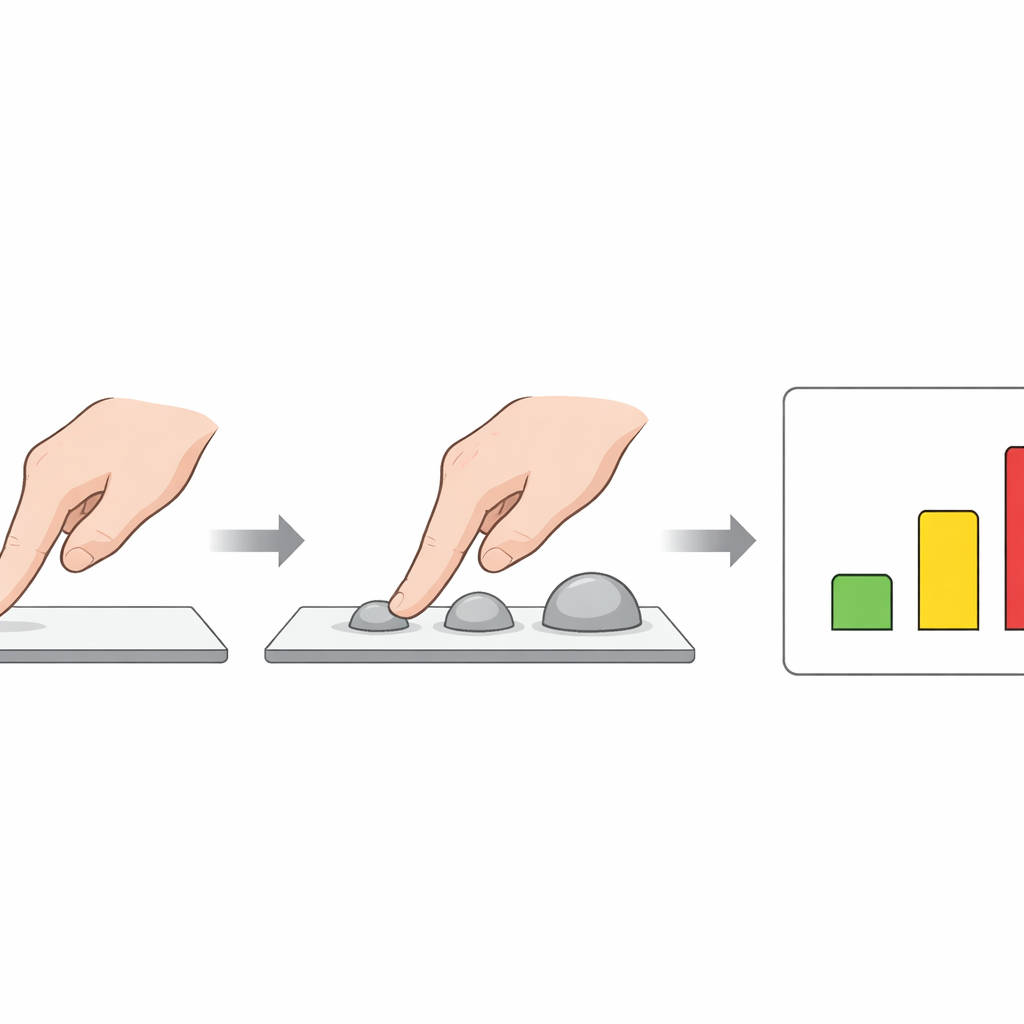
Feeling shape with the skin
Our fingertips are packed with nerve endings that let us feel fine textures and shapes far smaller than a grain of sand. Earlier research has shown how well people can notice single microscopic dots or the gentle curvature of objects about the size of a fingertip. But there has been a gap between these two scales: we knew a lot about very tiny features and about large, smooth curves, but much less about the “in-between” sizes that future tactile screens are likely to use. The authors focus on simple, dome-shaped bumps that stick out from an otherwise flat surface—a kind of basic building block that, when combined in patterns, can form letters, icons, or small relief images.
Testing how much difference we can feel
In the first experiment, the researchers asked how much the height of a dome has to change before people can tell that one bump is taller than another. Volunteers touched pairs of domes with their index fingertip and reported whether they felt a difference in height. The team used three base sizes for the domes—roughly 1.4, 2.8, and 5.6 millimeters across—and made them out of either a softer plastic or a stiffer material. They found that people became more sensitive, able to notice smaller height differences, as the base of the dome grew wider, especially when the domes were relatively low and shallow. Interestingly, whether the domes were soft or hard made almost no difference for this kind of comparison.
Finding the smallest bump we can detect
In the second experiment, the question changed from “which bump is taller?” to “is there a bump here at all?” Participants again explored small domes on flat samples, but this time the researchers gradually lowered the height of the bump until the person could no longer tell it apart from a perfectly flat surface. For each base size, they repeated the test several times and averaged the point at which the bump became undetectable. The results revealed a clear pattern: the smallest detectable height—called the absolute threshold—actually increased with the base diameter. In other words, very narrow domes could be shorter and still be felt, while broader domes had to be taller before people noticed them.
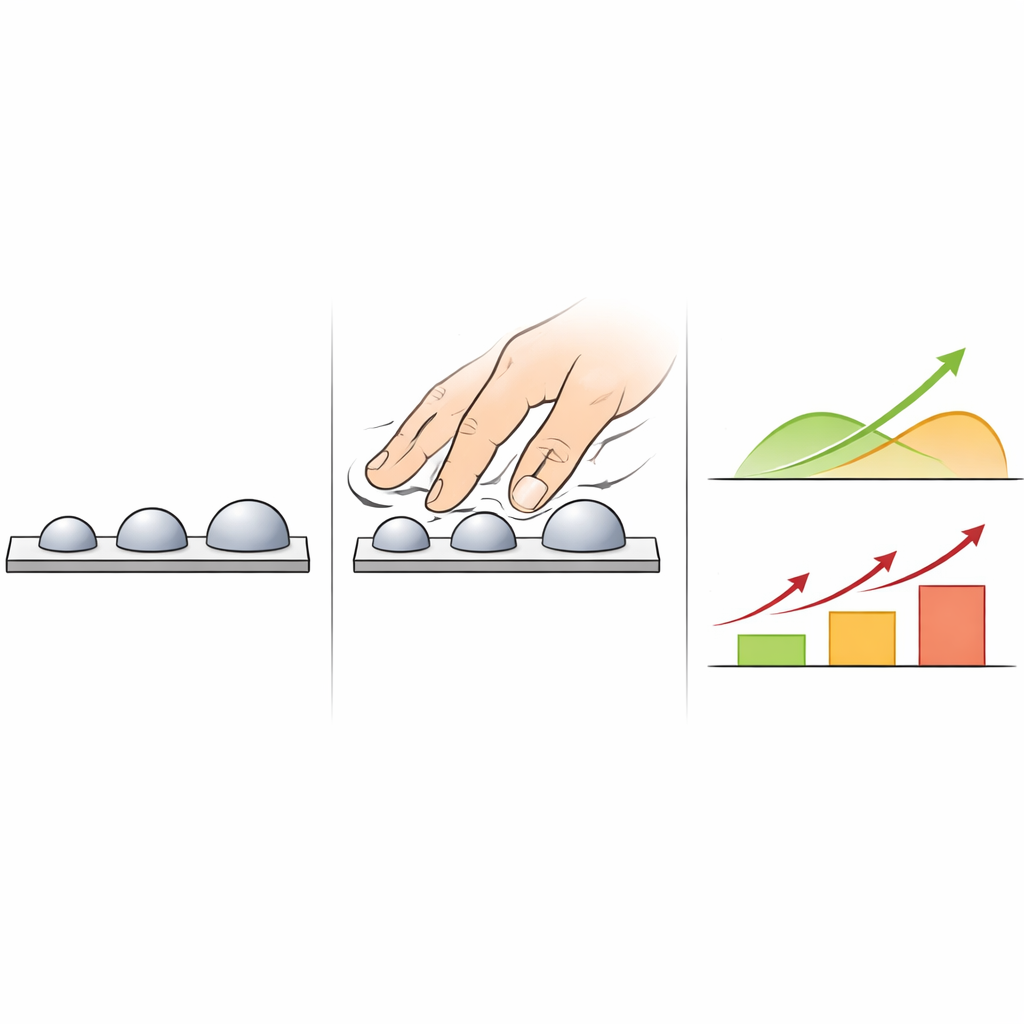
What bump size and shape really matter
Putting both experiments together, the study paints a nuanced picture of how we feel 2.5D surface features—that is, bumps that rise from a flat background without forming full 3D objects. When people compare two bumps, larger base areas and steeper bump “slopes” (height relative to width) help them detect differences in height more precisely. But when they are simply trying to notice whether a bump is present, narrow domes have an advantage, likely because the fingertip encounters sharper changes along the skin as it moves across them. The fact that material softness had little impact under these conditions suggests that the skin’s local deformation, rather than how deep the finger sinks, dominates perception for these small features.
What this means for future touchable displays
For designers of tactile screens, digital Braille, and morphing surfaces, these findings act like a set of design rules. If the goal is to let users distinguish between different feature heights or finely graded patterns, it helps to use somewhat larger domes with suitably steep slopes. If the goal is simply to ensure that a bump is noticeable at all, narrower features can stand a bit shorter and still be felt. Because surface softness did not strongly affect performance here, engineers may have more freedom to choose materials based on durability or manufacturing needs. Ultimately, the study offers concrete numbers and trends that can guide how high and how wide tactile bumps should be to make future touch-based interfaces both comfortable and reliably readable by human fingers.
Citation: Hwang, I., Yun, S. & Park, J. Haptic perception of 2.5D surface feature height. Sci Rep 16, 12116 (2026). https://doi.org/10.1038/s41598-026-42333-1
Keywords: haptic perception, tactile displays, surface morphing, touchscreen feedback, Braille technology