Clear Sky Science · en
Computational study of novel scandium and lithium perovskites based materials for sustainable energy devices
New building blocks for cleaner power
As the world searches for safer, longer-lasting materials to power solar panels, sensors, and other energy devices, scientists are turning to a family of crystals called perovskites. Many of today’s high-performing perovskites contain toxic lead or break down too easily under heat and intense light. This paper explores two newly designed, lead-free crystals built from common elements such as potassium, lithium, scandium, fluorine, and chlorine, revealing how a simple change in one ingredient can transform their behavior in light and heat–critical qualities for future green technologies.
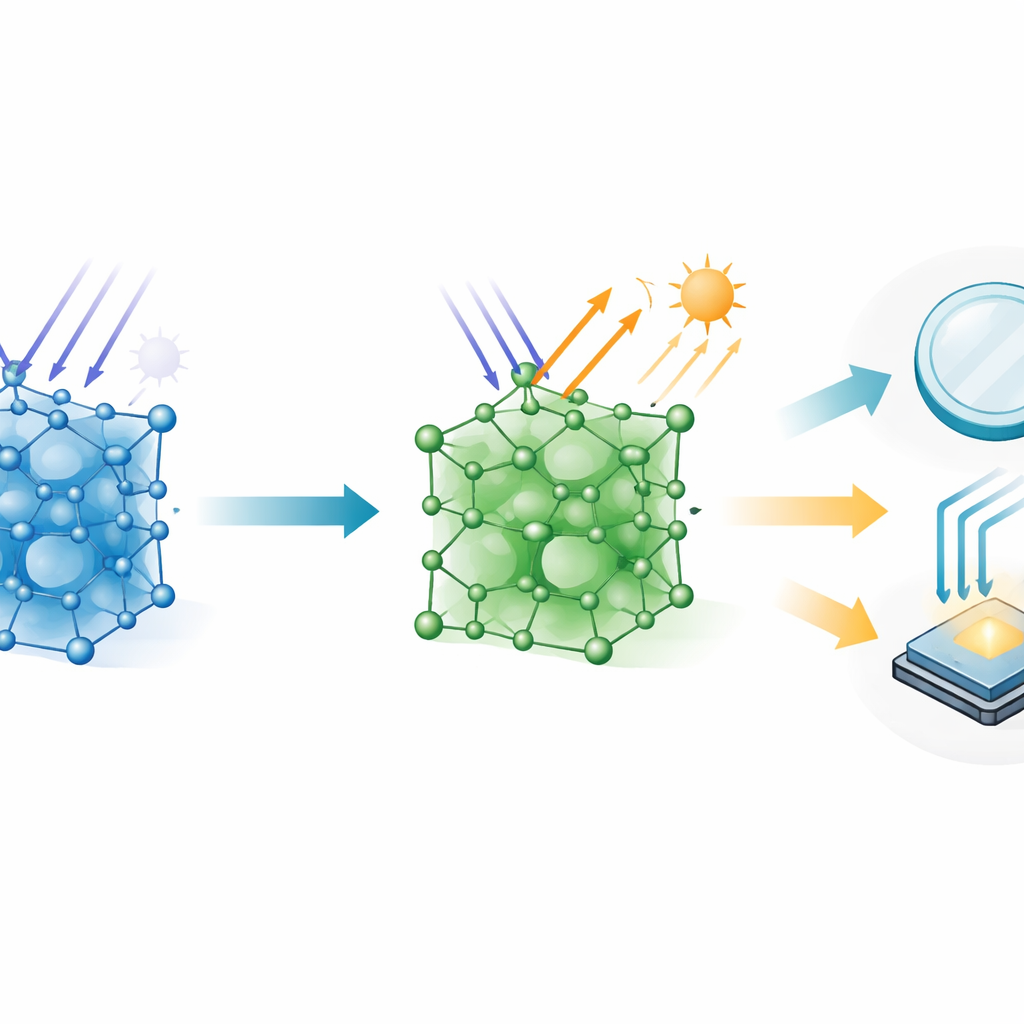
Two crystals, one simple swap
The researchers focus on a pair of closely related materials with the formula K₂ScLiX₆, where X is either fluorine (F) or chlorine (Cl). Both belong to the “double perovskite” family, which can be thought of as three‑dimensional frameworks of linked octahedra and cages that host different metal ions. Using quantum‑mechanical calculations rather than lab-grown samples, the team first confirmed that both versions prefer a symmetric cubic arrangement of atoms and are energetically stable enough to be synthesized. They then used well‑established measures, such as tolerance factors and formation energies, to show that the fluoride and chloride crystals should form robust, ordered lattices without collapsing into competing structures.
How the swap reshapes light and electricity
Although the two crystals differ only in whether fluorine or chlorine occupies the “X” site, that substitution dramatically reshapes how they interact with light. The fluoride version has a very wide electronic band gap, meaning it barely absorbs visible or near‑ultraviolet light and instead lets even deep‑UV photons pass through. The chloride version, with its larger and more easily polarized chlorine ions, has a smaller band gap and a richer pattern of allowed electronic transitions. As a result, it absorbs UV light more strongly, supports intense collective electron oscillations (plasmons) around 16 eV, and shows higher dielectric and refractive responses. These traits make K₂ScLiF₆ attractive as an exceptionally transparent window or coating for high‑energy UV, while K₂ScLiCl₆ behaves more like a UV filter or active layer that captures light.
Strength, stiffness, and heat flow
The team also examined how the two crystals would respond to mechanical stress and heat, key considerations for devices that must survive years outdoors or in hot electronics. Calculated elastic constants show that the fluoride is significantly stiffer and more resistant to compression than the chloride. It behaves in a ductile manner, meaning it can accommodate some deformation without fracturing, whereas the chloride is softer and brittle. From these same elastic data, the authors extracted sound velocities and Debye temperatures, which track how efficiently vibrations carry heat. Here again the fluoride stands out: it has a higher Debye temperature and melting point, pointing to better thermal conductivity and superior high‑temperature stability. The chloride’s lower Debye temperature implies that it will conduct heat poorly, a useful trait when thermal insulation or thermoelectric performance is desired.
Atomic motion and stability in motion
To go beyond static pictures, the researchers ran atom‑by‑atom molecular dynamics simulations at elevated temperature. In these computational “test drives,” the fluoride crystal maintained a very steady potential energy and well‑behaved temperature profile, signaling excellent structural integrity under heat. The chloride crystal remained largely intact but showed small energy fluctuations and soft vibrational modes, consistent with its phonon calculations that reveal a tendency toward slight structural distortions. Such softness usually suppresses heat transport, reinforcing the view of K₂ScLiCl₆ as a low‑conductivity, UV‑active material, while confirming K₂ScLiF₆ as a rigid, thermally robust host.
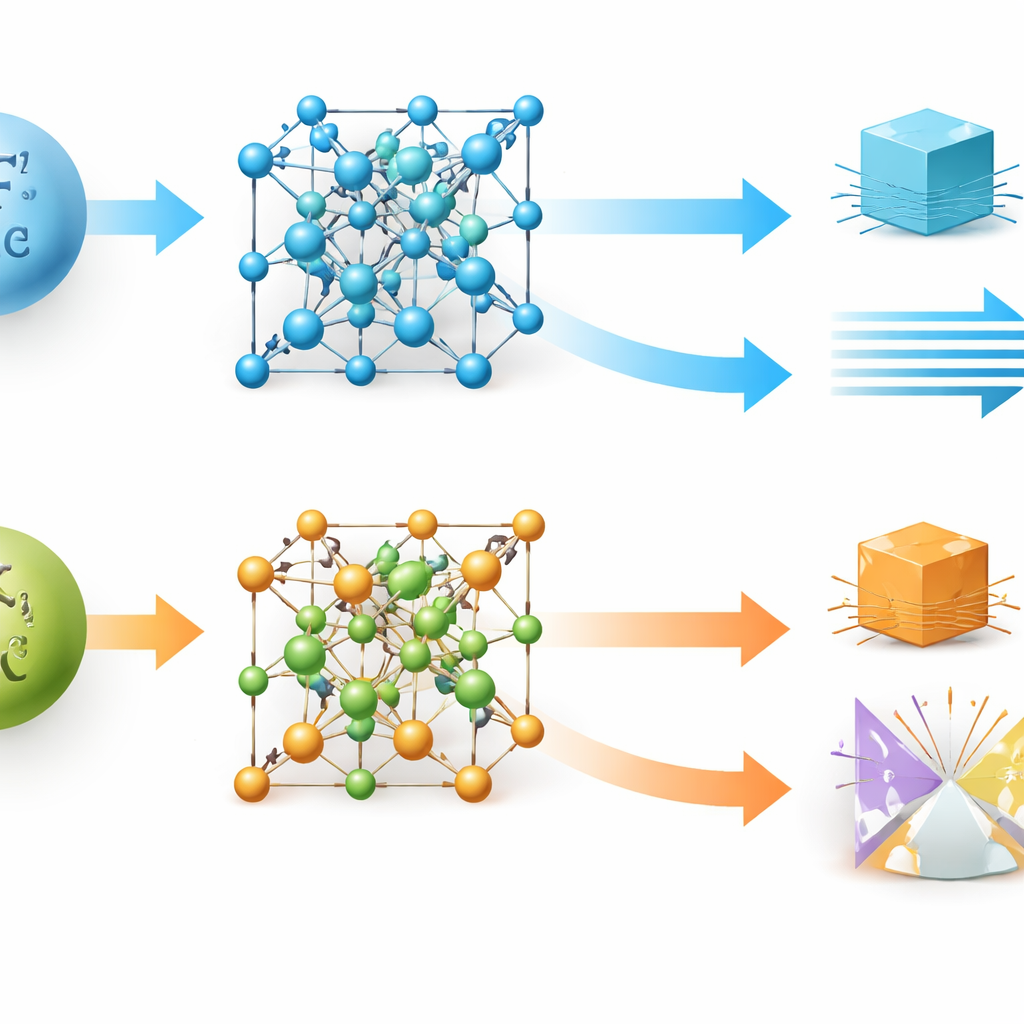
From crystal design to real devices
Taken together, the study demonstrates how “anion engineering” – swapping fluorine for chlorine while keeping the metal framework fixed – offers a powerful lever to tune performance without resorting to toxic lead. K₂ScLiF₆ combines deep‑UV transparency, mechanical strength, and thermal stability, making it a strong candidate for protective windows, coatings, and insulating layers in harsh optical environments. K₂ScLiCl₆, by contrast, couples strong UV absorption, pronounced plasmonic behavior, and low thermal conductivity, positioning it for UV‑shielding films, photodetectors, and possibly thermoelectric or radiation‑sensing devices. For a lay reader, the key message is that carefully re‑arranging common elements inside a crystal can yield tailor‑made materials that guide light and heat exactly where future sustainable energy technologies need them.
Citation: Hussain, A., Shahzad, M.K., Sagir, M. et al. Computational study of novel scandium and lithium perovskites based materials for sustainable energy devices. Sci Rep 16, 11885 (2026). https://doi.org/10.1038/s41598-026-42323-3
Keywords: lead-free perovskites, ultraviolet optoelectronics, energy materials, double perovskites, sustainable photovoltaics