Clear Sky Science · en
Modeling the impact of aerial water spray on the dynamics of anthropogenic pollutants to sustain industrialization
Why cleaning city air is so tricky
Modern cities depend on factories to provide jobs, electricity, building materials, and everyday goods. Yet the same smokestacks that power prosperity also load the air with tiny particles and gases that damage hearts and lungs. This paper asks a difficult question: can we keep industrial growth and a healthy population at the same time? Using a mathematical model, the authors explore how human numbers, industrial activity, and air pollution interact—and how targeted spraying of water into the air might tip the balance toward cleaner skies without shutting factories down.
People, factories, and dirty air
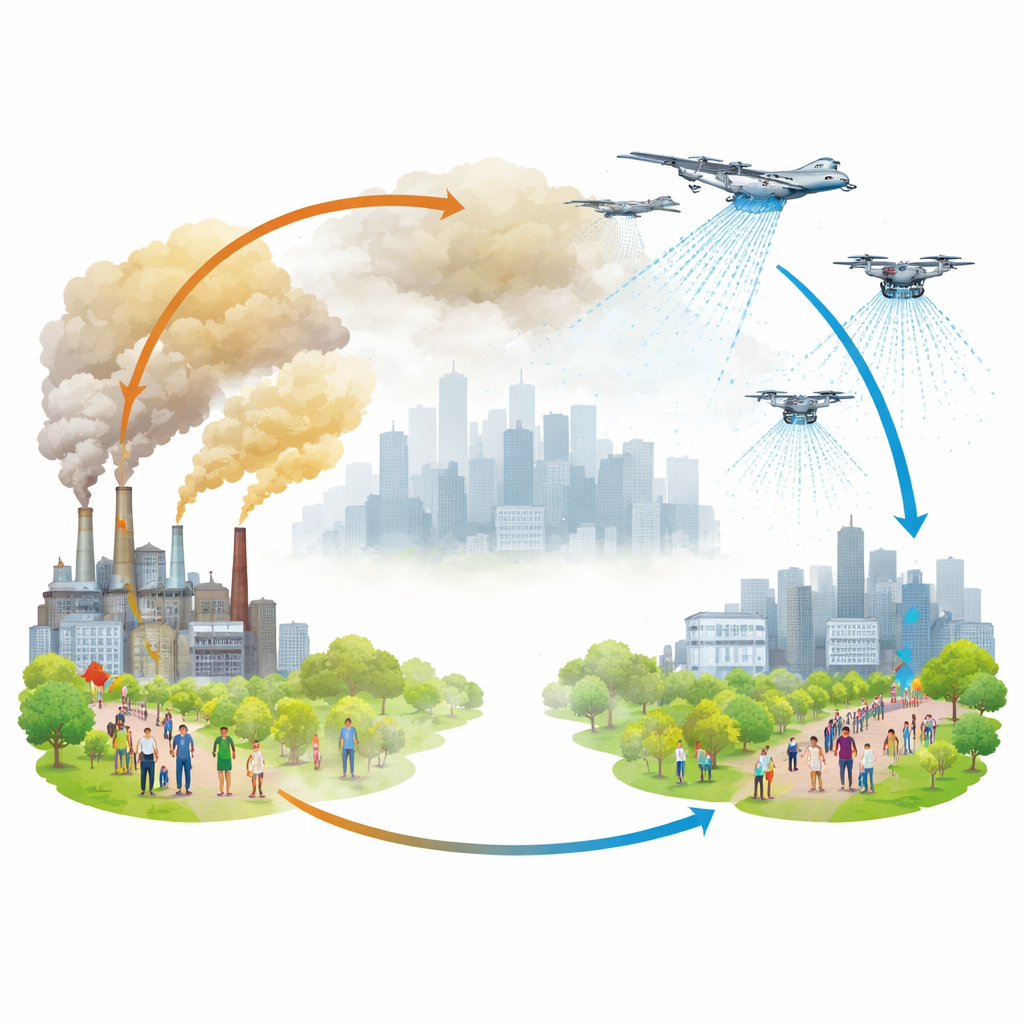
The study begins by looking at a simple chain of cause and effect. As more people live in a region, they demand more goods, power, and services, which encourages new factories to open. These factories in turn make life easier, attracting even more people. At the same time, both daily human activities and industrial processes release smoke and chemical pollutants into the air. Even at relatively low levels, these substances are linked to breathing problems, heart disease, and millions of premature deaths worldwide. Governments respond by pressuring or forcing heavily polluting factories to relocate or close, which then feeds back into jobs, population well‑being, and future industrial growth.
A mathematical "city in a box"
To untangle these relationships, the authors build a mathematical representation of an idealized region. The model tracks three main quantities over time: the density of the human population, the number of active industries, and the concentration of atmospheric pollutants. Rules describe how each quantity changes: people arrive and die; factories open in response to population demand and shut down naturally or under government pressure; pollutants are emitted from people and factories but also fade away through natural cleanup processes. Because these rules are nonlinear—effects do not scale in a simple straight line—the system can settle into different long‑term patterns depending on how strongly industry expands or how strictly it is regulated.
When growth becomes unstable
Analysis of the model shows that small shifts in key factors can flip the system from one long‑term state to another. If the rate at which new factories are established stays below a certain threshold, the region may end up with no industry at all, even though people remain. Once that threshold is crossed, a stable mix of people, factories, and pollutants can appear. But if industrial growth continues to intensify, the system can become unstable and start to oscillate: population levels, factory numbers, and pollution rise and fall in repeating cycles. Similarly, increasing the rate at which governments close or relocate factories to fight pollution can either stabilize the system or, if pushed too far, trigger sudden swings. These mathematical turning points, called bifurcations, act like hidden cliffs in the landscape of possible futures.
Adding water spray as a new lever
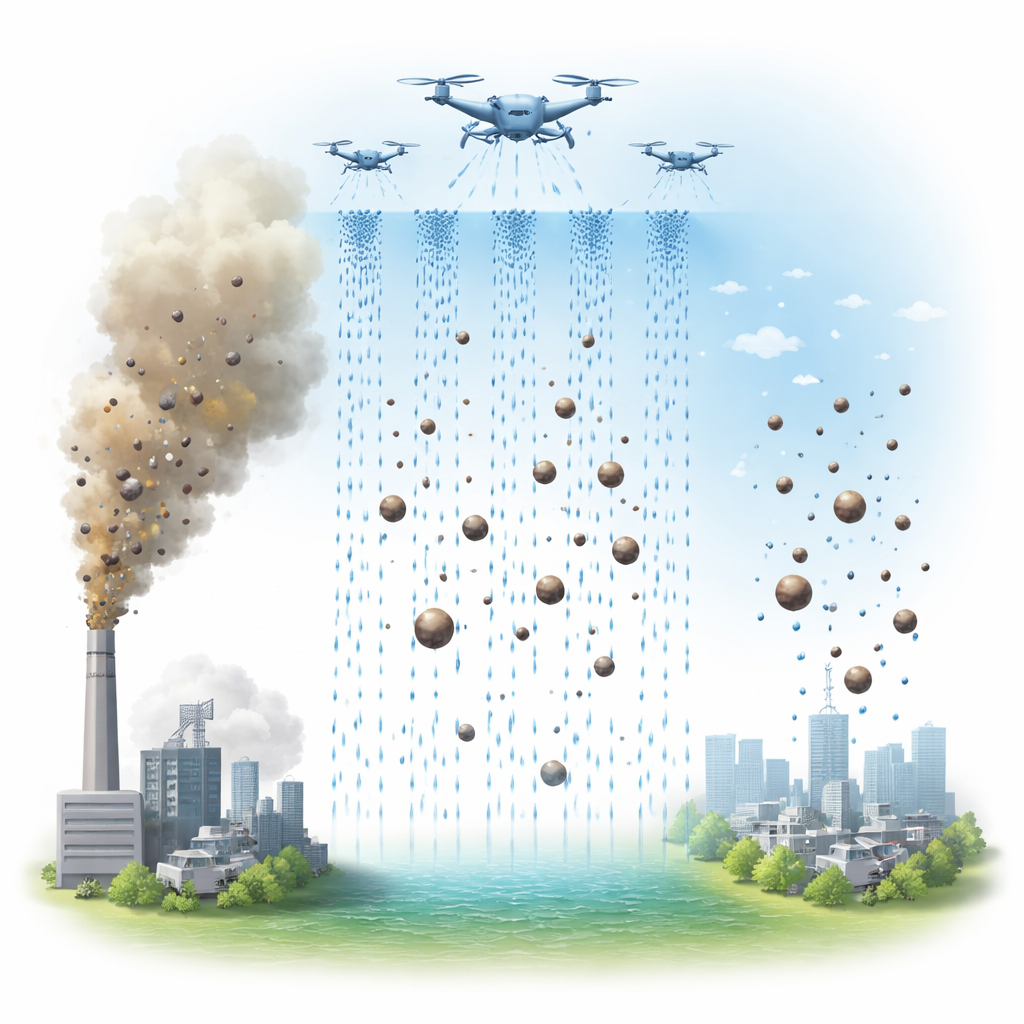
The authors then extend their model by adding a fourth ingredient: water sprayed into the air from aircraft, ground cannons, or drones. Fine droplets can latch onto airborne particles, making them heavier so they fall to the ground, much like an artificial drizzle. In the model, the amount of water spray responds to how polluted the air is, and the spray both removes pollutants and is itself depleted as it works. With this added process, the system gains new ways to return to a stable, pollution‑controlled state even when industrial growth would otherwise push it into oscillations. Under the right conditions—strong natural cleanup, effective pollutant capture by water, and well‑calibrated spray intensity—the long‑term pollution level drops, human population fares better, and wild swings in pollution disappear.
Finding the sweet spot for clean air and growth
For non‑specialists, the main takeaway is that industrial development, government action, and technological fixes like aerial water spraying interact in complex ways. The models suggest that simply building more factories or shutting many of them at once can backfire, leading to unstable cycles of dirty and cleaner air. By contrast, pairing moderate controls on industry with carefully tuned water spraying can expand the safe operating zone where both factories and people thrive under cleaner skies. The work offers a conceptual roadmap for policymakers: invest in natural and engineered cleanup, control emissions from both people’s activities and industry, and use interventions like water spraying thoughtfully to keep the system away from dangerous tipping points.
Citation: Agrawal, G., Misra, A.K., Agrawal, A.K. et al. Modeling the impact of aerial water spray on the dynamics of anthropogenic pollutants to sustain industrialization. Sci Rep 16, 13681 (2026). https://doi.org/10.1038/s41598-026-42300-w
Keywords: air pollution, industrialization, water spraying, mathematical modeling, urban environment