Clear Sky Science · en
AI driven dual constraint cooptimization of affective semantics and engineering parameters for biomimetic product design
Why Shape and Feeling Matter in Everyday Machines
From forklifts to household robots, many machines are built to work hard but look cold and unfriendly. Yet people respond strongly to how products feel visually—whether they seem safe, powerful, or approachable. This paper explores how artificial intelligence can design machines that are not only structurally sound, but also echo the shapes and moods we associate with living creatures, blending engineering logic with emotional appeal in a single, unified process.
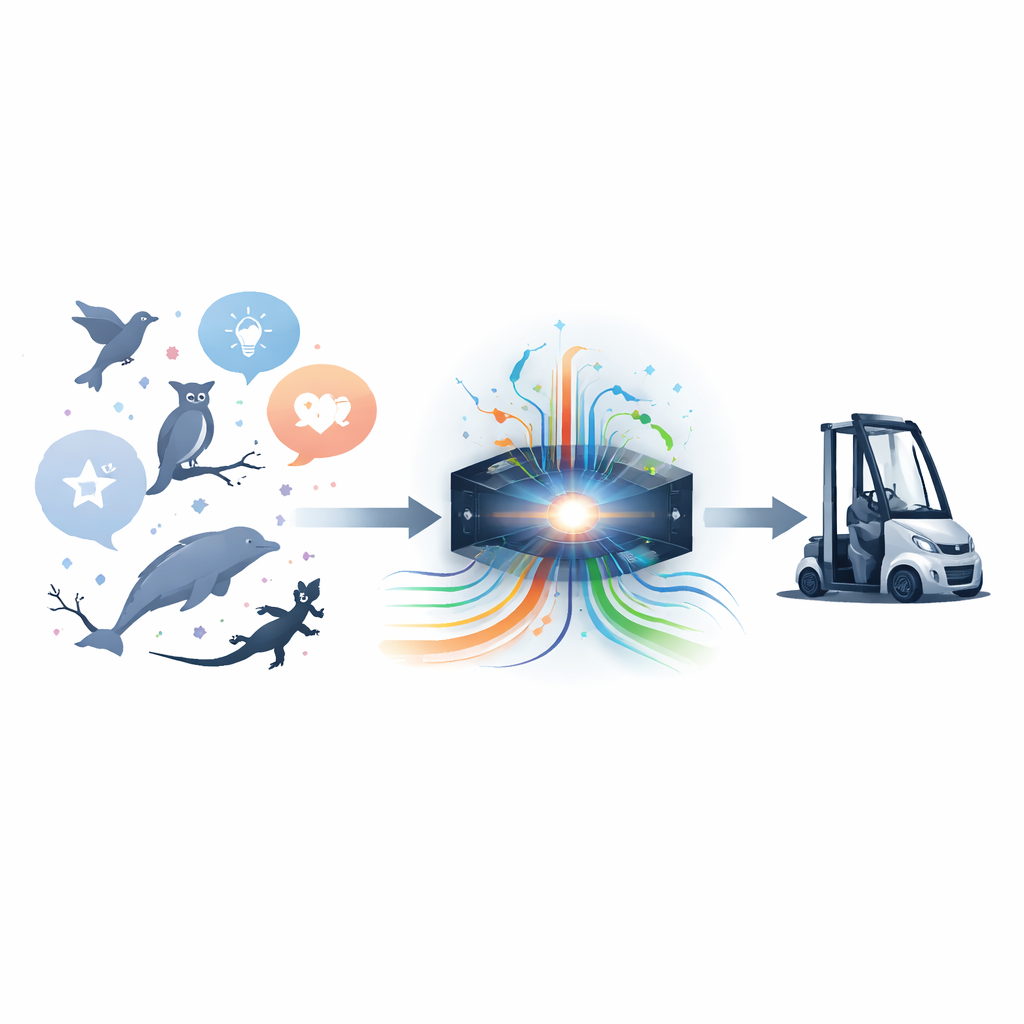
From Animal Shapes and Words to Design Ingredients
The researchers start by treating both language and images as raw material for design. They collect hundreds of side-view photos of animals, along with online reviews of popular forklifts from major shopping sites. The reviews are mined for feeling-laden words such as “sturdy,” “safe,” or “sporty,” which are turned into a kind of emotional map using natural-language algorithms. At the same time, computer vision tools trace the outlines of animals, breaking their bodies into precise contour lines that can be analyzed and stored. The result is a shared “library” where emotional terms, animal shapes, and mechanical needs can be compared in a common numerical space.
Marrying Mood and Mechanics
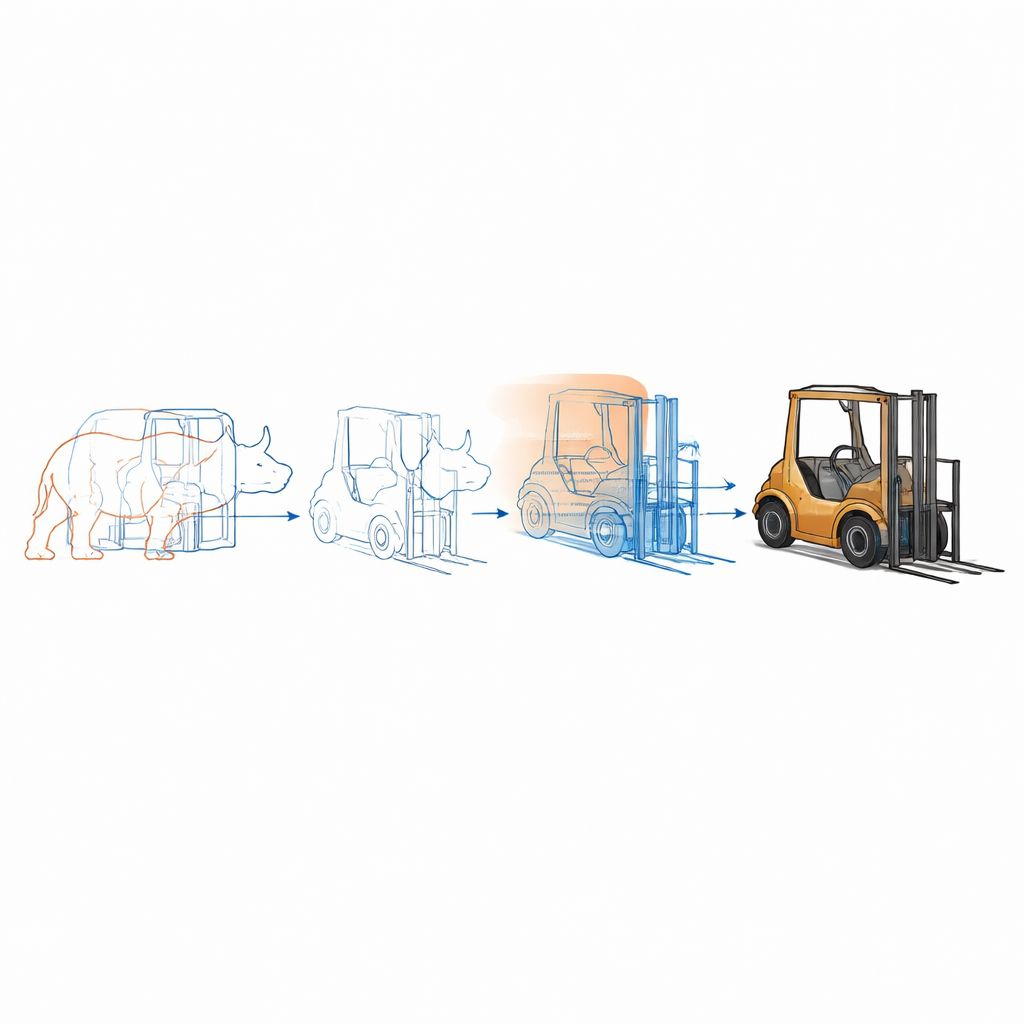
With this shared library, the system looks for animals whose shapes and implied feelings best fit a given product brief. In the case study, the team focuses on a Mingyu brand forklift that needs to feel powerful, safe, and modern while still meeting strict engineering rules. The AI scores each animal by two measures: how closely the emotional words around it match the target feelings, and how similar its side profile is to the forklift’s basic structure. A rhinoceros emerges as the closest match, thanks to clear overlaps between its horn and the forklift’s fork, its massive body and the vehicle’s counterweight, and its connotations of strength and dependability.
Shaping the Machine Like a Living Creature
Once the rhinoceros is chosen, the system begins to reshape the forklift so it carries the animal’s character without becoming a costume. It identifies dozens of key points along both the rhino and forklift outlines, then uses digital geometry to warp and blend the contours together. The outer silhouette is refined so that horn-like and torso-like curves are echoed in the fork, cabin, and counterweight, while still obeying mechanical limits such as ground clearance and turning radius. A second channel adjusts internal forms—such as panels, lines, and structural ribs—using rules inspired by how our eyes follow visual weight and tension, ensuring that the design looks balanced and purposeful rather than merely decorative.
Checking Both Feelings and Function
To verify that the new design really improves on tradition, the authors run a series of tests. Expert panels and ordinary users rate multiple versions of the forklift on how clearly they see the biological inspiration, how attractive the shape is, and whether it seems realistic to build. They also compare the AI-guided results to a conventional designer’s solution under the same constraints. Across these evaluations, the dual-constraint approach—balancing emotional meaning and engineering rules at every step—produces forklifts that are judged more recognizably biomimetic, better overall in performance, and faster to arrive at, cutting iteration time by nearly a third.
What This Means for Future Products
In plain terms, the study shows that it is possible to teach AI to design machines that “feel” like living creatures in a controlled, measurable way instead of relying on a designer’s intuition alone. By tying together words people use, shapes from nature, and the hard numbers of engineering, the framework turns vague emotional goals—like wanting a product to seem strong yet friendly—into specific curves, proportions, and structural choices. While the work so far focuses on a single forklift example and does not yet consider materials, costs, or long-term wear, it offers an early blueprint for everyday products that satisfy both the heart and the hardware at once.
Citation: Wang, Y., He, J., Yang, M. et al. AI driven dual constraint cooptimization of affective semantics and engineering parameters for biomimetic product design. Sci Rep 16, 12484 (2026). https://doi.org/10.1038/s41598-026-42297-2
Keywords: biomimetic design, affective product design, AI generative design, computer vision in design, industrial aesthetics