Clear Sky Science · en
Integrated source apportionment, co-enrichment mechanisms analysis, and risk assessment of arsenic and fluoride in groundwater of large-scale irrigation districts in semi-arid regions
Why This Groundwater Story Matters
In many dry parts of the world, people rely almost entirely on underground water for drinking and for growing food. In China’s Jiaokou Irrigation District, that lifeline is threatened by invisible pollutants—arsenic and fluoride—that can damage teeth and bones, harm internal organs, and even cause cancer after years of exposure. This study takes a close look at where these substances come from, how they build up in groundwater beneath a major farming area, and what that means for the health of adults and children who drink this water every day. 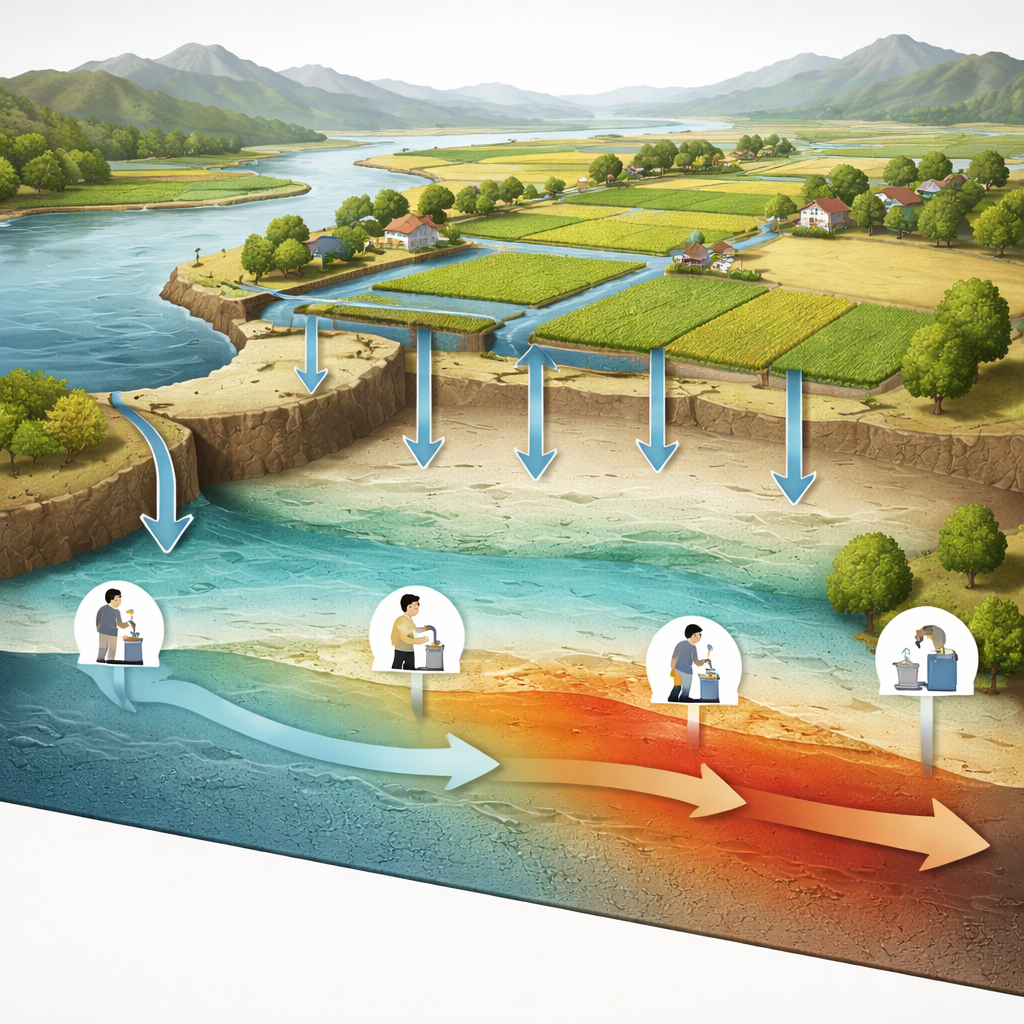
A Farming Region Dependent on Wells
The Jiaokou Irrigation District, in the semi-arid Guanzhong Basin of China, has been irrigated for more than 60 years. Most of its landscape is cropland, fed by water pumped from the Wei River and by hundreds of shallow wells that also supply drinking water to local residents. Because rainfall is low and evaporation is high, farmers depend heavily on irrigation, fertilizers, and pesticides to keep crops productive. The authors collected 51 groundwater and drainage canal samples across this area to measure arsenic and fluoride levels and to understand how water moves through the landscape from sky to soil to aquifer.
Hidden Chemicals in a Salty Underground
The team found that local groundwater is weakly alkaline and often salty, with over 98% of samples classified as brackish or saline. Arsenic levels exceeded the World Health Organization’s drinking water guideline in nearly 12% of samples, while fluoride levels were even more troubling: about 44% of samples were above the recommended limit. In more than half of the region, groundwater fluoride was high enough to make it unsuitable even for irrigation, raising concerns for both food safety and long-term health. Using a pattern-finding computer method, the researchers grouped the waters into three main “flavors” based on dissolved salts, revealing clear differences between more mineral-rich zones and less affected areas.
How Rocks, Climate, and Farming Work Together
To uncover why arsenic and fluoride build up together, the authors combined chemical tests, natural water isotopes, and mineral modeling. Rainfall and irrigation water seep down through soil and sediments rich in silicate and fluoride‑bearing minerals. In the slightly alkaline conditions found here, arsenic that was once stuck to iron-rich grain surfaces is released back into the water, and fluoride is freed from minerals such as fluorite and micas. Ongoing weathering of feldspar and other silicate rocks raises the water’s alkalinity and slows underground flow, giving more time for these reactions. At the same time, strong evaporation in this dry climate concentrates dissolved salts and pollutants. Intensive fertilizer and pesticide use adds extra arsenic and fluoride at the surface, which then leach downward, so natural geology and human activity reinforce each other. 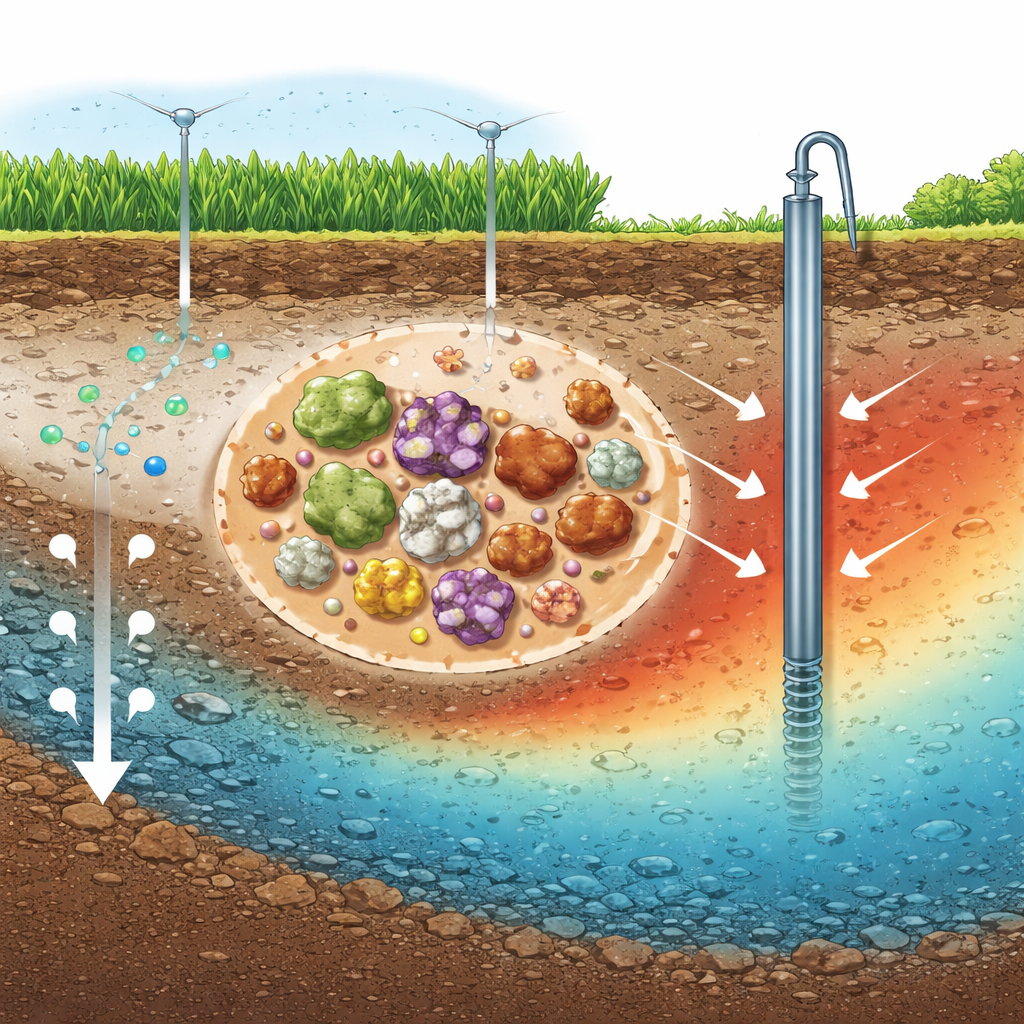
Risks for Adults and Children
Using health risk models combined with Monte Carlo simulations—a way to account for uncertainty—the study estimated how much danger these pollutants pose. The analysis considered both drinking and skin contact, but found that swallowing contaminated water is by far the main route of exposure. Fluoride was the leading driver of non-cancer health risks, especially for children, who drink more water per unit body weight. For non-cancer effects, more than 60% of groundwater samples posed potential concern for adults and over 95% for children when arsenic and fluoride were considered together. Arsenic carried the main cancer risk, particularly for adults, with nearly one in five sampling points exceeding the commonly used safety threshold for lifetime cancer probability.
What This Means for Safer Water
The authors conclude that arsenic and fluoride in this semi-arid irrigation district arise from a double origin: natural rock–water reactions under alkaline, salty conditions, and long-term farming practices that recycle and add these pollutants. Children are especially vulnerable to fluoride’s effects, while adults face higher cancer risk from arsenic. The study recommends prioritizing safer drinking water supplies for children in high‑risk zones and managing fluoride levels in groundwater used for agriculture. It also highlights low-cost treatment options, such as coagulation–filtration and bio-based filters made from fruit peels, as practical ways to reduce exposure while longer-term land and water management solutions are put in place.
Citation: Zhang, Q., Wei, A., Xu, P. et al. Integrated source apportionment, co-enrichment mechanisms analysis, and risk assessment of arsenic and fluoride in groundwater of large-scale irrigation districts in semi-arid regions. Sci Rep 16, 11007 (2026). https://doi.org/10.1038/s41598-026-42293-6
Keywords: groundwater contamination, arsenic, fluoride, irrigation districts, health risk