Clear Sky Science · en
Hedyotis diffusa and Scutellaria barbata enhance the anti-ovarian cancer effect of cisplatin through network pharmacology analysis and molecular docking technology
Herbal Help for a Tough Cancer
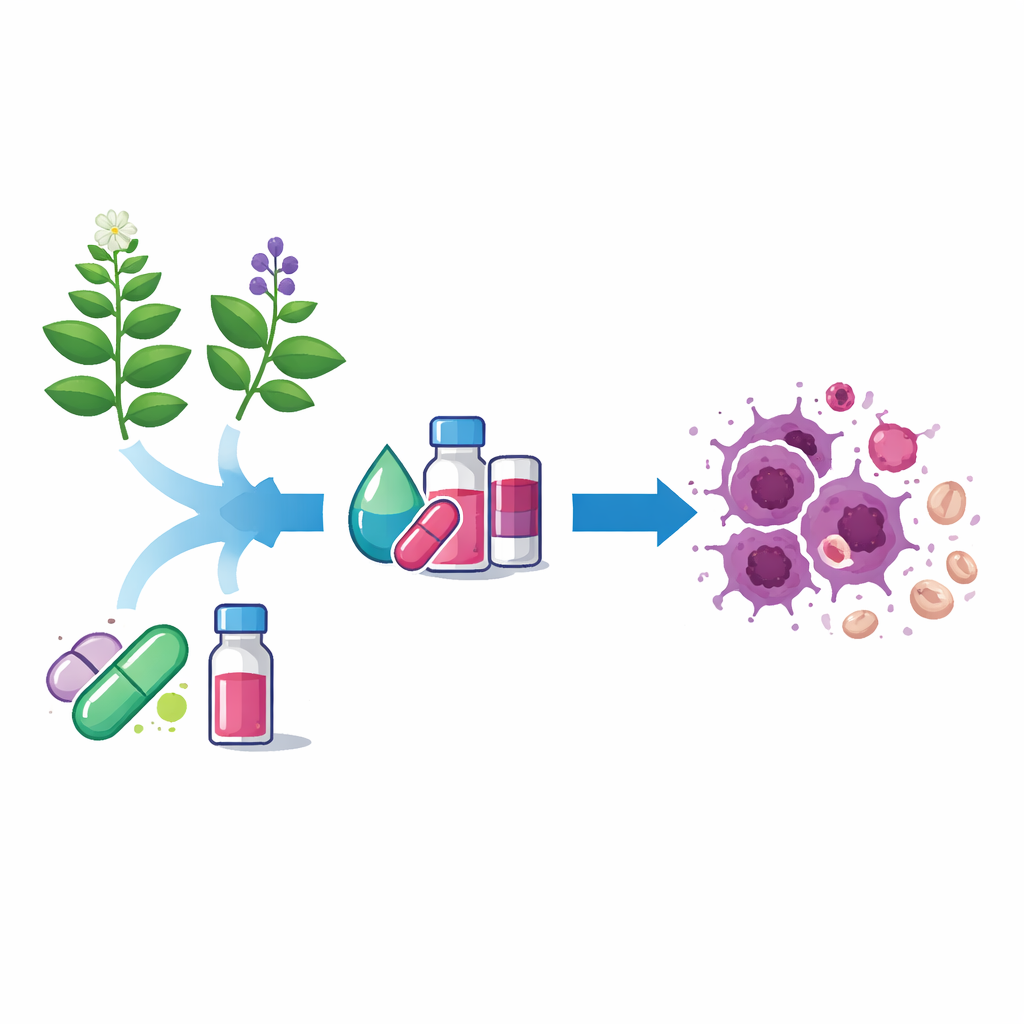
Ovarian cancer is one of the deadliest cancers affecting women, largely because it is often discovered late and frequently becomes resistant to standard chemotherapy drugs like cisplatin. This study explores whether two traditional Chinese medicinal herbs, Hedyotis diffusa and Scutellaria barbata, can work together with cisplatin to make treatment more effective while potentially allowing lower, safer doses of chemotherapy. The work links ancient herbal practice with modern molecular tools to see how this combination might better attack tumor cells yet spare healthy ones.
Why Current Treatment Needs a Boost
Cisplatin is a workhorse drug in ovarian cancer care. It damages the DNA of rapidly dividing cells, pushing them toward self-destruction. But this power comes at a cost: patients can suffer kidney, liver, hearing, and heart problems, and tumors often evolve ways to resist the drug. Doctors and researchers are therefore keen to find partners for cisplatin that can enhance its punch against cancer while lowering the chance of serious side effects and resistance. Traditional herbal medicines, long used alongside chemotherapy in China, are promising candidates for such “helper” roles.
The Herbal Pair Under the Microscope
Hedyotis diffusa and Scutellaria barbata have a long history in Chinese medicine as “heat-clearing” and detoxifying herbs, and modern laboratory work has shown they can slow the growth of several cancers. In this study, the authors combined extracts of the two plants (called HD-SB) with cisplatin and tested the mixture on two human ovarian cancer cell lines, SKOV3 and A2780, as well as on normal ovarian cells. They measured how well the cells survived, how quickly they moved and invaded through barriers (a proxy for spread), and how many cells underwent programmed cell death, or apoptosis. The combination treatment strongly reduced cancer cell growth, movement, and invasion, and triggered more cell death than either cisplatin or the herbal mix alone—yet it did not harm normal ovarian cells at the same doses.
Uncovering the Inner Wiring of the Cells
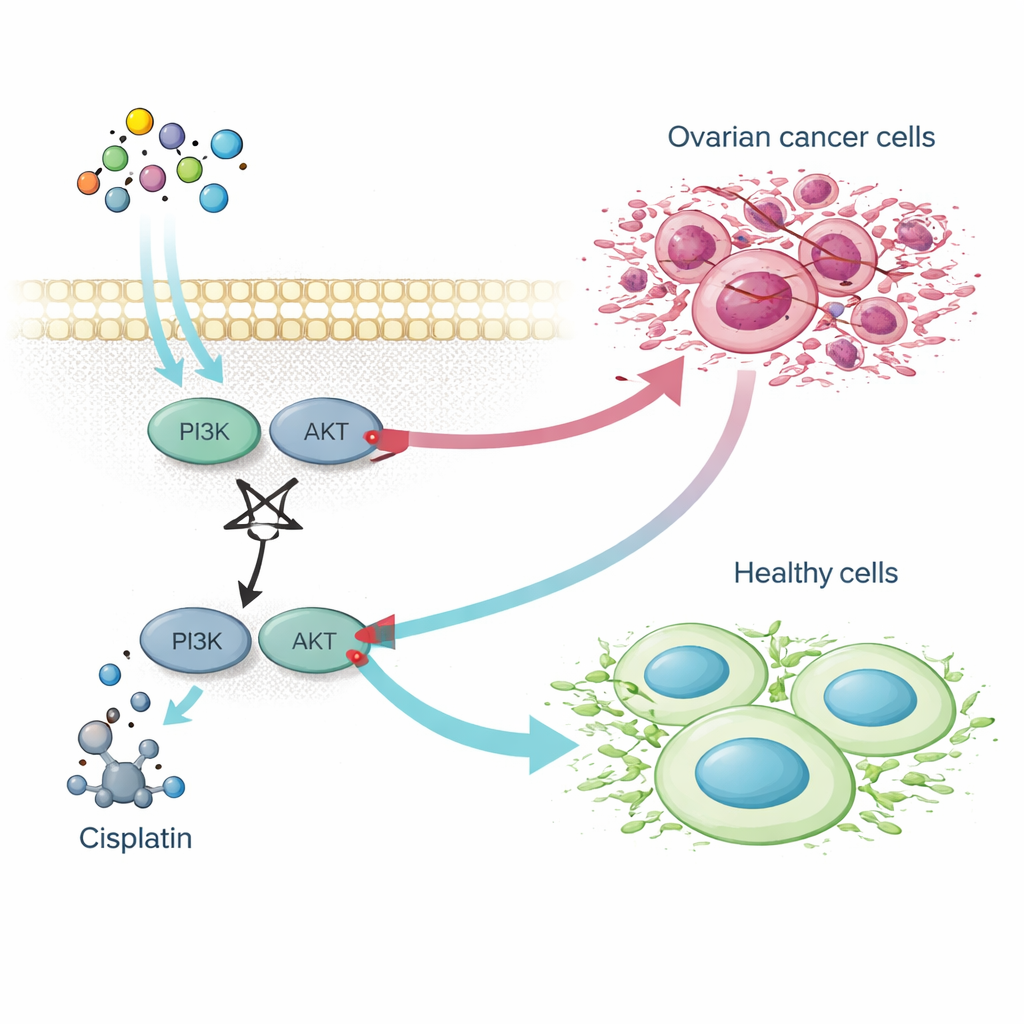
To understand how the herbs help cisplatin, the team turned to “network pharmacology,” a way of mapping which molecules in the body the herb compounds are likely to touch, and how those molecules connect in cellular signaling webs. They sifted through multiple public databases to match plant ingredients with protein targets and with genes linked to ovarian cancer. This yielded 236 overlapping targets and a complex interaction map highlighting several central proteins, including AKT1 and PIK3CA, both key players in a major growth-control route inside cells known as the PI3K/AKT pathway. Further computer-based docking simulations showed that three flavonoid molecules abundant in HD-SB—quercetin, luteolin, and wogonin—fit snugly into the three-dimensional structures of AKT1 and PIK3CA, suggesting they can directly bind and inhibit these proteins.
Turning Down a Cancer Survival Pathway
Because the PI3K/AKT pathway often behaves like a stuck accelerator in cancer, keeping cells alive, dividing, and resistant to drugs, the researchers tested whether HD-SB and cisplatin together could ease off this throttle. They examined tumor cells treated with each agent alone or in combination and measured the amounts of key pathway proteins and their activated, phosphorylated forms. While either treatment by itself only modestly altered these levels, the combination clearly reduced PIK3CA, AKT, and especially the activated form of AKT. It also lowered levels of MMP2 and MMP9, enzymes that help cancer cells chew through surrounding tissue and spread. These changes fit a picture in which the herbal flavonoids and cisplatin jointly weaken a central survival and migration circuit in ovarian cancer cells, making them more prone to die and less able to invade.
What This Could Mean for Patients
Taken together, the findings suggest that Hedyotis diffusa and Scutellaria barbata can sensitize ovarian cancer cells to cisplatin by dialing down a critical growth and survival pathway, while leaving normal ovarian cells largely unharmed in the tested conditions. In everyday terms, the herbs seem to act like a targeted chisel that chips away at the cancer’s internal defenses, allowing a standard drug to work better at potentially lower doses. Although these results come from cell studies and computer models rather than clinical trials, they point toward a future in which carefully characterized herbal mixtures could be used to strengthen chemotherapy, reduce side effects, and perhaps delay or overcome drug resistance in ovarian cancer.
Citation: Bi, R., Chen, F., Fu, Y. et al. Hedyotis diffusa and Scutellaria barbata enhance the anti-ovarian cancer effect of cisplatin through network pharmacology analysis and molecular docking technology. Sci Rep 16, 13811 (2026). https://doi.org/10.1038/s41598-026-42292-7
Keywords: ovarian cancer, cisplatin resistance, traditional Chinese medicine, PI3K AKT pathway, flavonoids