Clear Sky Science · en
Seepage characteristics of fractured sandstone under deep high-confined water and mining-induced stress
Why water sneaking through rock matters
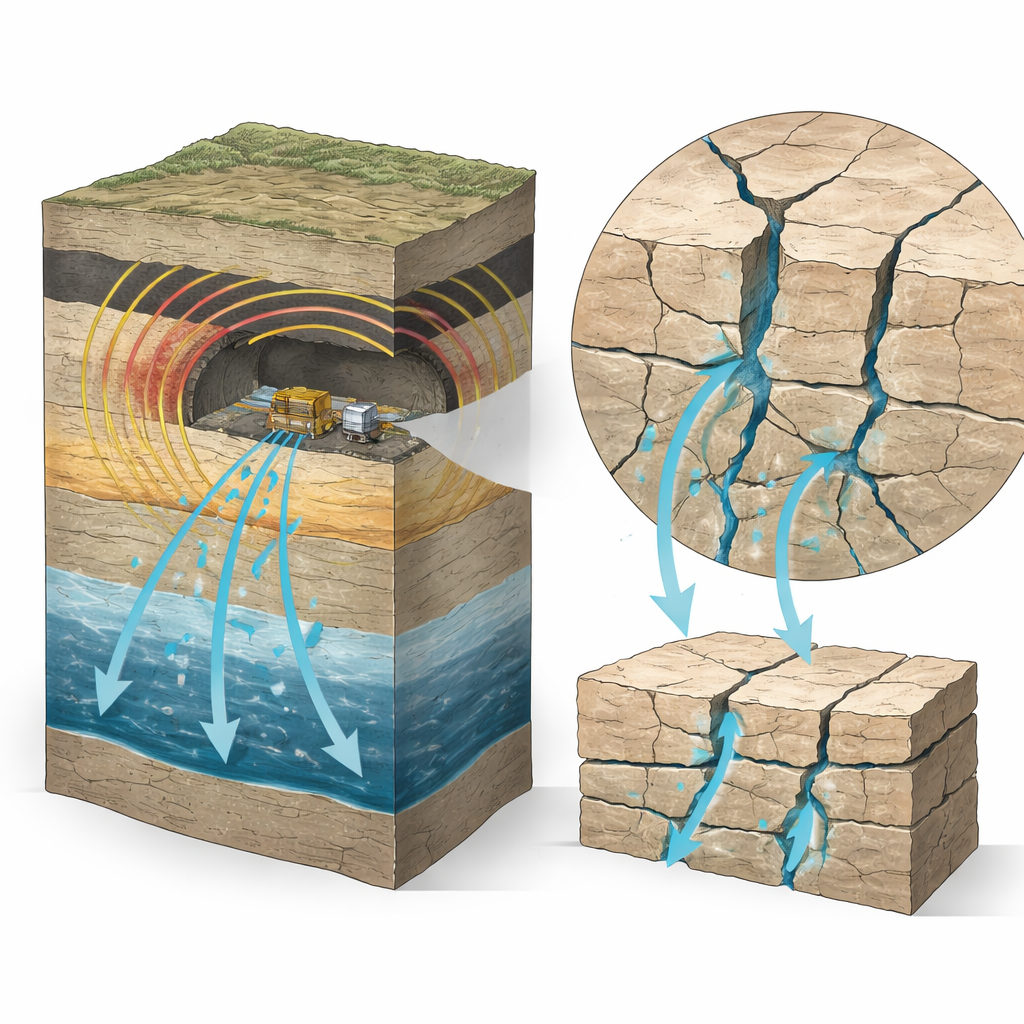
Deep coal mines do not just contend with heat and rock pressure; they also sit above powerful underground water reservoirs. If that pressurized water finds a fast pathway into mine tunnels, it can trigger sudden floods called water inrush disasters. This study examines how water seeps through cracked sandstone hundreds of meters underground, and how the shape of those cracks and the squeezing force of the surrounding rock together decide whether a fracture becomes a dangerous leak or a natural barrier.
Hidden plumbing beneath deep coal seams
The research is rooted in the Xingdong Coal Mine in China, where coal seams lie more than a kilometer below the surface and rest above a thick, water‑rich limestone layer. Sandstone between the coal and the aquifer is cut by natural and mining‑induced fractures that can turn into high‑speed channels for groundwater. The authors focus on single fractures within sandstone, treating each as a miniature water pipe whose capacity depends on how rough, wide, and tightly squeezed it is under deep underground stress.
Building realistic fractures in the lab
To mimic real mining conditions, the team drilled sandstone samples from the mine floor and carefully split them using specially shaped metal wedges. This allowed them to create five groups of samples with controlled levels of roughness, from nearly smooth to very jagged crack surfaces. They scanned the fracture faces in three dimensions to quantify how bumpy they were and then mounted each sample in a triaxial testing device that can squeeze the rock from all sides while forcing water to flow through the fracture. By changing both the surrounding pressure and the water pressure, they could watch how flow evolved over time and under different conditions.
How squeezing and water pressure compete
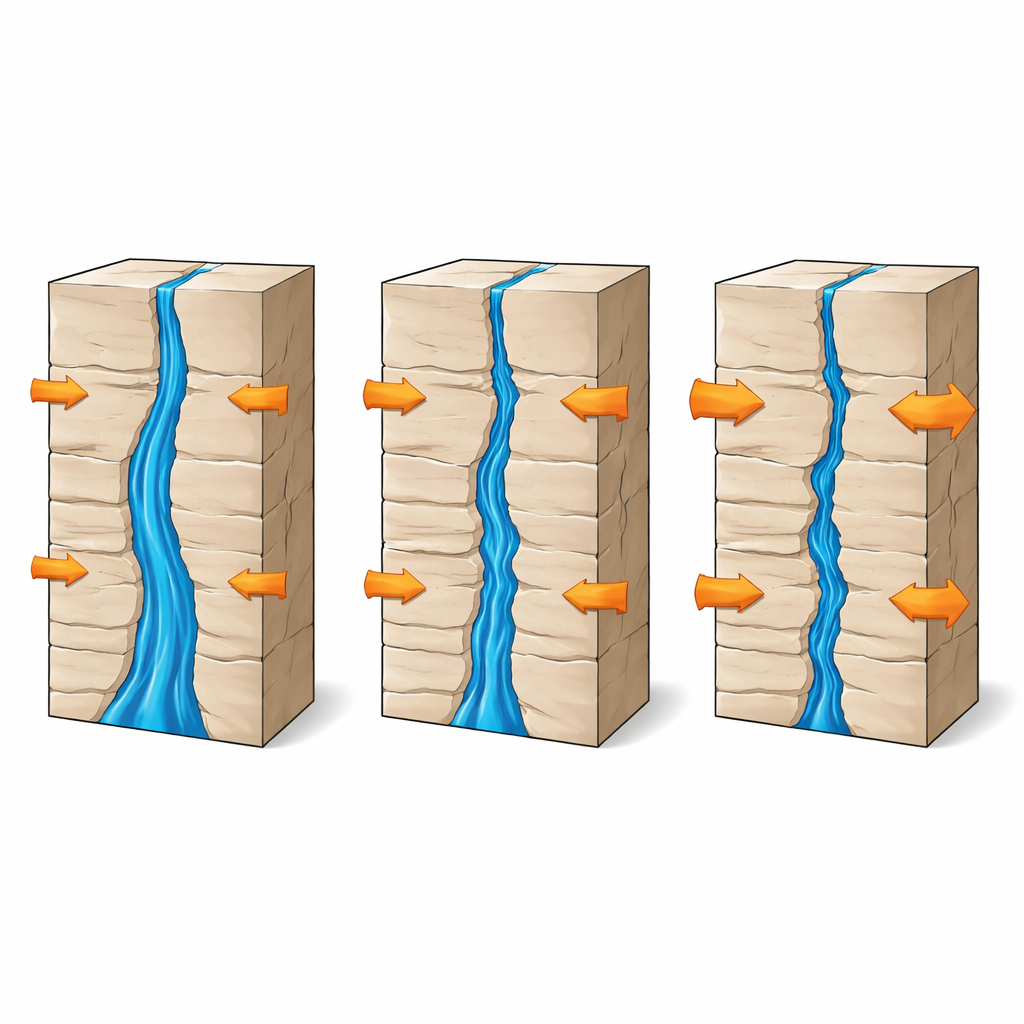
The experiments reveal a tug‑of‑war between rock squeezing and water pushing. As the confining pressure around the sample increases, it pinches the fracture partly shut and the flow drops sharply at first, then more gently, and finally levels off once the crack is nearly compacted. The authors describe three stages in this evolution: an early elastic stage where the surfaces bend and close quickly, a middle transition stage where tiny bumps are crushed and rearranged, and a final equilibrium where further squeezing hardly changes the flow. Water pressure pulls in the opposite direction: higher water pressure strongly boosts flow and partially pries the fracture open, especially when pressures exceed about 5 megapascals. In effect, water pressure can offset some of the closing influence of the rock around it.
Why crack roughness and width change the story
Not all fractures behave the same. Smoother, wider cracks initially carry much more water, making them the most dangerous pathways for sudden inrush. But they also respond more dramatically when pressure increases, losing permeability quickly as they are squeezed. Rougher fractures, with jagged, interlocking surfaces, start with much lower flow because the path is longer and more tortuous. Over time, grains and tiny rock fragments move and settle within these rough pathways, wearing down bumps and filling pockets, which further reduces flow. The study quantifies this behavior by linking a standard roughness index and the initial crack opening to the long‑term, stabilized permeability after the rock has been under pressure for many hours.
From lab curves to safer mines
By combining all of their tests, the authors derive simple mathematical relationships that predict how much water a fracture will carry once its behavior has stabilized under deep, high‑pressure conditions. These formulas show that greater roughness and smaller openings lead to lower long‑term seepage, while high water pressure and smoother, wider fractures favor persistent flow. For mine planners and safety engineers, this means that smooth, open fractures and fault zones beneath coal seams deserve special attention and reinforcement, while rough, tightly closed fractures may naturally limit water movement. Overall, the work provides a clearer picture of the hidden plumbing beneath deep mines and offers practical tools to assess and reduce the risk of catastrophic water inrush.
Citation: Tu, H., Wu, R., Jia, S. et al. Seepage characteristics of fractured sandstone under deep high-confined water and mining-induced stress. Sci Rep 16, 11507 (2026). https://doi.org/10.1038/s41598-026-42285-6
Keywords: deep mining, groundwater flow, fractured rock, water inrush, sandstone permeability