Clear Sky Science · en
A large-effect locus underlies migration timing in North American Atlantic salmon (Salmo salar)
Why salmon schedules matter
Each year, Atlantic salmon make an extraordinary journey from the open ocean back to their home rivers to spawn. The exact week they arrive can mean the difference between feast and famine, safety and danger. As climate change scrambles water temperatures and seasonal cues, these finely tuned schedules are starting to drift. This study asks a simple but crucial question: how much of a salmon’s internal "calendar" is written in its DNA, and can that help explain which populations are most at risk as conditions change?
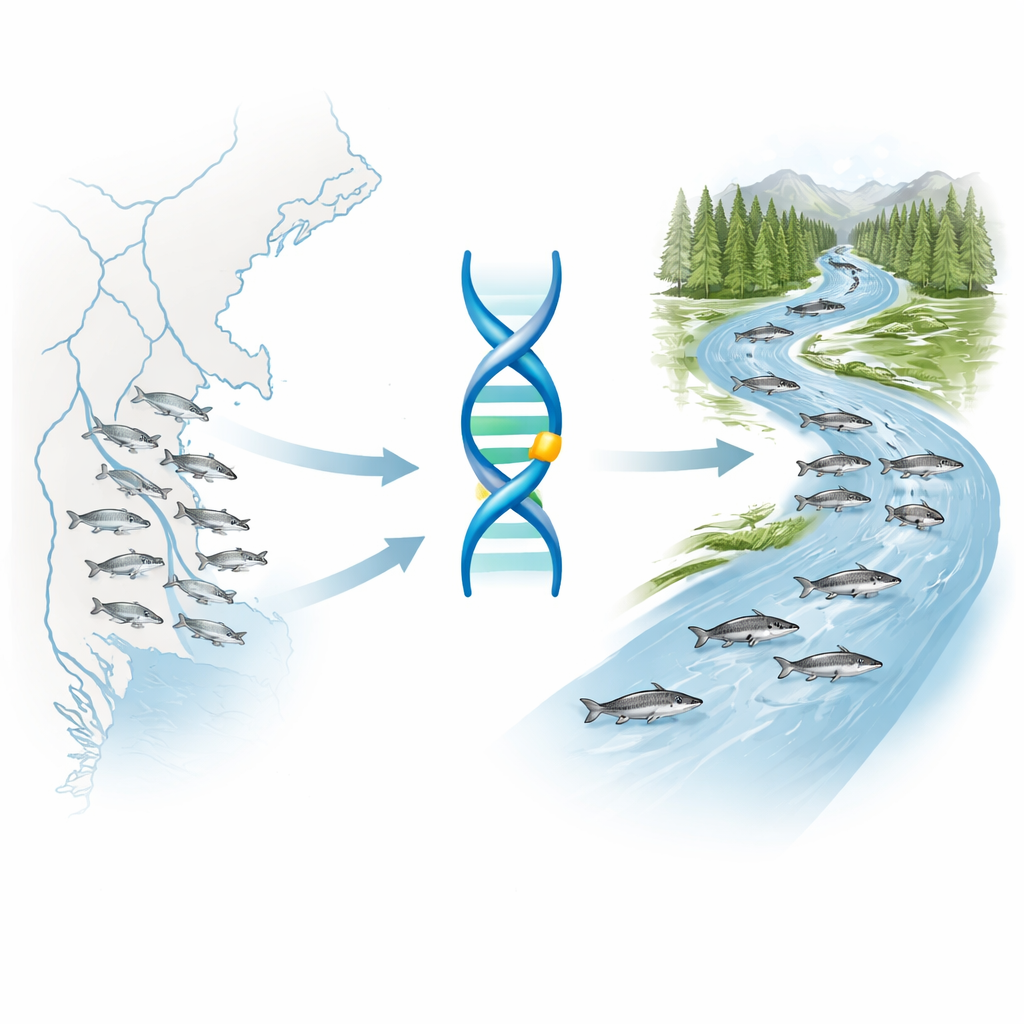
Salmon on the move
Atlantic salmon in North America migrate thousands of kilometers, timing their return so river conditions are just right for swimming upriver and laying eggs. In some rivers most fish arrive in a single broad pulse, while in others they come in two clear waves—an early group and a late group. These patterns affect not only the fish themselves, but also the predators, prey, and people who depend on them. If warming waters or shifting seasons break the link between migration and river conditions, salmon may arrive when food is scarce or flows are poor, putting already declining populations under even more pressure.
Reading the salmon genome
To uncover the genetic roots of migration timing, the researchers combined whole-genome sequencing from 498 salmon across seven rivers in Newfoundland, Labrador, and the Maritimes with detailed records of when each fish was caught on its upriver journey. Instead of using a small panel of genetic markers, they scanned nearly ten million sites across the genome. They then asked, for each tiny DNA difference, whether fish carrying one version tended to return earlier or later than those with another version, while accounting for sex, age at sea, and subtle genetic differences between rivers.
A powerful timing switch in the genome
The analysis revealed a standout region on chromosome 17 that was strongly linked to when adults returned to their rivers. Within this stretch, one gene in particular, called ppfia2, explained nearly a third of the variation in individual return dates—a remarkably large effect for a complex behavior. The strongest signal lay in nearby non-coding DNA, suggesting that switches controlling when and how strongly ppfia2 is turned on may be more important than changes to the protein itself. Other genes in the same region, and scattered signals elsewhere in the genome, point to a mixed picture: a major "hub" gene supported by many smaller contributors shaping the fine details of each salmon’s schedule.
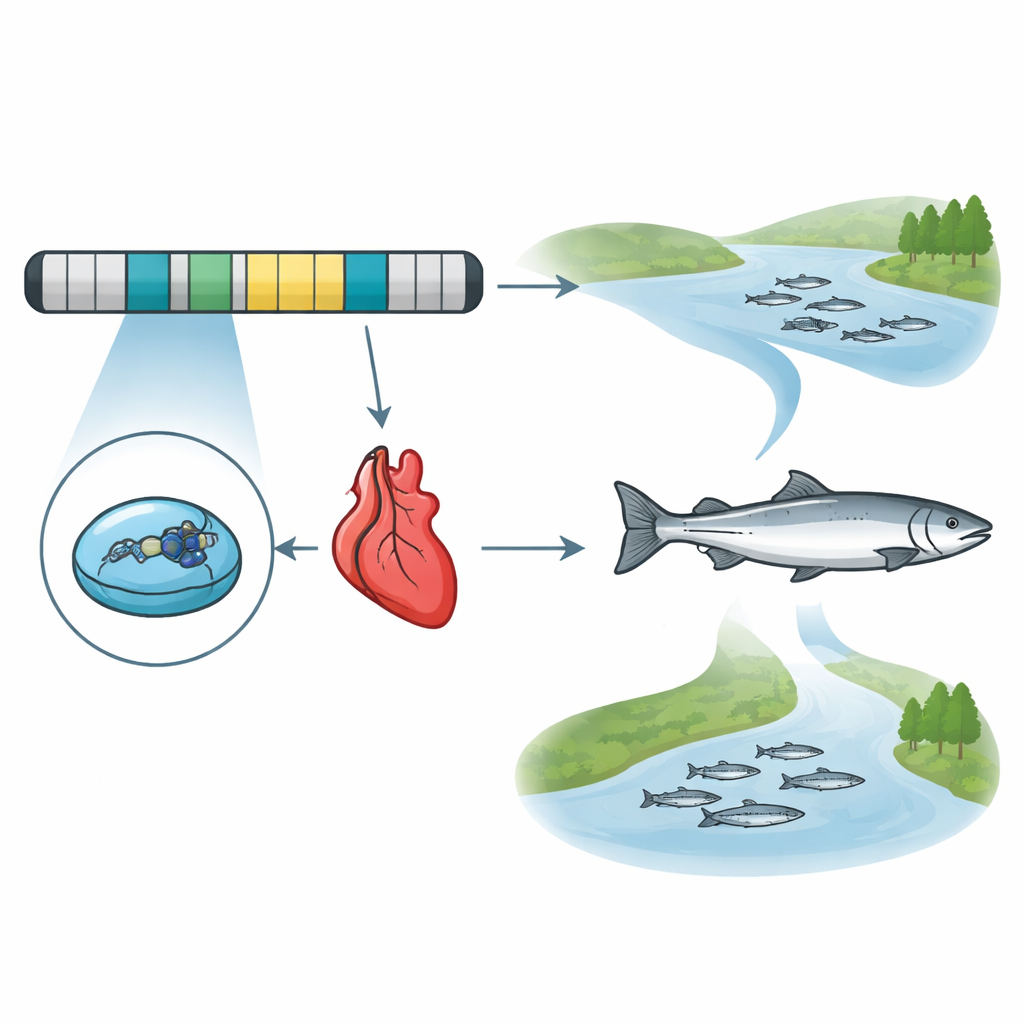
Shared migration tools across animals
Perhaps most striking, ppfia2 has also been tied to migration timing in a very different long-distance traveler: the purple martin, a North American songbird. In both salmon and birds, timing often splits into two distinct peaks, and the same gene appears to help set those patterns. In Atlantic salmon, a second copy of ppfia2 shows signs of being less important in landlocked populations that no longer undertake long sea migrations, hinting that this gene’s role is tightly linked to life on the move. The study also found that genes near the key region were enriched for roles in heart and circulation, suggesting that internal physiology—how well a fish’s body handles temperature and oxygen—may be part of how DNA shapes migration timing.
What this means for salmon futures
Together, these findings show that the timing of Atlantic salmon migrations is not just a flexible response to the environment; it has a clear and partly shared genetic foundation. A few powerful DNA regions, particularly around ppfia2, help set broad migration schedules, while many other genes fine-tune the details. As rivers warm and seasonal patterns shift, populations with more genetic diversity at these key sites may be better able to adjust their timing and avoid dangerous mismatches with changing conditions. For conservation, this means protecting not only salmon numbers but also the full range of their genetic "clocks," so that future generations retain the capacity to adapt to a rapidly changing world.
Citation: Beck, S.V., Kess, T., Nugent, C.M. et al. A large-effect locus underlies migration timing in North American Atlantic salmon (Salmo salar). Sci Rep 16, 11543 (2026). https://doi.org/10.1038/s41598-026-42281-w
Keywords: Atlantic salmon migration, genetic basis of timing, climate change adaptation, ppfia2 gene, fish conservation