Clear Sky Science · en
Bi-stable dipole polarity in spherical shell dynamo with quadruple convection
Why Earth’s magnetic flip matters
Earth’s magnetic field acts like a global shield, steering dangerous charged particles away from the surface and letting compasses point north. Yet this shield does not always keep the same orientation: over geological time it has flipped, so that north and south trade places. This paper uses powerful computer experiments to ask a deceptively simple question with big consequences: when a magnetic field like Earth’s is born and maintained by moving, electrically conducting fluid, is its north–south direction predetermined, or can it naturally settle into either orientation and stay there for a very long time?

A digital planet in a lab-sized shell
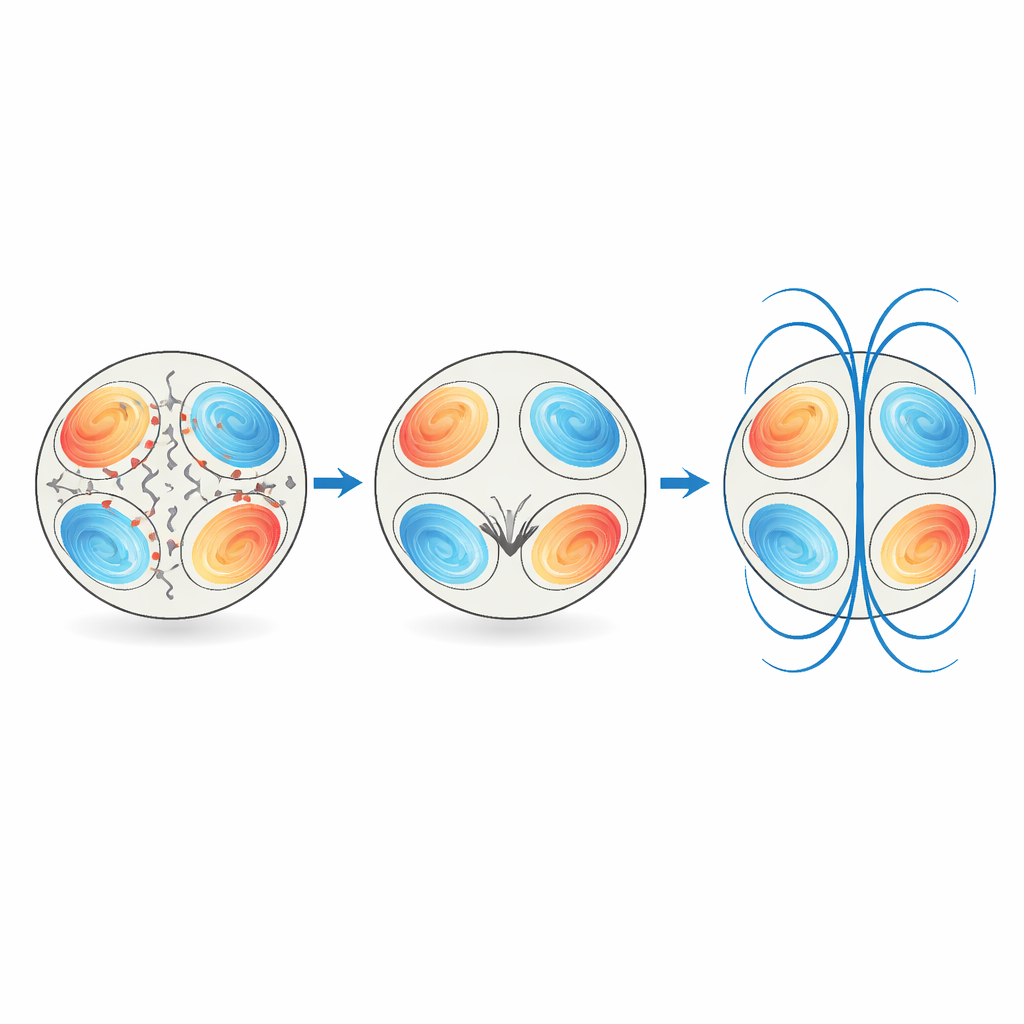
The authors simulate a simplified version of Earth’s deep interior: an electrically conducting fluid confined between two concentric spheres, like the metal in Earth’s outer core between the inner core and the mantle. Instead of including every realistic ingredient, such as rotation and gravity, they strip the setup down to focus on one key feature—large, swirling motions that twist as they rise and sink. They impose a carefully designed pattern of four giant circulation cells in the shell, with flows twisting one way in the northern half and the opposite way in the southern half. This idealized “quadruple convection” is easier to control than true planetary convection, but it still drives an electrically conducting flow capable of generating a magnetic field through dynamo action.
From tiny magnetic seeds to a strong global field
Once the flow pattern has settled into a steady state, the team introduces an extremely weak, randomly structured magnetic perturbation—essentially magnetic noise—with no preferred direction. The simulation then tracks how the fluid motion stretches, twists, and amplifies this seed field. In all runs, the magnetic energy rises rapidly and then levels off at a strength comparable to the kinetic energy of the flow, showing that a self-sustained global field has formed. The geometry of the field changes in time: early on, higher-order structures dominate, but as the system evolves it naturally locks into a configuration where a simple “bar-magnet”–like dipole component is strongest, matching the large-scale form of Earth’s magnetic field.
Two equally likely magnetic futures
A central discovery is that the final dipole field can point either way—northward or southward—with nearly equal probability, even though the underlying flow is the same in every experiment. By repeating the simulation 50 times with different random magnetic seeds, the authors find that about half end up with “north-up” polarity and half with “south-up”. Remarkably, reversing the direction of the background flow and running another 50 cases produces the same split. This shows that, in this model, the long-term polarity is not set by how the fluid spins overall, but instead by the tiny initial magnetic fluctuations. The dynamo behaves like a system with two equally deep valleys: the field must fall into one of them, but either choice is allowed.
An early dance, then a stubborn state
Looking more closely in time, the simulations reveal two distinct stages. In the early phase, the magnetic energy grows while the swirling motion reorganizes, and a brief episode of rapid back-and-forth polarity switches appears, a cyclic flip-flop that the authors call a cyclic polarity-reversal mode. During this stage, energy is actively traded between fluid motion and magnetic field, helping the dipole build up. After roughly 15 seconds in the model’s units, the system transitions into a main stage: the dipole chooses one polarity and stays there. Even when new magnetic noise is added later—noise strong enough to disturb weaker parts of the field—the dominant dipole resists change and quickly recovers. This robustness shows that the final north or south state is not easily dislodged once established.
What this means for Earth’s changing shield
To a lay reader, the take-home message is that a magnetic field like Earth’s can naturally have two long-lived, equally stable states: one with today’s orientation and another with everything flipped. In the authors’ simplified world, random microscopic magnetic ripples at the birth of the dynamo decide which state is chosen, and small later disturbances are too feeble to force a flip. For Earth, whose magnetic history includes many reversals separated by irregular and often very long intervals, this suggests that additional processes—such as changes in how the core fluid mixes, or extra magnetic diffusion triggered by plasma instabilities—may be needed to push the field from one stable polarity valley into the other. The study does not solve the reversal puzzle outright, but it clarifies that bi-stable polarity is a natural outcome of dynamo action, sharpening the search for the rare events that can tip our planet’s magnetic shield upside down.
Citation: Hasegawa, H., Ohtani, H. & Sato, T. Bi-stable dipole polarity in spherical shell dynamo with quadruple convection. Sci Rep 16, 11875 (2026). https://doi.org/10.1038/s41598-026-42280-x
Keywords: geomagnetic reversals, magnetic dynamo, Earth core, magnetohydrodynamics, planetary magnetism