Clear Sky Science · en
Anatomical and physiological traits to identify low-vigor Persian walnut accessions as candidate dwarfing rootstocks
Smaller Trees for Smarter Walnut Orchards
Modern nut orchards increasingly rely on compact trees that are easier to prune, spray, and harvest, while using less water and space. But for Persian walnut, widely grown from Iran to California, true size-controlling rootstocks are still missing. This study explores what makes some walnut trees naturally small and slow-growing, and shows how those traits could be harnessed to breed dwarfing rootstocks that reshape future walnut orchards.

Why Tree Size Matters to Growers
Traditional walnut trees can grow into towering giants, demanding wide spacing, tall ladders, and intensive labor. Smaller trees, in contrast, allow high-density planting, more efficient use of water and fertilizers, and safer, cheaper harvests. In many fruit crops, this is achieved by grafting commercial varieties onto dwarfing rootstocks that quietly limit tree size from below ground. For walnut, breeders have suspected that early-fruiting, naturally weak-growing trees might hide the right rootstock candidates, but the underlying traits needed to select them confidently were poorly understood.
Hunting for Naturally Compact Walnuts
The researchers began with 15 Persian walnut genotypes collected from eight regions of Iran, ranging from very vigorous to clearly low-vigor trees. Seeds from these “mother” trees were grown side by side under identical field conditions so that environmental differences could not confuse the picture. After two years of tracking growth, four contrasting groups were chosen for closer study: two low-vigor, early-fruiting lines called ‘Qazvin 1’ and ‘Qazvin 2’, one intermediate line (‘Urmia’), and one strongly vigorous line (‘Damavand’. The team examined thin cross-sections of stems under the microscope, measured how easily water could move through the wood, monitored leaf water status over the day, and quantified the size and abundance of leaf pores (stomata) that regulate water loss and gas exchange.
Inside the Wood: Water Pipes That Shape Tree Size
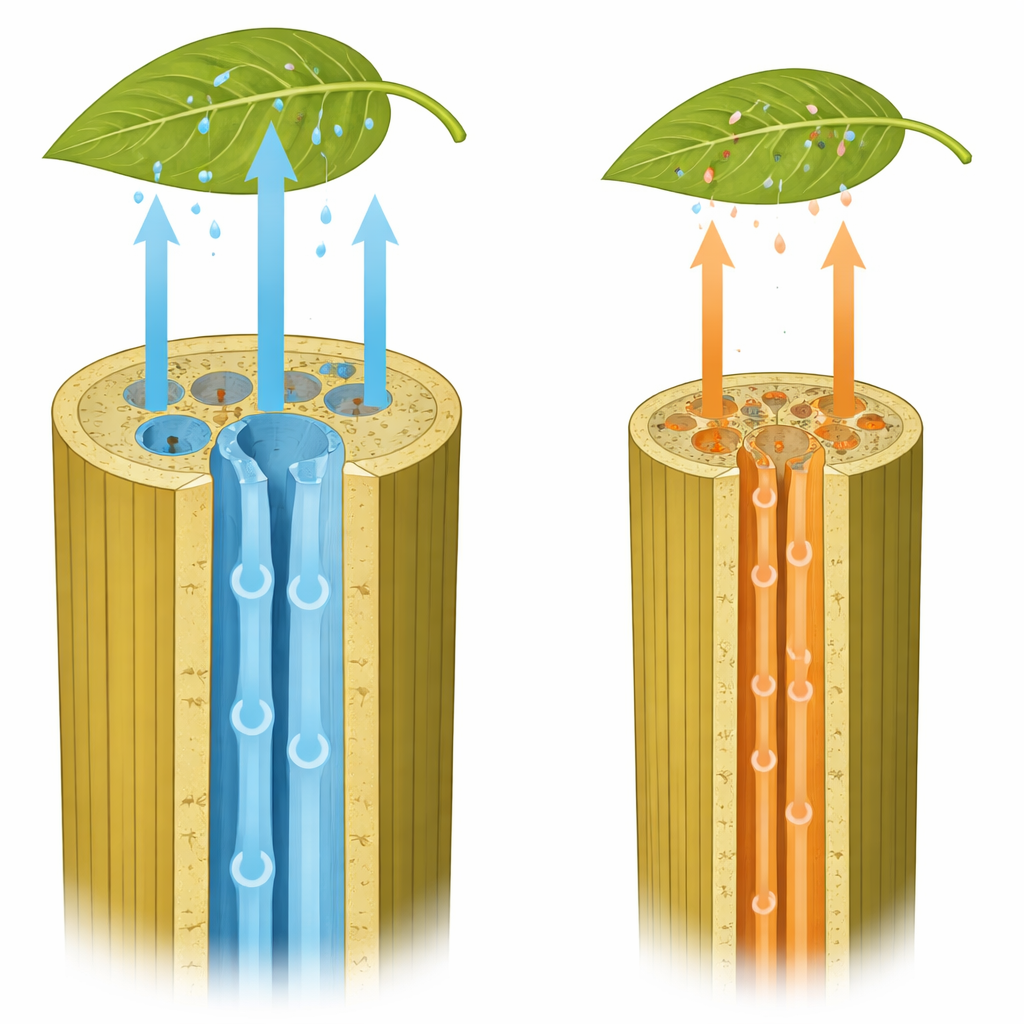
Water in trees travels through tiny tubes in the wood called vessels. In the compact ‘Qazvin’ types, the stems contained a large number of vessels, but most of them were narrow, falling into the small and medium size classes. In contrast, the vigorous ‘Damavand’ and semi-vigorous ‘Urmia’ had fewer vessels overall but a much higher share of wide ones. Because the capacity of each vessel to carry water rises steeply with its radius, a few large pipes move far more water than many small ones. Calculations based on vessel size showed that ‘Damavand’ had almost double the theoretical water transport capacity of ‘Qazvin 1’. This reduced “plumbing power” in the ‘Qazvin’ genotypes closely matched their weaker growth, pointing to xylem structure as a key driver of natural dwarfing.
Leaves, Water Stress, and Subtle Ways to Save
Differences above ground painted a similar picture. Under a controlled irrigation schedule, all trees started the day with similar leaf water status, but as midday heat and dryness rose, the low-vigor ‘Qazvin’ seedlings showed more negative water potential and slightly lower leaf water content than the vigorous trees. This indicates stronger daytime water stress and earlier tightening of the plant’s internal water budget. On the leaf surface, the ‘Qazvin’ genotypes had stomata that were slightly smaller but not fewer in number. Smaller pores generally open and close more quickly, helping plants fine-tune water loss and potentially improve water-use efficiency. Together, narrower vessels, lower water transport capacity, and smaller stomata push the ‘Qazvin’ lines toward conservative water use, slower shoot growth, and more compact canopies.
What This Means for Future Walnut Orchards
By linking internal wood structure, leaf water status, and stomatal traits to overall tree vigor, the study shows that low-vigor Persian walnut types share a consistent, growth-limiting design. ‘Qazvin 1’ and ‘Qazvin 2’ stand out as promising candidates for dwarfing rootstocks, with anatomy and physiology tuned toward smaller tree size. While long-term grafting trials are still needed, breeders can now use simple, measurable traits—such as vessel diameter, calculated hydraulic conductance, and stomatal size—as early markers when screening walnut seedlings. In practical terms, this work brings growers a step closer to high-density walnut orchards filled with manageable, compact trees that are cheaper to run and kinder to limited water resources.
Citation: Sadeghi-Majd, R., Roozban, M.R., Sarikhani, S. et al. Anatomical and physiological traits to identify low-vigor Persian walnut accessions as candidate dwarfing rootstocks. Sci Rep 16, 11475 (2026). https://doi.org/10.1038/s41598-026-42279-4
Keywords: Persian walnut, dwarfing rootstocks, tree vigor, xylem anatomy, orchard management