Clear Sky Science · en
Respiratory sound analysis in a rabbit tracheomalacia model
Why Listening to Breathing Matters
Doctors usually diagnose serious breathing problems like a floppy windpipe using scans and tiny cameras placed into the airway. These tests can be stressful, especially for babies and young children, and they are not always easy to repeat. This study explores whether careful listening to breathing sounds, combined with modern computer analysis, could offer a gentle, non-invasive way to detect when the windpipe is too soft and prone to collapse.
When the Windpipe Goes Soft
Tracheomalacia is a condition in which the windpipe (trachea) loses its stiffness and tends to narrow or collapse during breathing. People with this problem may have noisy breathing, shortness of breath, and, in severe cases, brief episodes where they stop breathing altogether. Today, doctors rely on X-rays, CT scans, and bronchoscopy—threading a scope into the airways—to confirm the diagnosis. These methods expose patients to radiation, require sedation, and carry some risk, which is a particular concern in fragile newborns and infants.
Building a Safe Stand-In for Sick Babies
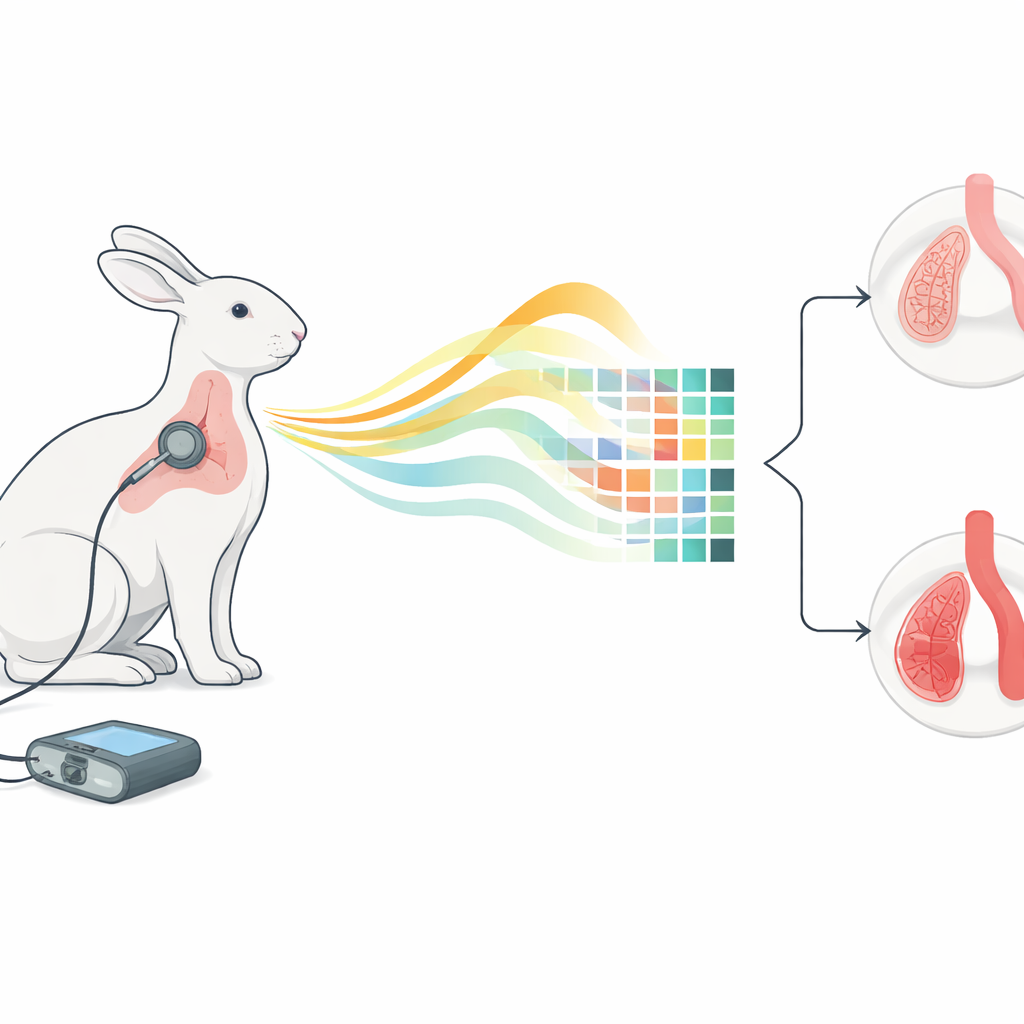
Because it would be unethical to experiment directly on infants, the researchers created a controlled animal model that mimics the airway of a small child. They operated on five rabbits, carefully removing part of the cartilage rings that normally hold the windpipe open. This produced a weakened airway that widened during inhalation and narrowed during exhalation, closely resembling one major form of tracheomalacia. Using a clinical stethoscope head and a standardized recording device placed on the neck and chest, they captured breathing sounds while also measuring pressure inside the airway, ensuring that changes in sound truly reflected changes in airflow and airway shape.
Turning Breaths into Numbers
The team focused on the outward-breathing phase, where the sounds were strongest and most consistent. They used a widely adopted audio-analysis toolkit to break each exhalation into very short slices and describe each one using thousands of simple measures, such as how loud it was, how its pitch and tone were distributed across frequencies, and how those properties changed over time. From every breath they extracted 6,373 such features, then narrowed these down to 51 that reliably differed between healthy and floppy windpipes in at least four of the five rabbits. These features served as the raw material for computer programs designed to tell the two conditions apart.
Training Computers to Hear Trouble
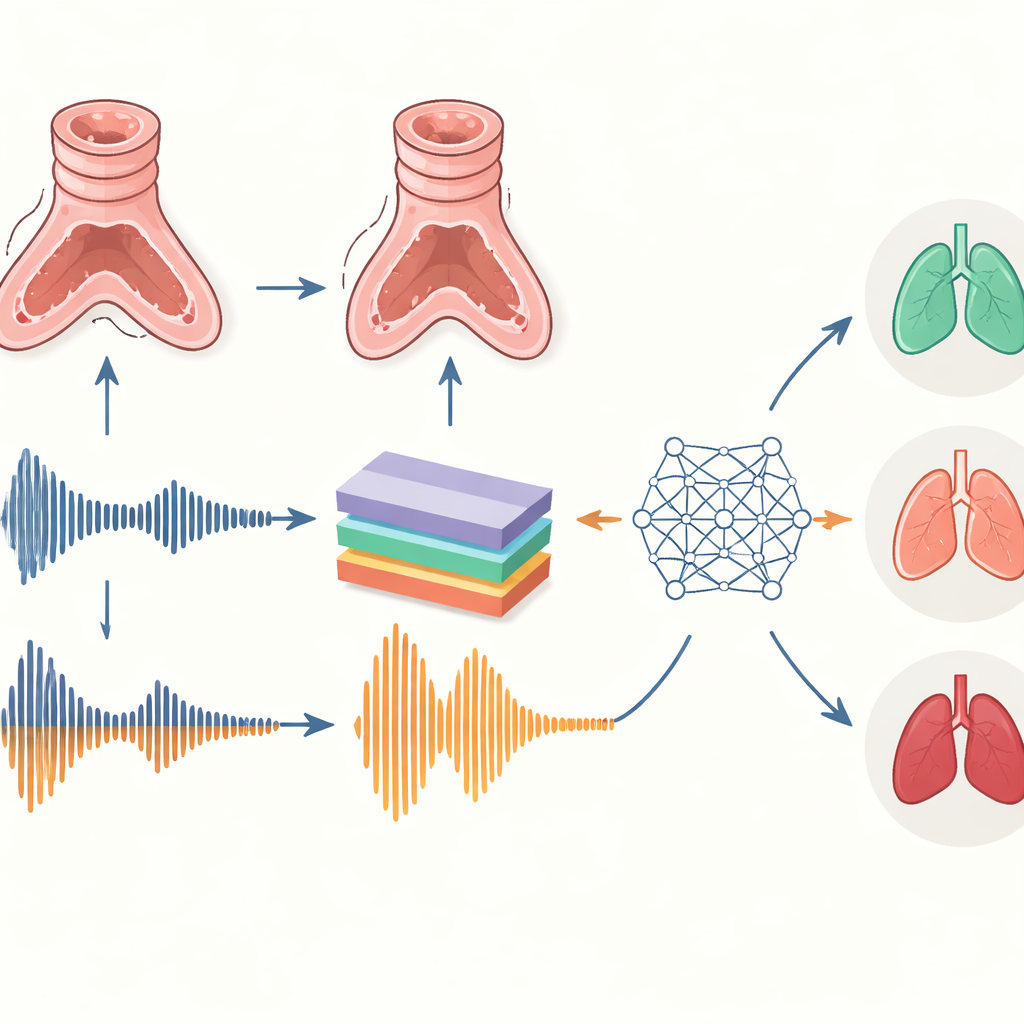
Three types of machine learning models were tested: logistic regression, support vector machines, and a modern tree-based method called LightGBM. To avoid “cheating,” the researchers grouped data by each rabbit and airway condition, making sure that breaths from the same situation did not end up both in training and testing sets. All models performed reasonably well, but LightGBM stood out. Its ability to distinguish normal from weakened airways reached an accuracy level that, in medical statistics, is considered strong: the area under the curve was above 0.78 for single breaths and above 0.80 when decisions were averaged per rabbit. The features that mattered most were low-frequency components of so-called Mel-frequency cepstral coefficients, tools borrowed from speech recognition that are especially good at capturing the overall “shape” and subtle fluctuations of a sound.
What the Sounds Reveal
The importance of these low-frequency patterns suggests that a collapsing windpipe changes how air flows through the throat in ways too subtle for human ears alone but clear enough for algorithms. Even when breath sounds did not contain obvious wheezing, the models could still pick up on slight distortions in tone and rhythm that signaled narrowing of the airway. Remarkably, this was achieved using standard medical equipment similar to what doctors already use for everyday listening, combined with relatively straightforward computer processing.
From Lab Rabbits to Children’s Wards
Because rabbit windpipes are similar in size to those of newborns, this model offers a realistic testbed for tools aimed at pediatric care. While the study used only five animals and one specific type of airway weakening, it lays crucial groundwork. The results show that non-invasive sound recordings, paired with machine learning, can reliably flag a floppy windpipe without the need for radiation or scopes. With larger studies and testing in human patients, this approach could evolve into a bedside screening tool that helps doctors decide which children truly need invasive tests—and which can be safely monitored using nothing more than a sensitive “smart stethoscope.”
Citation: Ismael, A.C., Omiya, Y., Higuchi, M. et al. Respiratory sound analysis in a rabbit tracheomalacia model. Sci Rep 16, 12249 (2026). https://doi.org/10.1038/s41598-026-42275-8
Keywords: tracheomalacia, respiratory sounds, machine learning, noninvasive diagnosis, pediatric airway