Clear Sky Science · en
A GWAS–machine learning framework reveals protein-synthesis pathway signals for yield in Theobroma cacao after population-structure correction
Why Better Cacao Matters to Everyone
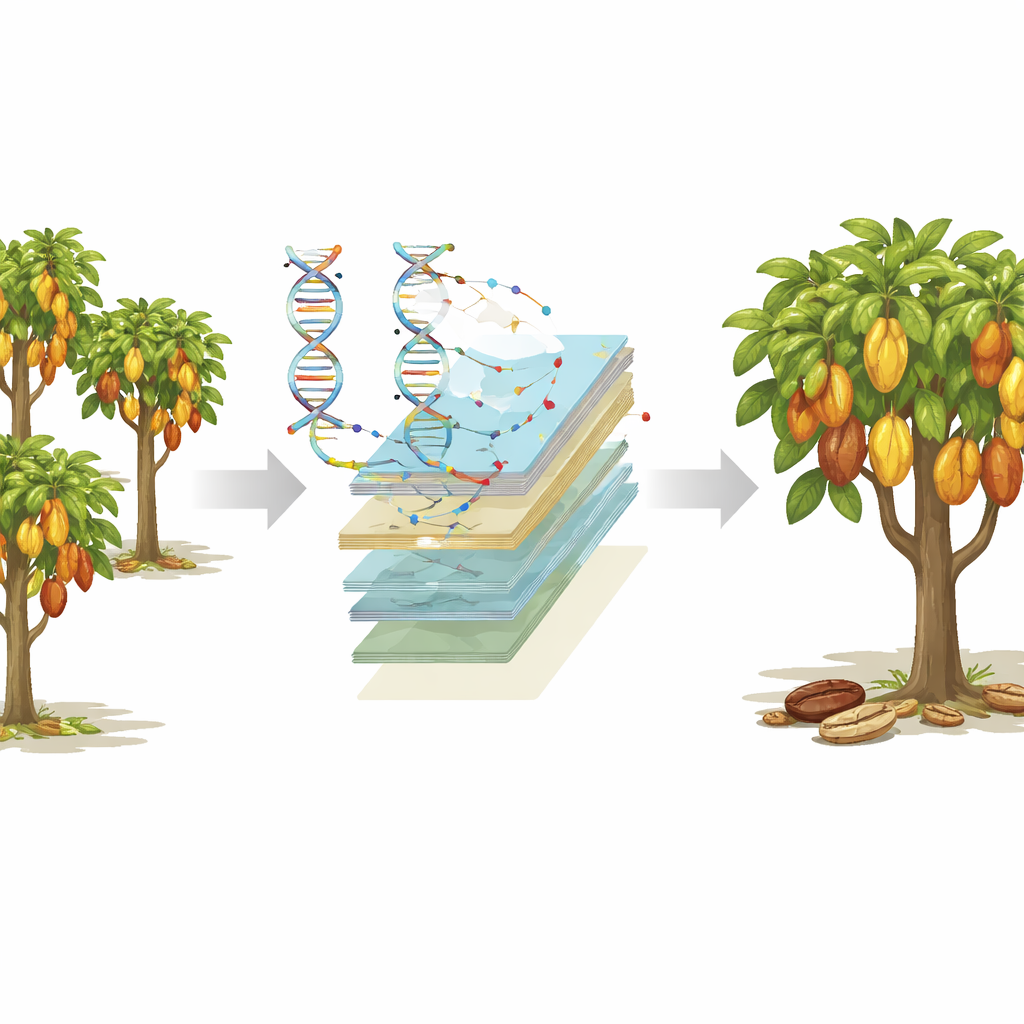
Chocolate starts with the cacao tree, a crop grown mostly by smallholder farmers whose livelihoods depend on steady harvests. Yet cacao yields are highly variable and difficult to improve because many different plant traits and hidden genetic factors interact, and traditional breeding can take years to show results. This study re-examines a large international cacao collection using modern data tools—genome-wide DNA markers and machine learning—to search for genetic signals linked to yield and to find simple, easy-to-measure traits that could help breeders and farmers select more productive trees.
Looking Inside a Global Cacao Collection
The researchers worked with 346 cacao accessions from the International Cocoa Genebank in Trinidad, a living library that captures much of the crop’s worldwide diversity. For each tree, earlier work had already measured 27 traits describing flowers, pods, and seeds, and genotyped hundreds of DNA markers scattered across the genome. The team first compared how trees are related genetically with how different they look in the field. They found only weak links: trees that are distant cousins in DNA terms are only slightly more different in key traits such as pod index (a measure of how many pods it takes to make a kilogram of dried beans) and seed size. This means visible differences among trees cannot be predicted just from broad ancestry and that more targeted genetic analyses are needed.
Separating Ancestry from True Yield Signals
When scientists try to connect DNA markers to traits, they can be misled if entire subgroups of plants share both ancestry and performance—for example, if one lineage is generally more vigorous. To avoid confusing such background effects with true cause-and-effect links, the authors explicitly corrected for population structure: they used principal component analysis on the DNA data to capture ancestry patterns, then removed those signals from each trait before running their association analysis. They relied on a Bootstrap Forest, a machine learning approach that ranks markers by how important they are for predicting each trait. Comparing models with and without this correction showed that failing to account for structure can highlight broad stress-response genes, whereas the corrected analysis zeroed in on more specific and biologically coherent candidates.
Protein Factories and Bigger Seeds
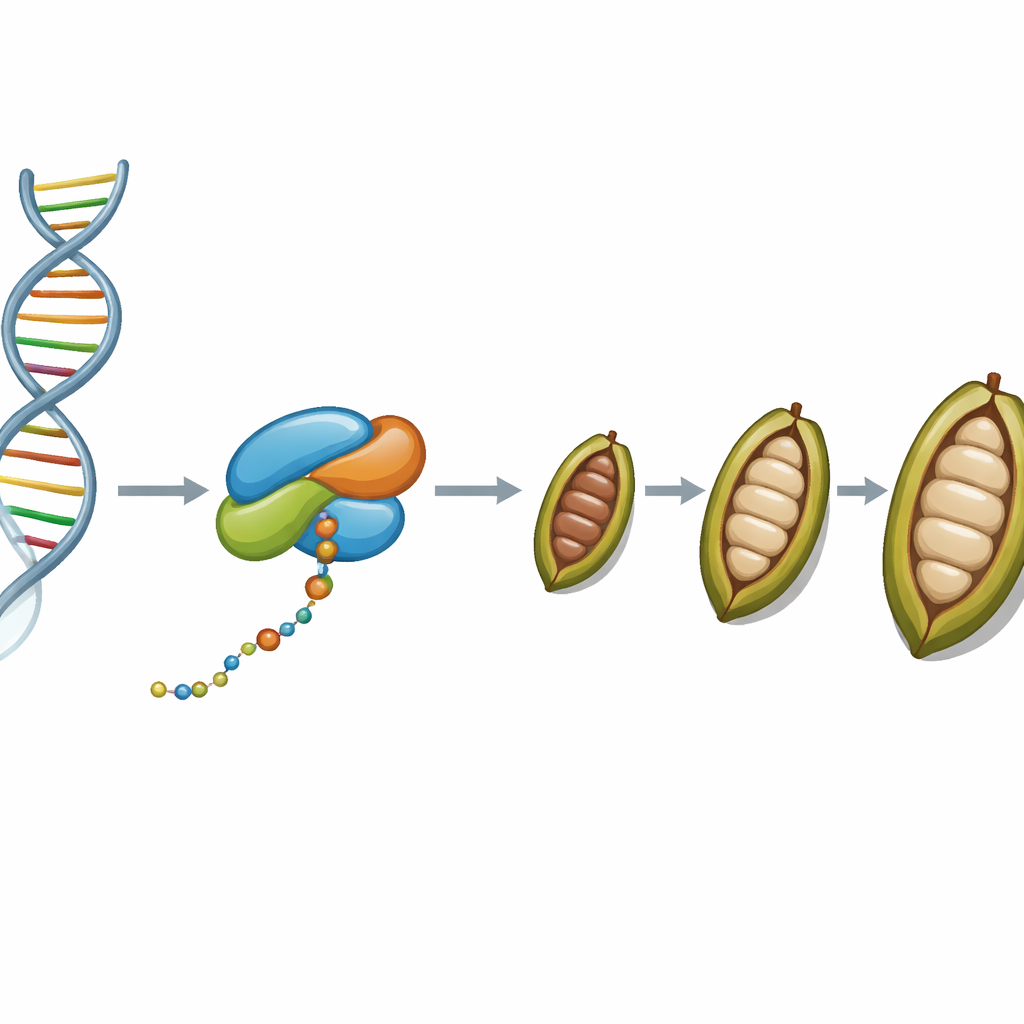
After adjustment for ancestry, a striking pattern emerged across several yield-related traits, including pod index, wet bean mass, and seed number. A small set of DNA markers kept reappearing near genes involved in the ribosome—the cell’s protein factory—as well as seed storage and basic metabolism. When the team looked at groups of traits together (pod index, seed number, bean mass, and seed dimensions), enrichment analysis showed a strong and consistent signal for protein synthesis pathways. In simple terms, trees that appear genetically primed to make proteins efficiently also tend to produce larger or more numerous seeds. Other trait groups revealed different themes: pigmentation traits pointed to energy metabolism and light-harvesting processes, while specific fruit shape and husk hardness traits tied into energy transport, respiration, and cell-wall formation.
Machine Learning Finds Simple Clues to Yield
In parallel, the researchers built a separate prediction model for wet bean mass using only visible or easily measured traits, deliberately excluding obvious near-duplicates like seed number and pod dimensions. A boosted neural network, tested with five-fold cross-validation, predicted wet bean mass with good accuracy. It identified cotyledon mass (the weight of the inner seed tissue) and cotyledon length as the dominant predictors, jointly explaining most of the model’s predictive power. This suggests that simple measurements on the seeds themselves could serve as an efficient proxy for overall yield in this collection, although the authors emphasize that more long-term, multi-environment tests are needed before breeders rely on them as early screening tools.
What This Means for Future Chocolate
By carefully correcting for ancestry and combining genome-wide markers with machine learning, this study shows that cacao yield is strongly tied to the tree’s capacity for protein production and to a handful of seed traits, rather than to broad lineage alone. The work does not claim to have pinpointed single "yield genes," but it offers a short list of promising candidates and a framework for prioritizing them. For breeders, these results highlight cotyledon mass and length as practical traits to watch and suggest that genomic selection—using many small DNA signals at once—could accelerate the development of higher-yielding cacao. In the long run, such data-driven breeding could help stabilize cacao production, improve farmer incomes, and secure a more reliable supply of chocolate for consumers.
Citation: Baek, I., Bhatt, J., Lim, S. et al. A GWAS–machine learning framework reveals protein-synthesis pathway signals for yield in Theobroma cacao after population-structure correction. Sci Rep 16, 13840 (2026). https://doi.org/10.1038/s41598-026-42273-w
Keywords: cacao yield, machine learning, genetic markers, protein synthesis, plant breeding