Clear Sky Science · en
Optimization and experimental demonstration of mesh-patterned 4H-SiC betavoltaic cells for enhanced power density
Power from Invisible Particles
Imagine tiny batteries that quietly generate electricity for decades without ever being recharged—powering implants deep inside the body, or sensors on spacecraft where sunlight is scarce. This study explores one such technology, called betavoltaic cells, and shows how a clever “mesh” design carved into a silicon carbide crystal can squeeze more usable power out of the faint drizzle of radiation these cells rely on.
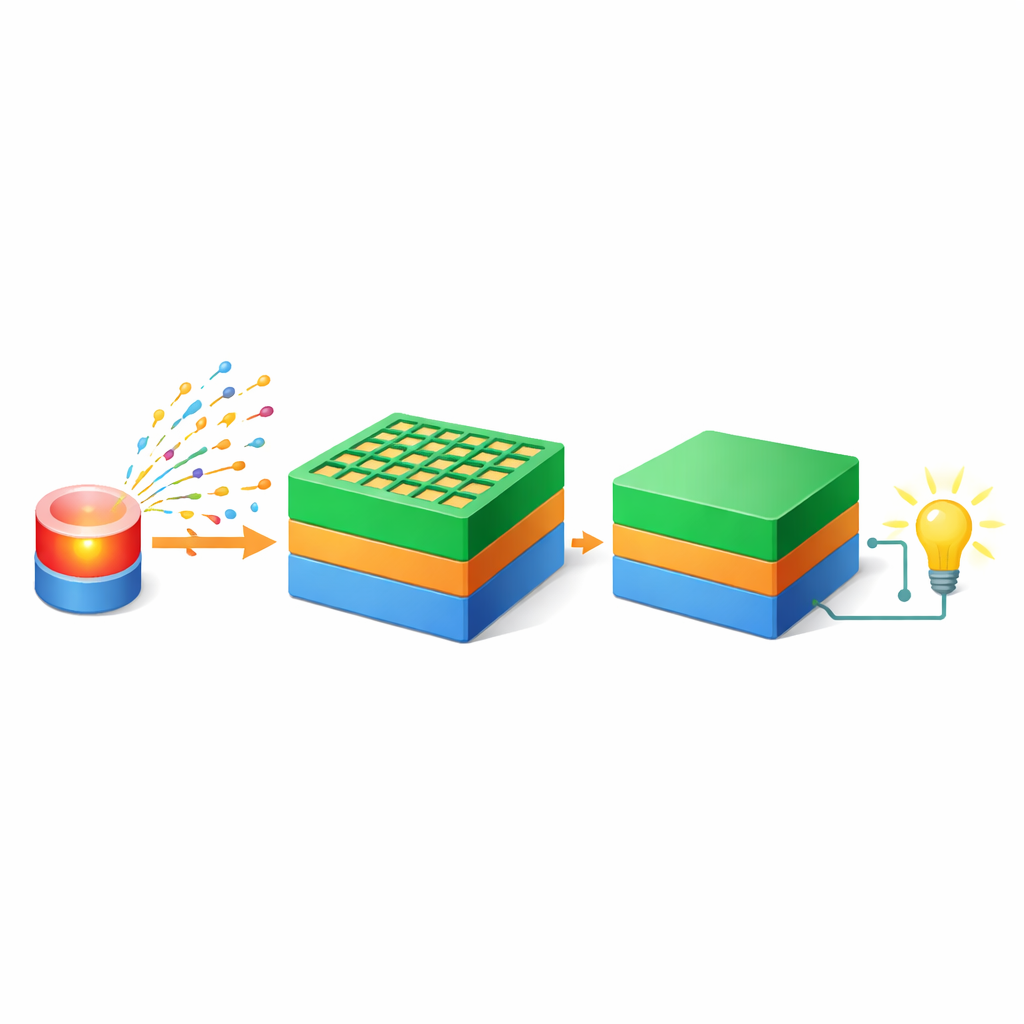
Turning Radiation into Electricity
Betavoltaic cells work a bit like solar cells, but instead of catching light, they capture energy from beta particles, which are high-speed electrons emitted by a radioactive material. When these particles hit a semiconductor, they knock loose pairs of positive and negative charges. If the internal electric field of the device can quickly pull those charges apart and guide them to contacts, their motion becomes a tiny but steady electrical current. Because some radioisotopes, such as nickel‑63, decay very slowly, they can provide a remarkably stable source of power for decades.
Why Silicon Carbide and Why a Mesh?
The researchers focus on a particularly tough semiconductor called 4H‑silicon carbide. This material can withstand high temperatures and intense radiation, making it ideal for long‑life devices in harsh places—from inside reactors to deep space. However, standard betavoltaic cells made from silicon carbide still fall short of their theoretical efficiency. A big culprit is geometry: most of the beta‑generated charges are created in regions that do not overlap well with the cell’s built‑in electric field, or they must travel long distances before collection, giving them more chances to disappear through recombination. In a conventional design, the top layer of the device is a continuous slab. The team asked a simple question: what if that top layer were instead patterned into a grid of thin lines, leaving open windows down to the underlying material?
Designing the Tiny Power Grid
To answer this, the authors used three‑dimensional computer simulations to model how beta‑induced charges move inside both the traditional and the new mesh‑patterned designs. They mimicked the energy distribution of nickel‑63 by using electron beams at three energies—5, 17, and 25 kiloelectronvolts—and fed detailed depth profiles of where the energy lands into their device models. Then they systematically varied four key geometric knobs: the width of the mesh lines, the size of the openings, and the thicknesses of the top and middle layers. By tracking how the current and voltage changed, they identified combinations that delivered the highest power per unit area. One optimal configuration for the mesh design increased the simulated power density to about 2.60 microwatts per square centimeter at the representative 17‑keV condition.
From Simulation to Real Devices
Next, the team fabricated actual silicon carbide betavoltaic cells using the same basic recipe for both the conventional and mesh versions, changing only how the top region was patterned. Under low‑energy irradiation, where most of the particles deposit their energy very close to the surface, the mesh made the biggest difference. Experiments showed that the mesh‑type cell produced about 65 percent more power than its planar cousin at 5 keV. At the average nickel‑63 energy of 17 keV and at 25 keV, the gains were more modest—around 4–5 percent—but remained consistent. These results mirror the simulations and confirm that the mesh extends the active region toward the surface and shortens the paths charges must travel, helping more of them reach the electrodes before they vanish.
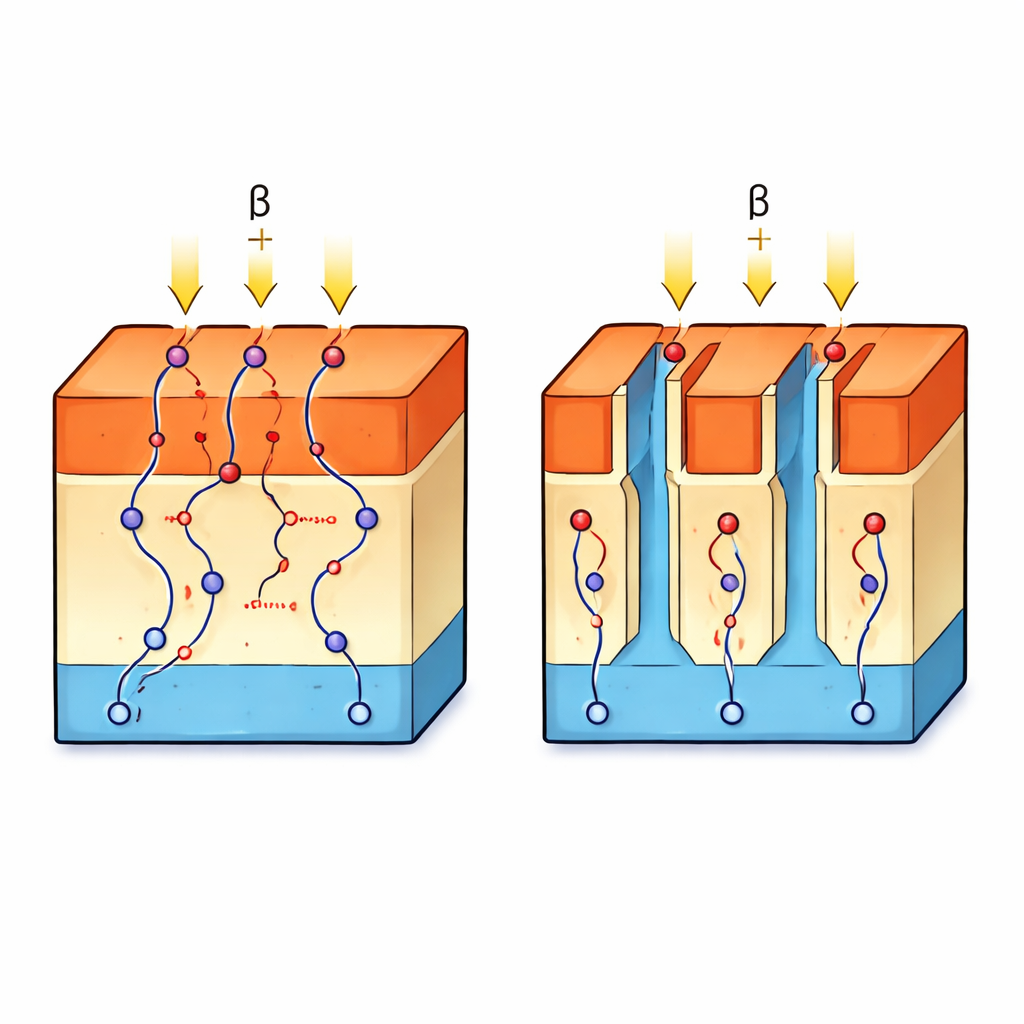
What This Means for Long‑Life Batteries
In essence, the study shows that carving a two‑dimensional mesh into the top layer of a silicon carbide betavoltaic cell is a simple but powerful way to boost its output, especially for the lower‑energy part of the radiation spectrum that is otherwise wasted. By better matching where charges are born to where they can be collected, the mesh design consistently outperforms the traditional solid‑top structure in both simulations and experiments. While the absolute power levels are still small, such improvements are crucial for devices meant to run unattended for years. The work also lays out design guidelines—how thick each layer should be and how wide the mesh lines and openings should be—that can guide future nuclear microbatteries for medical implants, remote sensors, and space missions.
Citation: Kim, K.M., Kim, K.H., Woo, S.Y. et al. Optimization and experimental demonstration of mesh-patterned 4H-SiC betavoltaic cells for enhanced power density. Sci Rep 16, 11906 (2026). https://doi.org/10.1038/s41598-026-42272-x
Keywords: betavoltaic batteries, silicon carbide, nickel-63, radiation-hardened power, long-life micro power sources