Clear Sky Science · en
Quantifying crustal stress in the Sinai Peninsula caused by gravitational potential energy and its tectonic implications
Why the Ground Beneath Sinai Matters
The Sinai Peninsula sits at the intersection of three major tectonic plates and is home to important cities, tourist sites, and critical infrastructure. Yet the rocks deep beneath it are under constant push and pull from both plate motions and the weight of mountains and seas above. This study asks a deceptively simple question with big implications for earthquake risk: how much of the stress in Sinai’s crust comes from its own topography and density—the way mass is distributed—rather than from the slow shoving of distant plates?
How Height and Depth Create Hidden Forces
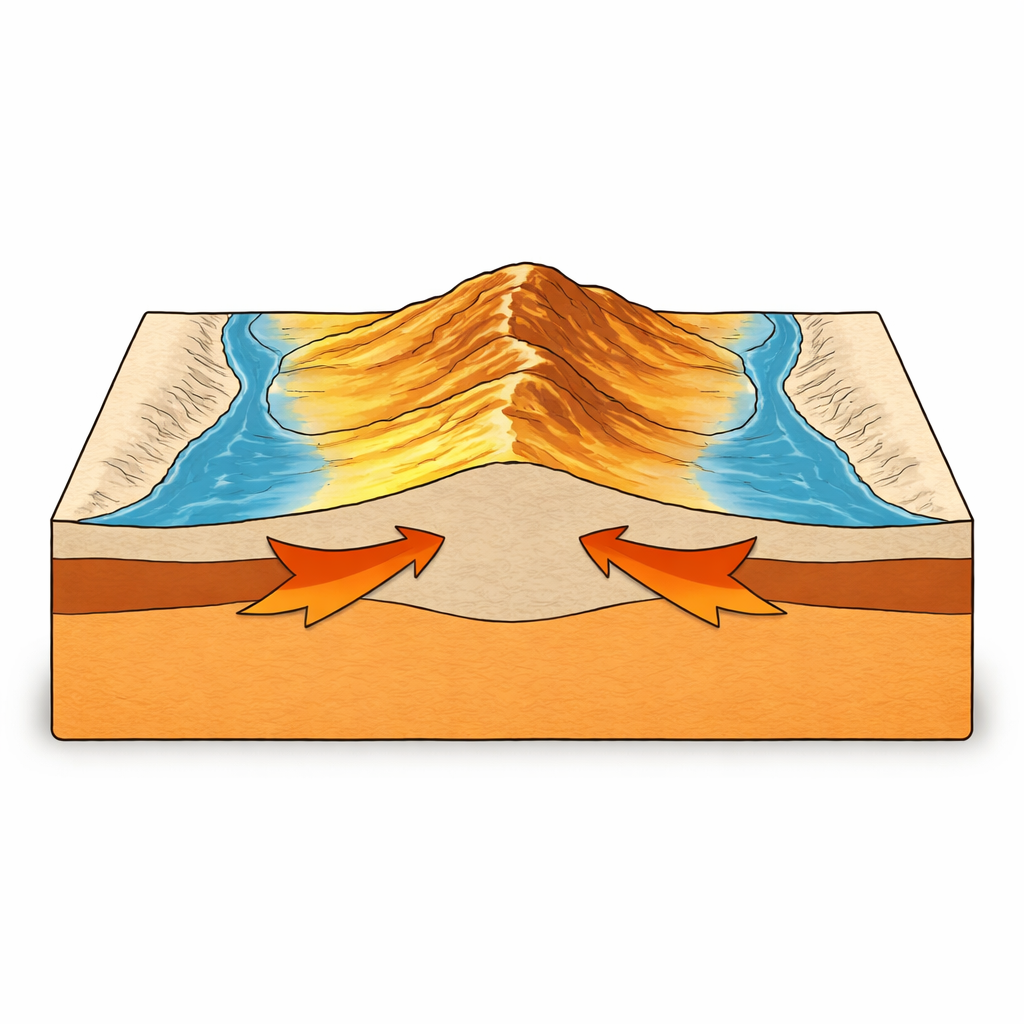
The authors focus on a concept called gravitational potential energy, which in plain terms reflects how high and heavy different parts of the crust are. A thick, high mountain block stores more of this energy than a thin, low area like a rift or gulf. When neighboring regions have different amounts of stored energy, the crust feels horizontal forces that can stretch or squeeze rocks. In Sinai, dramatic contrasts exist between the high central and southern block—where elevations exceed two kilometers—and the low-lying Gulf of Suez and Gulf of Aqaba rifts. The team uses detailed maps of surface topography and the depth of the Moho, the boundary between crust and mantle, to turn these height and thickness differences into quantitative estimates of horizontal forces.
Turning the Subsurface into a Numerical Experiment
To do this, the researchers build a simplified two-layer model: a crust of varying thickness resting on a lithospheric mantle layer. They assign densities to each layer based on seismic studies, then calculate how gravitational potential energy changes from place to place. These variations translate into a horizontal force per unit length—a measure of how strongly one part of the crust pushes or pulls on its neighbor. They also compute the associated deviatoric stress, the portion of stress that actually deforms rocks. Importantly, the model deliberately excludes the direct effect of far‑field plate motions, isolating the contribution from gravity-driven forces alone. A Monte Carlo uncertainty analysis tests how sensitive the results are to errors in density, elevation, and crustal thickness, showing that the main patterns are robust.
Where the Crust is Pulled Apart and Where It is Squeezed
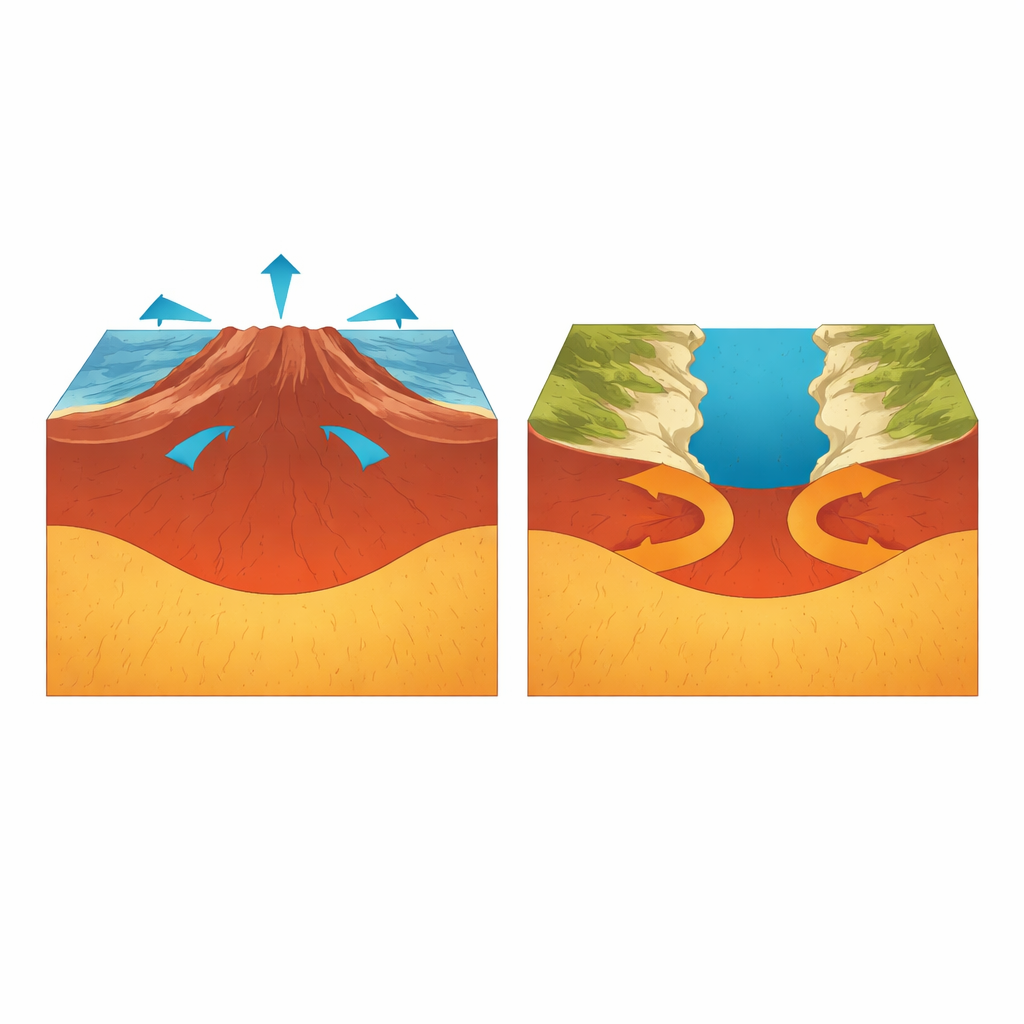
The calculations reveal that gravity-related forces in Sinai are substantial, with horizontal forces reaching about 2×10¹² newtons per meter and deviatoric stresses ranging from about −20 megapascals (compression) to +20 megapascals (tension). The central and southern highlands of Sinai experience mainly extensional stress, encouraging the crust to stretch and faults to open. In contrast, the Gulf of Suez and Gulf of Aqaba, despite being zones of rifting and shear at the surface, show gravity-driven compressional stress in the model because of their thinner crust and lower elevation. These patterns line up with known variations in crustal thickness: the Moho lies deeper beneath central Sinai and shallows toward the Red Sea and Mediterranean, creating strong lateral contrasts in buoyancy.
Comparing Gravity’s Push with Real Earthquakes
To see how these modeled stresses relate to what actually happens, the authors compare their results with earthquake data and GPS measurements. Focal mechanisms—which describe how faults moved during earthquakes—show that the Gulf of Suez is dominated by normal faulting, a hallmark of extension, while the Gulf of Aqaba exhibits mainly strike‑slip motion with a modest extensional component. Central and southern Sinai also display normal faulting consistent with stretching. This comparison reveals a key distinction: in the plate‑boundary gulfs, the observed extensional and shear behavior is driven chiefly by plate motions and regional forces that overwhelm the compressional signature from gravity. Inside Sinai’s highlands, however, the modeled extensional stresses match the earthquake patterns, suggesting that gravitational forces from elevated, thick crust play a leading role there.
What This Means for Hazards and Earth History
For non‑specialists, the take‑home message is that the shape and thickness of the crust beneath Sinai are not passive features; they actively help steer where and how the region deforms. The gravity-related stresses are strong enough to contribute to fault reactivation and extension, especially in the central and southern interior, even though plate-boundary forces dominate near the gulfs. By combining models of gravitational potential energy with real‑world seismic and geodetic observations, the study offers a more complete picture of why some parts of Sinai are more prone to stretching and earthquakes than others. This integrated view improves our understanding of the region’s geodynamic evolution and provides valuable input for assessing seismic hazard in an area where even subtle shifts in stress can have far‑reaching consequences.
Citation: Jallouli, C., Abdelfattah, A.K. & Alzahrani, H. Quantifying crustal stress in the Sinai Peninsula caused by gravitational potential energy and its tectonic implications. Sci Rep 16, 12415 (2026). https://doi.org/10.1038/s41598-026-42269-6
Keywords: Sinai tectonics, crustal stress, gravitational potential energy, earthquakes, seismic hazard