Clear Sky Science · en
Higher plant seed container germination success predicted by smart farming optical RGB approach
Why Seed Color Matters for Future Forests
As the world leans on forests to lock away carbon, protect soils, and supply timber, it becomes vital that each tiny tree seed has the best chance to grow. Yet seed lots used for reforestation can be a mixed bag: some seeds burst into life, while others never sprout. This study explores a surprisingly simple idea with big potential: using the color of Scots pine seeds, captured with an ordinary office scanner, to predict which seeds are most likely to germinate successfully in nursery containers.
From Seed Orchard to Simple Scanner
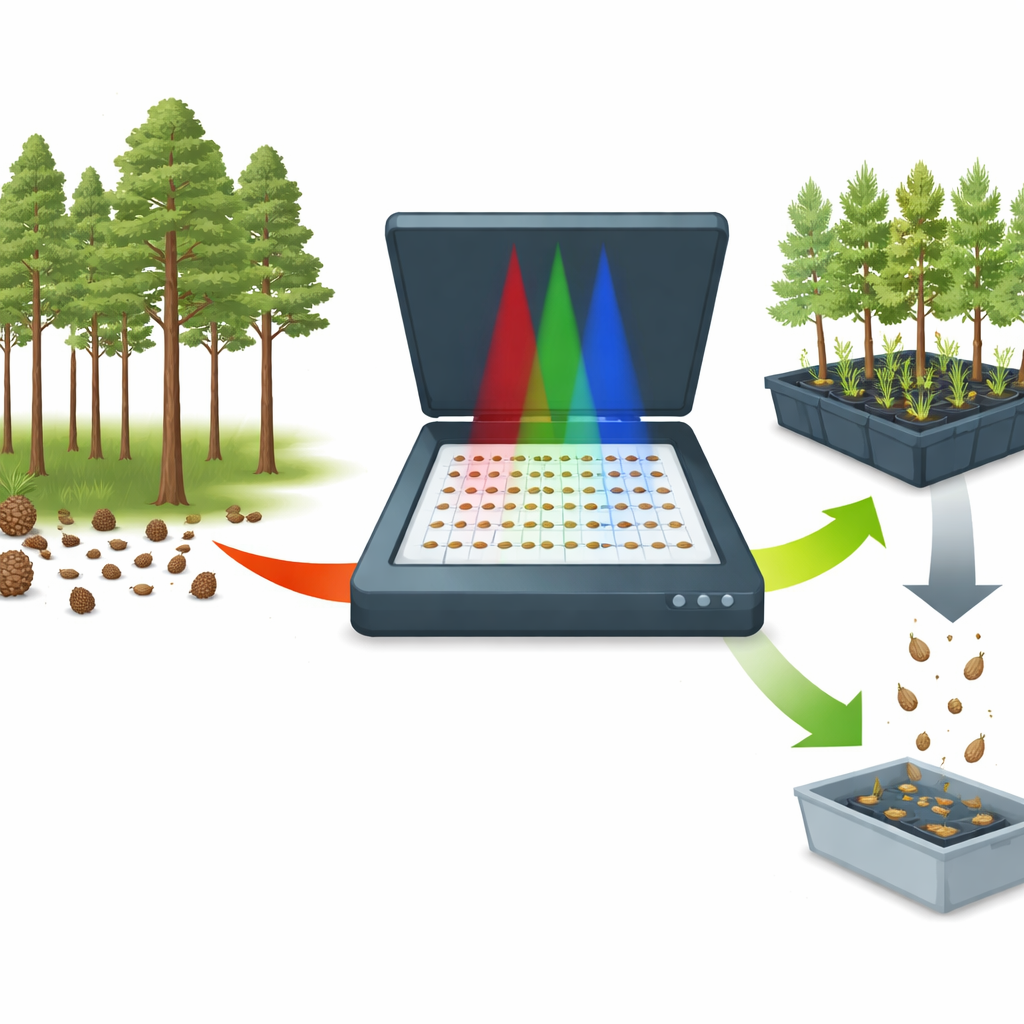
The researchers focused on a cultivated form of Scots pine grown in a seed orchard in Belarus, chosen for its good growth and high seed production. They collected 1,200 seeds, carefully cleaned and dewinged them, and then built a detailed “passport” for each seed. This passport linked three types of information: the seed’s basic physical traits (such as mass and size), its color as recorded by a flatbed scanner, and whether it eventually germinated in a container cell. To keep everything perfectly matched, each seed was assigned a unique code and tracked from the scanner glass to its exact position in the nursery tray.
Reading Seeds by Their Reflected Light
Instead of expensive laboratory equipment, the team used a standard consumer scanner on its default settings with a white background. They scanned seeds in small, organized groups and later used freely available ImageJ software to outline each seed and measure how bright it appeared in the red, green, and blue channels of the digital image. These brightness values, ranging from dark to light, act as a numerical description of seed coat color. The same individually tracked seeds were then sown into peat-filled container cells in a greenhouse, where temperature, humidity, and watering were carefully controlled over a 30-day period. At the end of this time, each seed was simply recorded as either germinated or not.
What Color Revealed About Seed Success
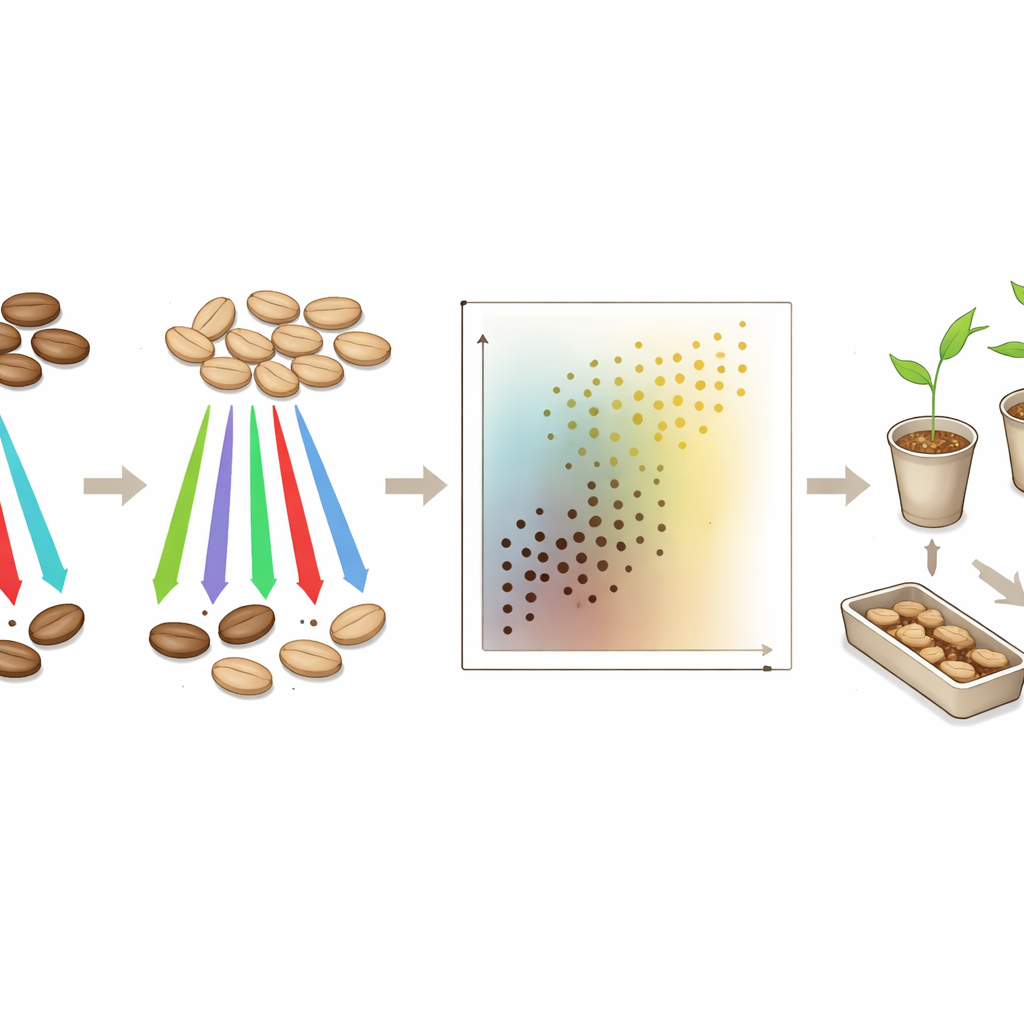
The results showed clear and statistically strong patterns. Seeds that failed to germinate were, on average, lighter and more reflective across all three color channels than seeds that produced seedlings. In other words, darker seeds tended to be more successful in germinating. While non-germinating seeds also tended to be slightly lighter in mass, the differences in color were more pronounced and easier to separate. Analyses of medians and distributions revealed a distinct upward shift in brightness, especially in the red and green channels, for seeds that did not sprout. Additional statistical tools, such as principal component analysis, confirmed that color added information beyond simple size: even when seed size was taken into account, brightness still helped distinguish good seeds from poor ones.
Turning Images into Practical Decisions
To test whether this information could be used in real-world sorting, the authors trained simple machine learning models on the combined physical and color data. These models, including logistic regression and linear discriminant analysis, correctly retained most seeds that were capable of germination, while discarding many that were unlikely to sprout. The models achieved high recall (few good seeds were thrown away) and solid overall accuracy, suggesting that an optical sorting step based on RGB color could significantly lift the average germination rate of seed batches. Importantly, all of this was done using low-cost, widely available tools rather than specialized imaging systems.
What This Means for Forest Nurseries
The study concludes that, for this Scots pine seed lot, brighter, lighter-colored seeds have a lower chance of germinating under standard container nursery conditions, while darker seeds fare better. This simple visual signal, captured with an office scanner and processed by straightforward software, can serve as a fast, non-destructive way to presort seeds before sowing. Although the authors note that color thresholds may differ between seed lots and environments, their work offers a proof-of-concept: everyday digital imaging can become a “smart farming” tool, helping nurseries choose stronger seed material, boost seedling output, and ultimately support more reliable and resilient forest restoration.
Citation: Novikova, T.P., Tylek, P., Petrishchev, E.P. et al. Higher plant seed container germination success predicted by smart farming optical RGB approach. Sci Rep 16, 13021 (2026). https://doi.org/10.1038/s41598-026-42258-9
Keywords: Scots pine seeds, seed germination, RGB imaging, forest nurseries, precision forestry