Clear Sky Science · en
Experimental crystallization of analcime zeolite from clay and feldspar precursors
Why this rock story matters
Hidden deep in many oil and gas reservoirs, tiny crystals can quietly make or break the rocks that store our energy resources. This study explores how one such mineral, analcime, grows inside sandstone under hot, salty conditions similar to those in ancient lakes and modern subsurface settings. Understanding how these crystals form and reshape the rock helps scientists better predict where fluids like oil, gas, water, or even injected CO₂ can be stored and how easily they can flow.
The special crystals inside everyday rocks
Analcime belongs to a family of minerals called zeolites, which are prized in industry for filtering, catalyzing chemical reactions, and cleaning up pollution. In nature, analcime commonly appears in sandstones formed in lake basins and volcanic regions, where it can dramatically alter porosity—the tiny spaces between grains that hold fluids. Until now, most research has focused on analcime forming from volcanic glass or from another zeolite named clinoptilolite. This paper tackles a key missing piece: can ordinary sandstone ingredients such as clay and feldspar also give rise to analcime, and if so, under what conditions?
Recreating deep-earth conditions in the lab
The researchers started with a feldspar-rich sandstone from the Al Wajh Formation in northwest Saudi Arabia, a rock unit deposited by ancient rivers and shallow lakes. They placed crushed samples of this sandstone into sealed steel vessels filled with sodium carbonate solutions, then heated them to temperatures between 80 and 250 °C for about two weeks. These conditions mimic hot, strongly alkaline waters that may circulate during burial in sedimentary basins. Before and after the experiments, they used X‑ray diffraction, optical microscopy, and high‑resolution electron microscopy to track how the mineral mix and textures of the rock changed.
How old grains dissolve and new crystals grow
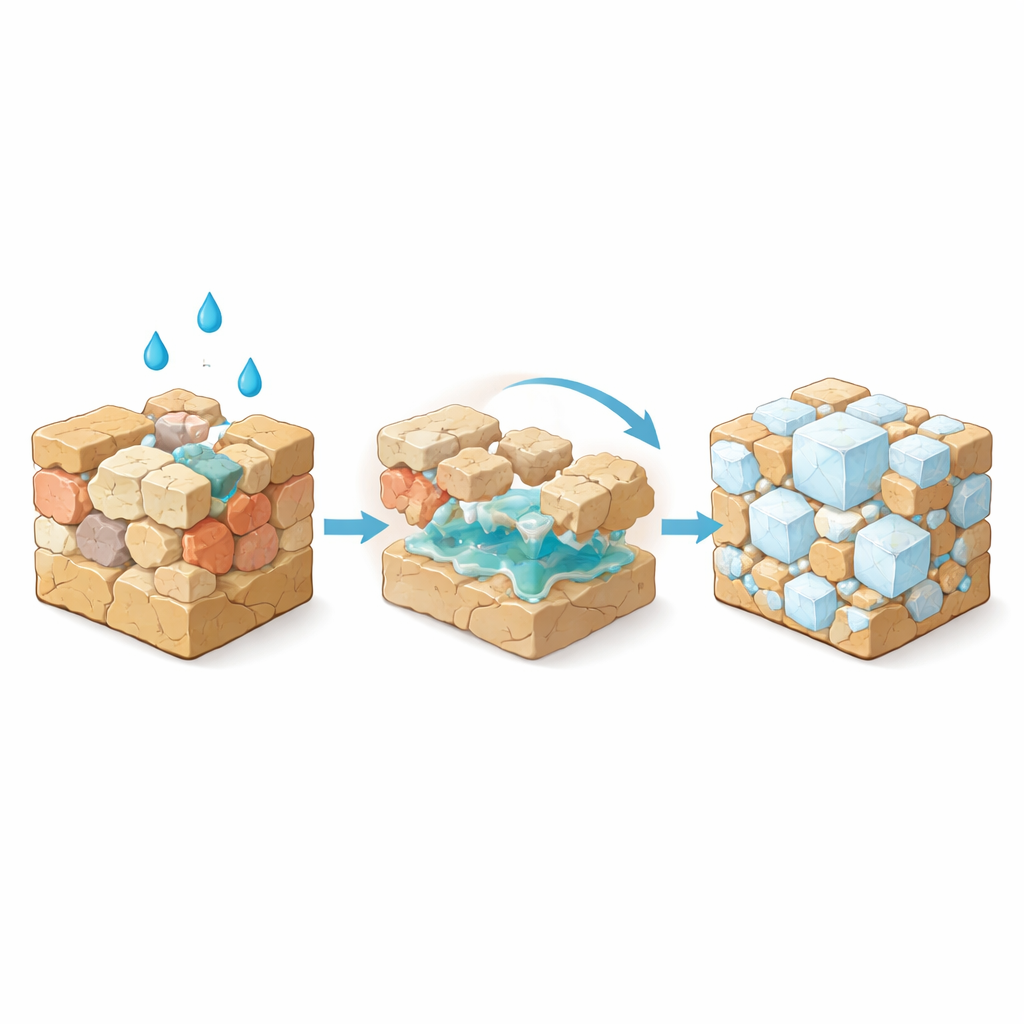
The experiments showed that analcime becomes the dominant new mineral between 150 and 250 °C. Feldspar grains and several types of clay—including kaolinite, smectite, and illite—partly dissolve, releasing key building blocks such as silicon, aluminum, and sodium into the surrounding fluid. In places, this material first appears as a soft, amorphous gel, and then reorganizes into sharply faceted analcime crystals. The new crystals take on several shapes—spherical, cubic, and multi‑faceted forms—and occur in four main ways: replacing original grains, replacing clay coatings, lining grain surfaces, and filling pores. At the highest temperatures, two additional zeolites, mordenite and chabazite, also appear in small amounts, especially where smectite and illite break down.
Tiny pores and stronger rock frames
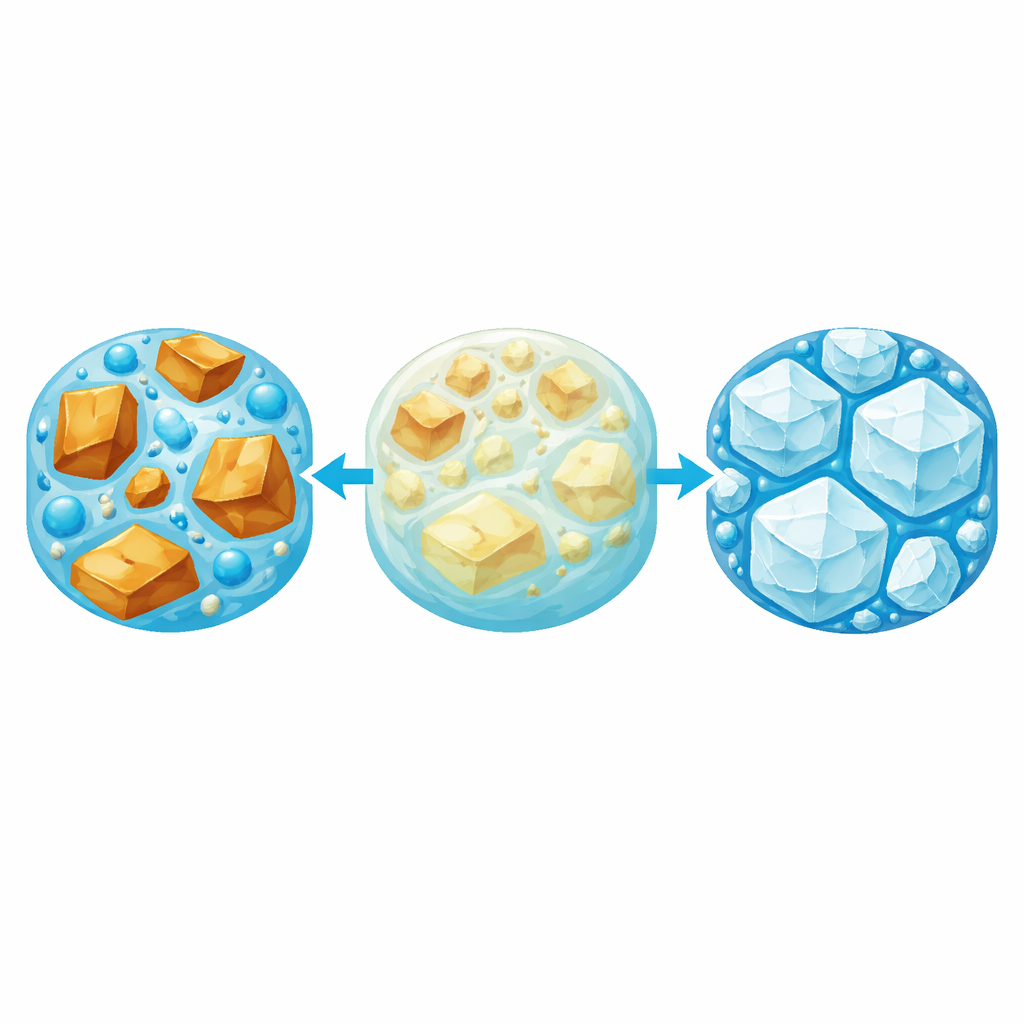
As analcime crystals grow, they often pack together yet leave numerous small gaps between them. These intercrystalline pores can reach nearly 10 micrometers in size, forming a connected network that could store and transmit fluids. At the same time, analcime consumes soft clay material that would otherwise weaken the sandstone. By converting the clay into rigid crystals and tying grains together, analcime can make the rock more resistant to squeezing and collapse under deep burial. The study suggests that if these analcime-rich rocks later encounter acidic waters—for example, during the movement of organic acids from source rocks—the analcime itself may dissolve, generating a second generation of pores within the crystals.
What this means for future reservoirs
For geoscientists and engineers, these findings help explain why some sandstones gain or lose quality as reservoirs over time. The work shows that common minerals like feldspar and clay, when bathed in hot, alkaline fluids, can be transformed into analcime and other zeolites that both stiffen the rock and create intricate pore systems. Over geological time, cycles of crystal growth and later dissolution could produce complex, finely structured porosity that enhances the storage and flow of hydrocarbons, groundwater, or injected CO₂. In short, the study links microscopic crystal chemistry to the large‑scale performance of subsurface reservoirs.
Citation: Bello, A.M., Salisu, A.M., Amao, A.O. et al. Experimental crystallization of analcime zeolite from clay and feldspar precursors. Sci Rep 16, 12274 (2026). https://doi.org/10.1038/s41598-026-42250-3
Keywords: analcime, zeolite diagenesis, sandstone reservoir, clay and feldspar alteration, porosity evolution