Clear Sky Science · en
AI-driven dynamic resource allocation for ISAC systems in 6G networks: intelligent beamforming, interference management, and power allocation
Smarter Wireless Networks for Everyday Life
Future 6G networks will not only connect our phones, cars, and home gadgets—they will also act as finely tuned sensors that continuously scan the environment. This paper explores how artificial intelligence can help these dual-purpose networks automatically decide where to aim their signals, how much power to use, and how to avoid interference. The goal is to make wireless connections faster and more reliable while enabling precise sensing for applications like autonomous driving, smart cities, and safety monitoring.

One Network for Talking and Sensing
Instead of building separate systems for communication and radar-like sensing, integrated sensing and communication (ISAC) combines both in the same hardware and radio channels. A single 6G base station uses many small antennas to send signals that both carry data to users and bounce off objects to reveal their position and movement. This shared setup promises better use of spectrum, lower costs, and new services, but it also creates tension: signals meant to talk to users can disturb sensing, and sensing signals can interfere with data transmission. In fast-changing environments—cars moving at high speed, crowded city streets, or fluctuating traffic loads—old "static" settings no longer suffice.
Why Fixed Rules Fall Short
Traditional wireless systems often rely on predesigned rules or heavy mathematical optimization that assumes slowly changing conditions and near-perfect knowledge of the channels. In ISAC, the base station must constantly juggle beam directions, power levels, and frequency choices while handling several kinds of interference: echoes from its own signals, clashes between different users, and cross-talk between sensing and communication links. Solving this balancing act repeatedly with conventional tools is too slow and too rigid for real 6G scenarios, where users move, demand shifts, and interference patterns change from moment to moment.
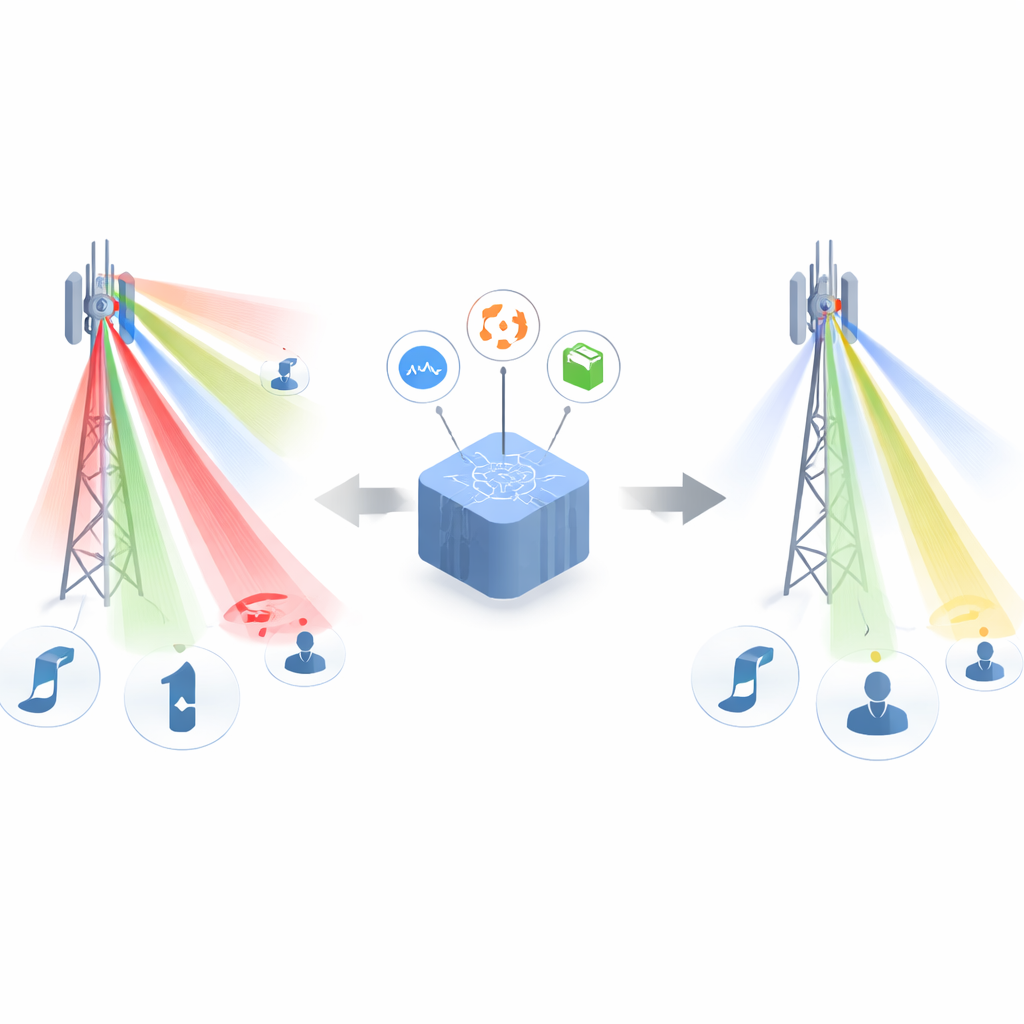
How the AI Controller Learns to Adapt
The authors propose an AI-driven controller based on deep reinforcement learning. The controller continuously observes the state of the network: how good the channels are, how quickly users move, how much interference is present, how accurate sensing needs to be, and how much power is available. At each instant it chooses actions—how to shape the beams, how to share power among users and sensing tasks, and how to assign frequencies. After each decision, the system receives a reward that reflects several goals at once: higher data rates, better sensing accuracy, lower energy use, and less interference. Over many simulated interactions, the AI discovers strategies that balance these goals better than fixed designs, and once trained, the learned policy can be applied in real time with modest computational effort.
Performance Across City Streets and Open Fields
To test this approach, the researchers simulate three typical 6G settings: a high-speed urban environment with fast-moving vehicles, a dense smart city with many closely packed users, and a quiet rural area with few devices but high sensing demands. Across all three, the AI-controlled system delivers clear gains. It raises the total data-carrying capacity by up to about 45% compared with classical optimization and by around 50% versus static beam patterns, especially when the base station has many antennas or higher transmit power. At the same time, it sharpens the energy focus in the desired sensing directions, boosting beam pattern gain and lowering the theoretical error bounds on target location, which translates into more precise sensing of objects and surroundings.
Saving Power and Cutting Signal Clutter
The benefits go beyond speed and accuracy. By learning when and where power is actually needed, the AI-based method can maintain a given data rate while cutting transmit power by roughly 40% compared with traditional solutions. It also learns to suppress different forms of interference—self-interference, user-to-user clashes, and cross-talk between sensing and communication—by up to about 50%. This cleaner signal environment improves both wireless links and sensing performance, particularly in crowded or fast-changing conditions. The authors further analyze the computational cost and show that the heavy learning phase can be done offline, while the online decisions are quick enough for strict 6G timing requirements.
What This Means for Future 6G Systems
For a general reader, the main takeaway is that the paper shows how AI can act as a real-time "air-traffic controller" for radio waves in future 6G infrastructure. Instead of relying on fixed settings, the network learns how to steer its beams, share power, and avoid mutual disturbance between talking and sensing, all on the fly. The result is a more flexible, energy-conscious, and precise wireless system that can better support self-driving cars, smart factories, and other data-hungry, safety-critical applications. The study suggests that such AI-driven resource allocation could become a key enabling technology for practical deployment of integrated sensing and communication in 6G.
Citation: Aman, M., Rehman, G.U., Zubair, M. et al. AI-driven dynamic resource allocation for ISAC systems in 6G networks: intelligent beamforming, interference management, and power allocation. Sci Rep 16, 12613 (2026). https://doi.org/10.1038/s41598-026-42247-y
Keywords: 6G wireless, integrated sensing and communication, deep reinforcement learning, beamforming, interference management