Clear Sky Science · en
Spectral characterization and severity assessment of rice brown planthopper damage using multivariate models
Why tiny insects matter for your rice bowl
Rice feeds billions of people, especially across Asia, but a pin‑sized insect called the brown planthopper can quietly drain fields of life, wiping out up to four‑fifths of a harvest. Farmers usually spot trouble only after plants have already yellowed and died, when it is too late to save yields. This study explores how "listening" to the light reflected from rice leaves with special sensors, and interpreting those signals with modern machine‑learning tools, could turn brown planthopper damage from a hidden menace into a clearly visible warning—well before fields collapse.
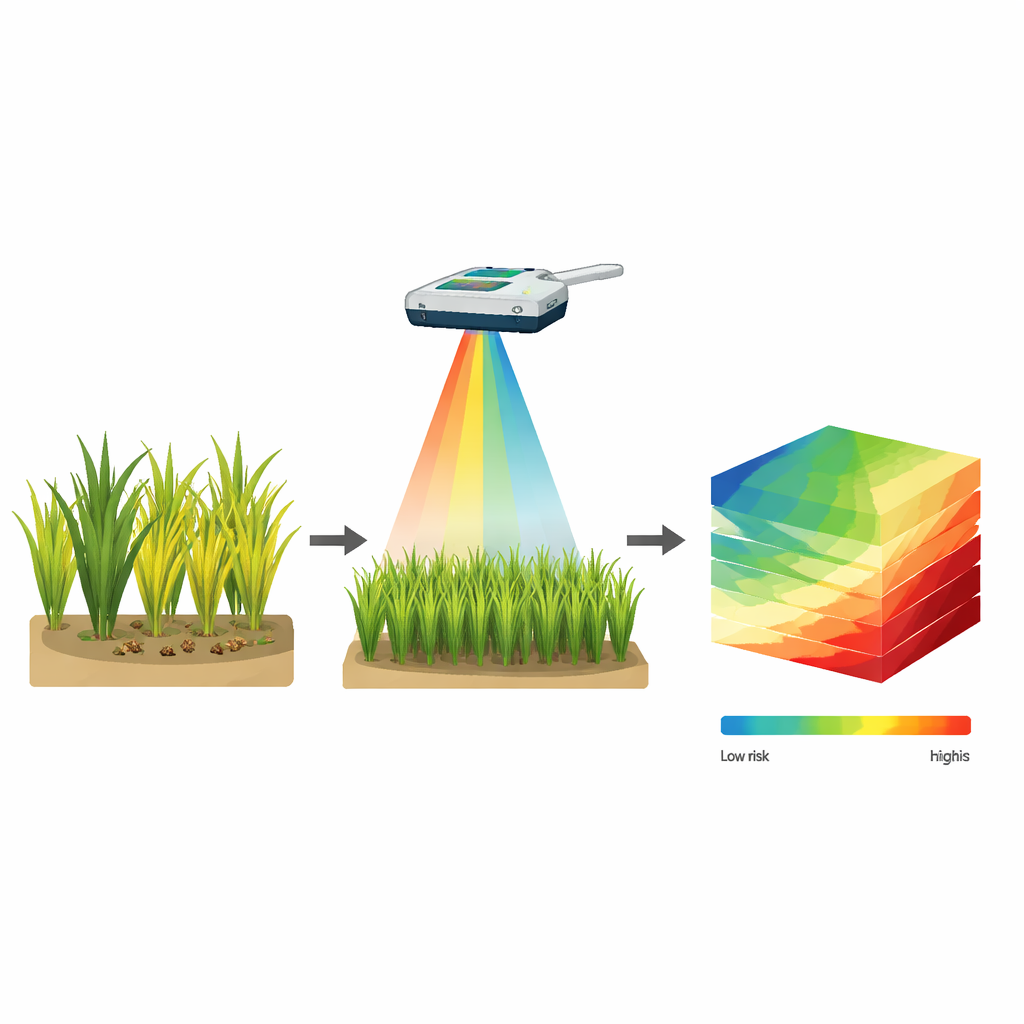
Watching rice plants through their reflected light
The researchers worked with three rice varieties, including two popular basmati types and one known to be especially vulnerable. Instead of waiting for obvious damage, they deliberately exposed potted plants to increasing numbers of brown planthopper nymphs—ranging from none to very heavy infestations—and then measured how the leaves reflected sunlight‑like radiation from 350 to 2500 nanometres using a portable hyperspectral sensor. This type of sensor splits light into hundreds of narrow “color” bands, far beyond what human eyes can see, capturing subtle fingerprints of plant health related to pigments, water content, and internal leaf structure.
Subtle color shifts reveal hidden stress
Even when the plants still looked relatively normal, their spectral signatures were already changing in systematic ways as insect numbers rose. Healthy leaves, rich in chlorophyll and intact cells, strongly absorbed red light and reflected a lot of near‑infrared light. Under heavier planthopper feeding, the red reflection increased (signaling pigment loss), while the near‑infrared and short‑wave infrared reflection patterns shifted in ways consistent with cell damage and drying. A particularly sensitive transition zone, called the “red edge,” between red and near‑infrared light, shifted downward as stress intensified. By 40 days after infestation, severely attacked plants reflected light more like bare soil than living foliage, capturing the near‑total collapse of their tissues.
Turning light patterns into pest severity scores
To make these spectral clues useful for real‑world monitoring, the team converted the raw reflectance into vegetation indices—simple combinations of wavelengths that emphasize features like green biomass and pigment content. Out of 28 such indices tested, a small group tied to leaf pigments stood out as especially responsive to planthopper attack. The scientists then trained several types of multivariate models, including Random Forests, Support Vector Machines, and Partial Least Squares Regression, to link either these indices or the full spectral curves to the actual number of insects per plant. Using just four key indices, the Random Forest approach predicted pest severity with striking accuracy in controlled tests, and it remained reliable when challenged with independent field data collected under natural infestations.
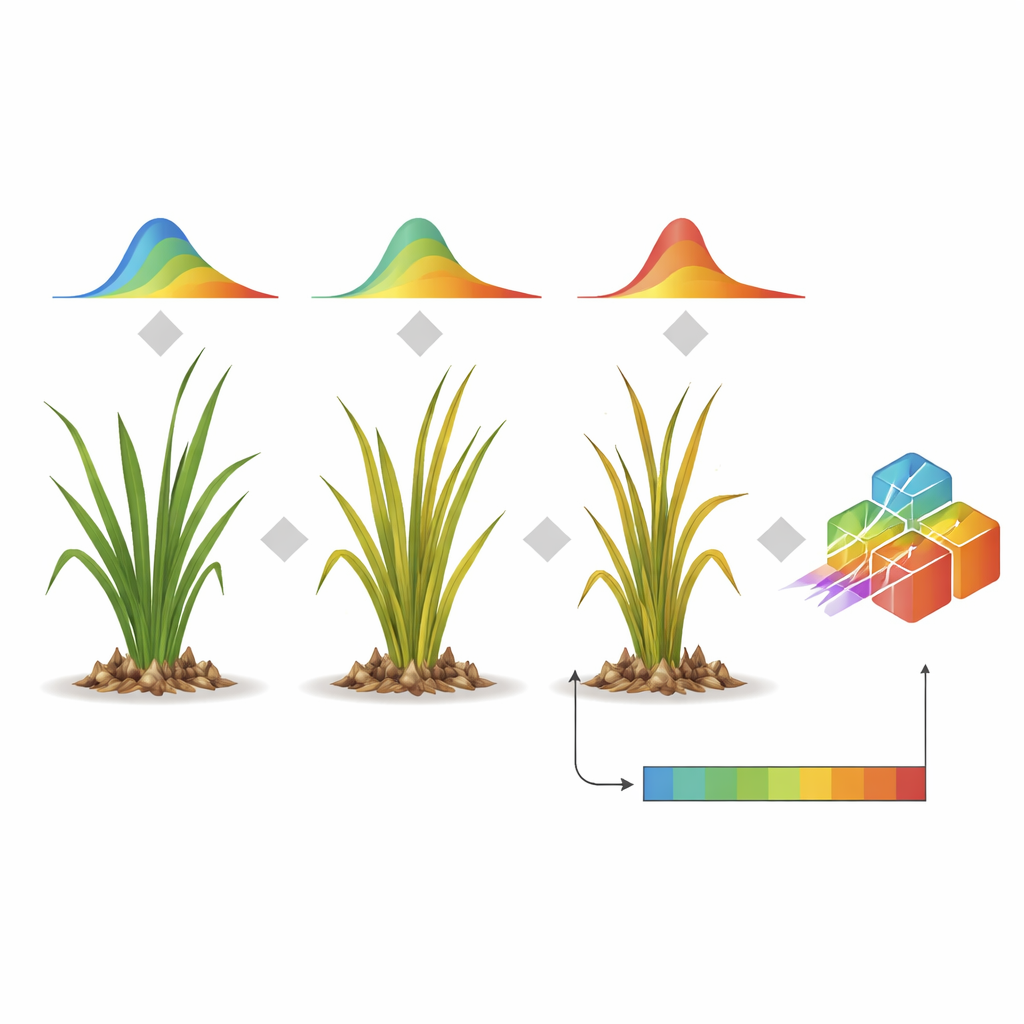
Connecting insect damage to plant chemistry
Because light reflection ultimately depends on what is happening inside the leaf, the researchers also measured biochemical traits such as chlorophyll, carotenoids, proteins, and flavonoids. As planthopper numbers increased, chlorophyll, carotenoids, and proteins steadily declined, confirming that the insects were undermining photosynthesis and basic metabolism. Models using the full hyperspectral data could estimate these key biochemical changes quite well, again with Partial Least Squares Regression performing best. Flavonoids behaved differently: they rose at moderate stress levels and fell only when damage became severe, reflecting their role in short‑term plant defenses rather than steady wear‑and‑tear, which made them harder to predict from spectra alone.
From proof of concept to smarter fields
Together, the results show that brown planthopper damage does not suddenly appear; it leaves a long trail of optical and biochemical clues that can be captured non‑destructively and translated into meaningful risk scores. While this work was carried out in a single season and region, and mostly in a glasshouse, it demonstrates that hyperspectral sensing combined with machine learning can detect harmful insect populations early, across different rice varieties, without uprooting plants or relying solely on expert eye‑balling. With further validation and deployment on drones or satellites, the same principles could underpin early‑warning systems that help farmers see invisible stress in time to act, protecting both harvests and food security.
Citation: Madhuri, E.V., Ramalingam, S., Rupali, J.S. et al. Spectral characterization and severity assessment of rice brown planthopper damage using multivariate models. Sci Rep 16, 11880 (2026). https://doi.org/10.1038/s41598-026-42245-0
Keywords: rice pests, brown planthopper, hyperspectral sensing, precision agriculture, machine learning