Clear Sky Science · en
Effect of drying methods on Acetobacter xylinum bacterial cellulose aerogels and cryogels
From Tea and Sugar to High-Tech Sponges
Bacterial cellulose might sound exotic, but it is a natural, ultra-pure form of cellulose that tiny microbes can spin from everyday ingredients like sugar and tea. Because it forms a lightweight, web-like solid with huge internal surface area, this material is promising for filters, insulation, packaging, and even medical products. This study asks a deceptively simple question with big practical consequences: if you change how you dry this delicate material, do you change what it can do?
Why Drying Matters for Delicate Networks
The researchers grew thin sheets, or pellicles, of bacterial cellulose using a common strain, Acetobacter xylinum, in a simple tea-and-sugar liquid. In their natural, water-swollen state, these sheets are mostly liquid held in a fine network of nanofibers. To turn them into useful lightweight solids, the water must be removed without crushing that network. Traditional air or oven drying tends to collapse the pores and create dense, less useful films. Here, the team compared two gentler routes that aim to keep the three-dimensional structure intact so that the finished solids behave more like airy sponges, known as aerogels and cryogels. 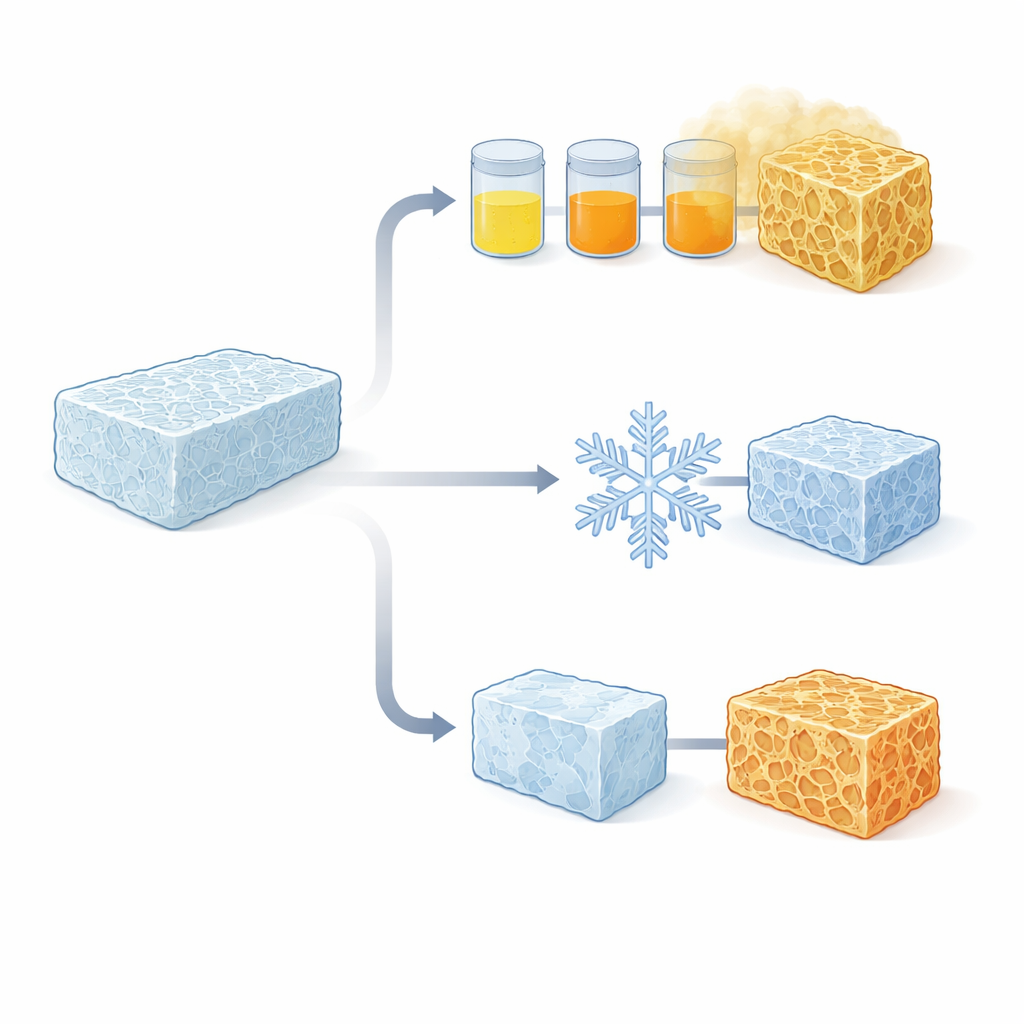
Two Gentle Routes to Dryness
In the first route, the water in the cellulose pellicles was gradually replaced with acetone, a liquid that mixes well with carbon dioxide at high pressure. The samples were then dried using supercritical carbon dioxide, a state of CO₂ that behaves like both a gas and a liquid and can remove the acetone without creating the strong liquid–vapor forces that crush tiny pores. This process produced ultralight aerogels with extremely high porosity (over 99% empty space), a large internal surface area, and a fine, uniform nanofiber network. Microscopy images showed a smooth, open, sponge-like architecture, and chemical tests confirmed that the material remained very pure.
A Simpler but Rougher Path
The second route used direct freeze-drying, or lyophilization. Instead of a separate, carefully controlled deep-freezing step, the wet cellulose sheets were briefly frozen inside the freeze-dryer itself and then dried under vacuum as ice turned directly into vapor. This simpler approach avoided extra chemicals and complicated handling, making it attractive for scale-up and sustainability. The resulting cryogels were also extremely light and more than 98% porous overall. However, detailed imaging revealed that some parts of the network had bunched-together fibers and denser patches, especially in thicker samples. The internal surface area and pore volume were roughly half those of the aerogels, showing that the nanoscale structure had partially compacted even though the bulk porosity stayed high.
Peering Inside: What the Measurements Reveal
To move beyond simple appearances, the team combined several techniques. Scanning electron microscopy mapped the fiber network, while three-dimensional confocal microscopy measured how rough or flat the surfaces were. Gas adsorption experiments quantified how much inner surface was available for gases to reach, and spectroscopic methods checked that the cellulose chemistry stayed the same. Together, these measurements showed that supercritical CO₂ drying produced the most uniform, finely textured network with a well-developed system of medium-sized pores. Freeze-dried cryogels still preserved the basic nanofiber framework and overall shape but had more irregular pores, thicker bundles of fibers, slightly lower purity, and somewhat smoother, denser surfaces in some regions. 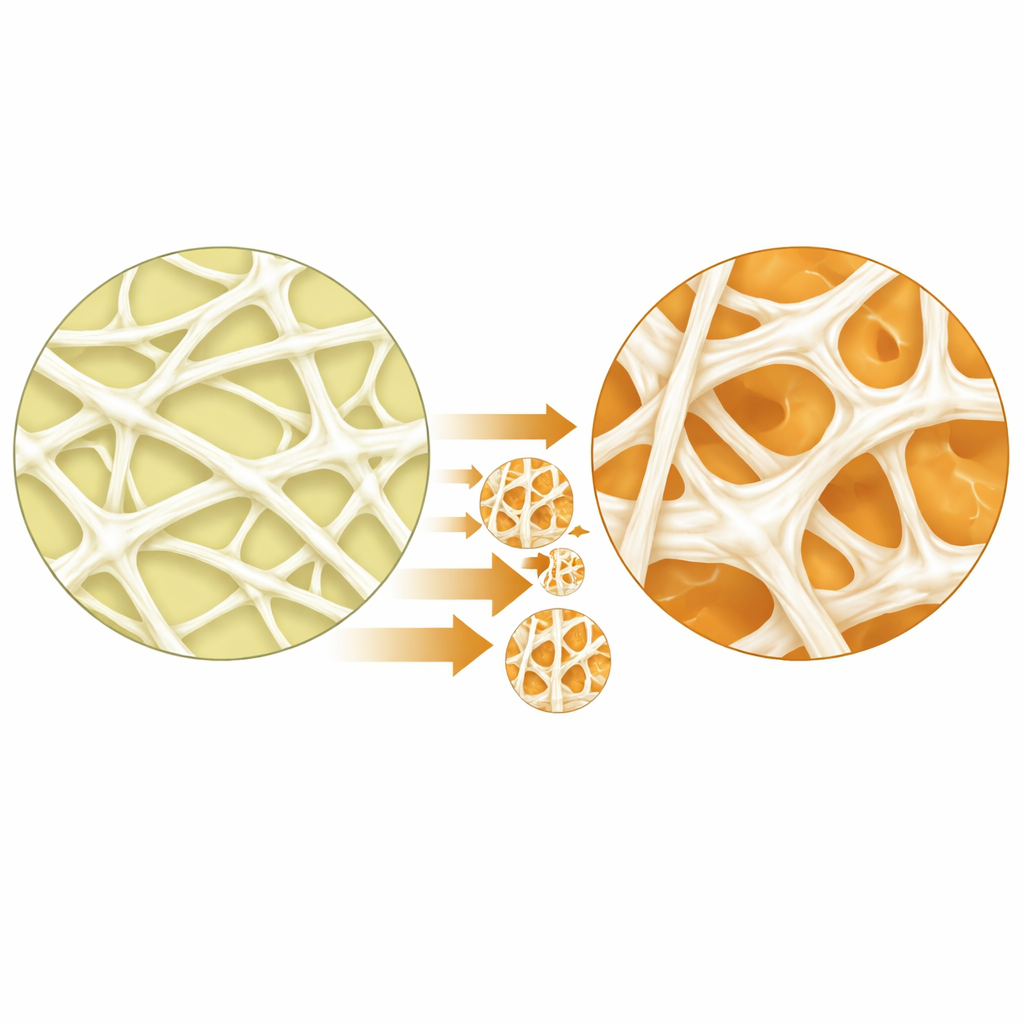
Balancing Performance and Practicality
For a lay reader, the key message is that how you dry a delicate, sponge-like material can strongly influence its hidden architecture, and therefore its performance, even when it looks similar from the outside. The supercritical CO₂ method delivers the most even and highly porous structures, ideal when precise control is needed, for example in advanced filters or insulation. Yet the simpler freeze-drying route, using no extra chemicals and straightforward equipment, still yields very light, workable materials whose internal networks are “good enough” for many uses. The authors conclude that there is no single perfect method: instead, engineers can choose between slightly better performance and greater simplicity and sustainability. This trade-off, clearly mapped out in the study, can guide the development of greener, cellulose-based materials for everyday technologies.
Citation: Sözcü, Ş., Wiener, J., Frajová, J. et al. Effect of drying methods on Acetobacter xylinum bacterial cellulose aerogels and cryogels. Sci Rep 16, 12264 (2026). https://doi.org/10.1038/s41598-026-42244-1
Keywords: bacterial cellulose, aerogels, freeze-drying, supercritical CO2, porous materials