Clear Sky Science · en
Energy management strategies for solar photovoltaic-based EV parking lots with consideration of battery degradation cost
Why smarter charging for electric cars matters
As electric vehicles become more common, the simple act of plugging in a car can quietly strain power grids and wallets. This study explores how solar-powered parking lots—places where many cars sit for hours each day—can trade energy with each other in a smart way. By coordinating when they charge, when they share surplus solar power, and how much extra wear they allow on car batteries, the researchers show it is possible to cut charging costs and make better use of clean energy.
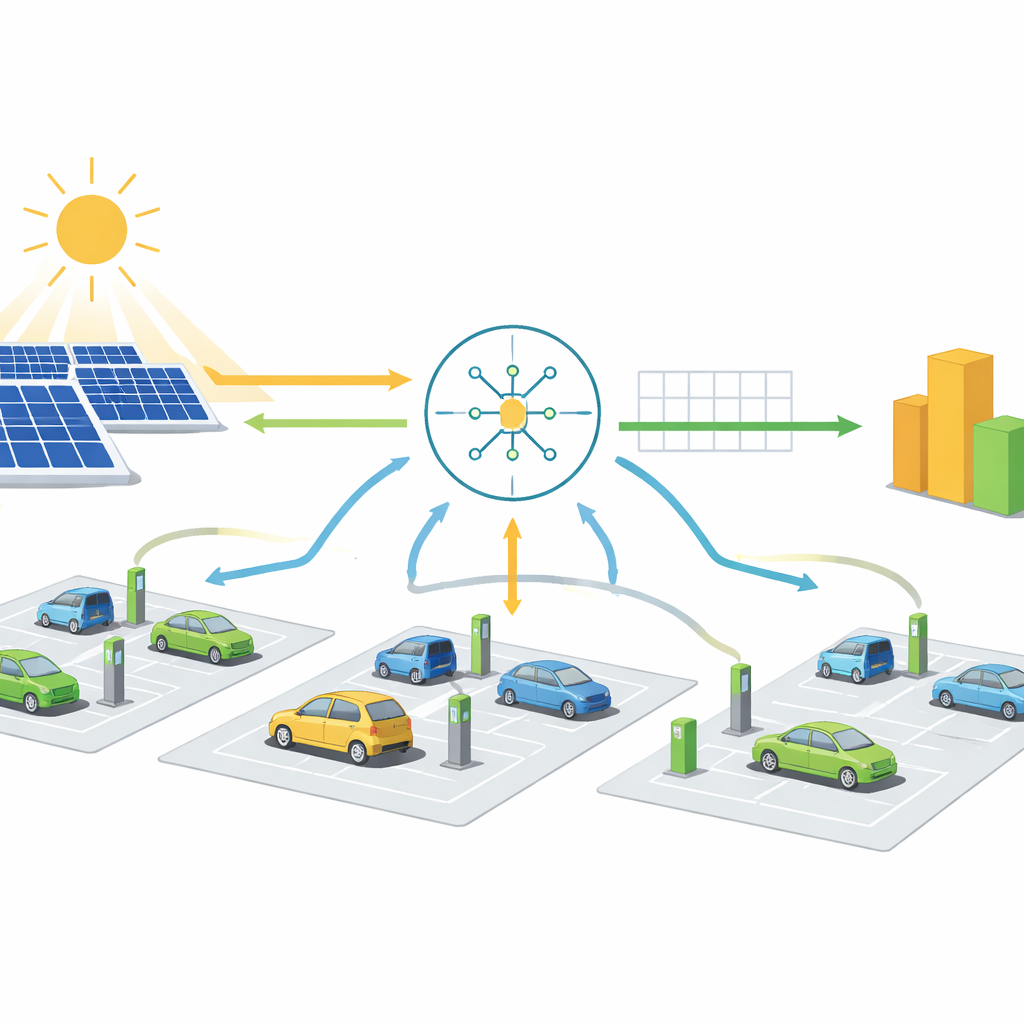
Turning parking lots into mini power hubs
The work imagines a city neighborhood with several large parking lots, each covered with solar panels and filled with parked electric cars. Instead of every lot simply buying power from the grid and selling any extra solar back at a low price, each parking lot acts like a small energy hub. It can charge cars from its own solar panels, buy or sell power to the wider grid, and trade surplus solar energy directly with other parking lots. The key idea is to manage all of this through a price-based marketplace so that energy naturally flows to where it is most valuable at any given hour.
Letting buyers and sellers bargain
To coordinate this local marketplace, the authors design a “double-sided bidding” system. Parking lots that need energy submit offers to buy; those with extra solar power or energy from plugged-in vehicles submit offers to sell. A central software agent collects these bids and clears the market: higher buying offers get served first, and lower selling offers get matched as long as both sides benefit compared with simply using the main grid. This setup keeps the agreed prices between the normal retail electricity price and the cheaper rate paid for exporting solar back to the grid, so both buyers and sellers gain from trading locally.
Planning for clouds, traffic, and battery wear
Real life is messy: sunlight changes with weather, and drivers arrive and leave at unpredictable times. The study tackles this by running its market on many possible “what if” scenarios. It uses a specialized neural network to forecast solar output, then builds several versions of the day with slightly higher or lower sunlight and charging demand. The model also estimates how much each round of charging and discharging wears down the car batteries and assigns a money cost to that wear. All of these factors are fed into a mathematical optimization engine that searches for the combination of trades and charging schedules that keeps cars charged while minimizing total cost.
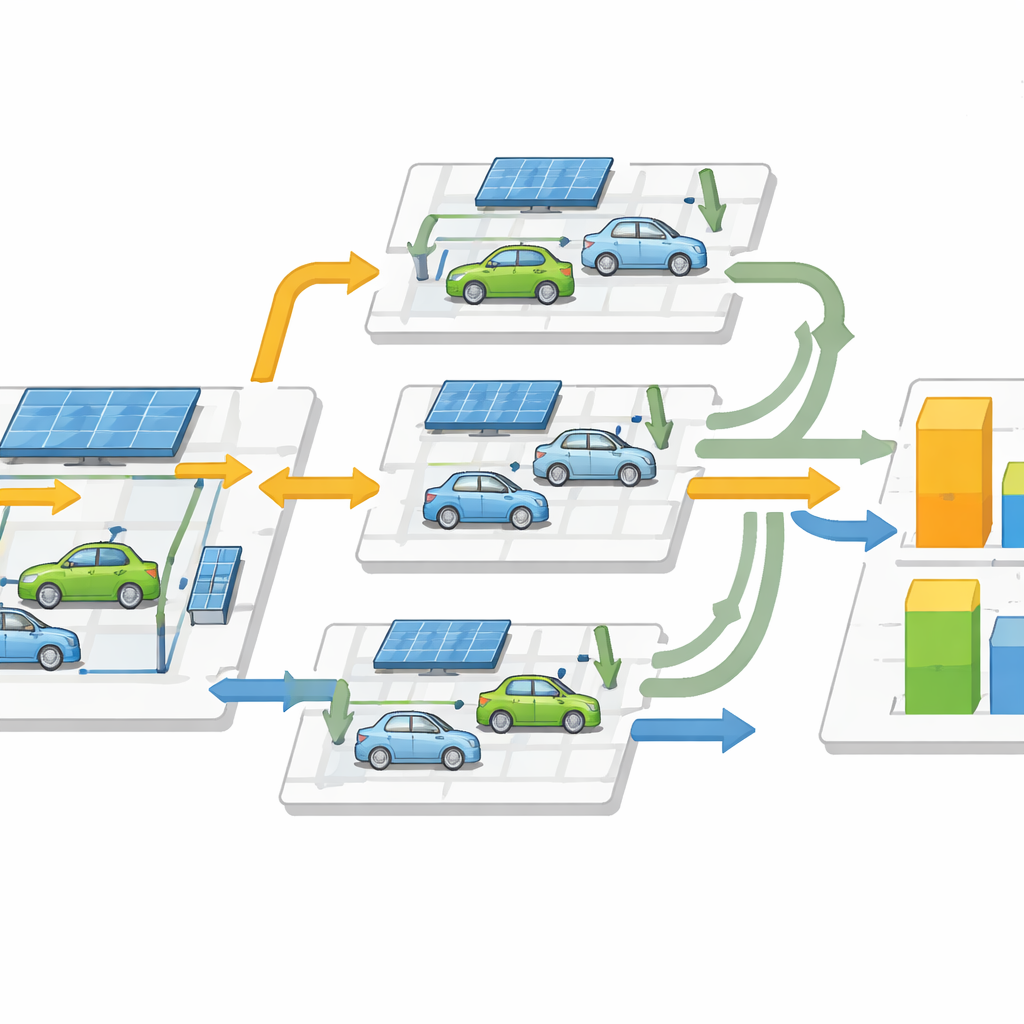
What the simulations reveal
The researchers test their approach on a standard model of an urban power network containing six large EV parking lots, each serving about one hundred cars. They compare their trading strategy with a more conventional setup where each lot simply uses its own solar panels and buys any extra power it needs from the grid. When local trading is allowed, overall charging costs fall noticeably: by about 11.8% under a dynamic pricing scheme where electricity prices change over the day, and by nearly 2% under a fixed-price scheme. Even when the assumed cost of battery wear is increased by up to 30%, the trading approach remains cheaper than the conventional case. The system also proves robust when solar output and driving patterns are varied up or down by 10%.
What this means for future charging
In plain terms, the study shows that treating solar-equipped parking lots and plugged-in cars as active participants in a local energy market pays off. By letting parking lots bargain with each other and by accounting for battery aging and weather-related uncertainty, the proposed strategy lowers charging bills and wastes less solar power. If adopted widely, similar market-based approaches could make electric driving cheaper and cleaner while easing the burden on power grids as EV numbers continue to grow.
Citation: Khan, M.O., Ahmad, F., Ali, M. et al. Energy management strategies for solar photovoltaic-based EV parking lots with consideration of battery degradation cost. Sci Rep 16, 13841 (2026). https://doi.org/10.1038/s41598-026-42238-z
Keywords: electric vehicle charging, solar parking lots, energy trading, vehicle-to-grid, battery degradation