Clear Sky Science · en
Proof-of-concept thermoelectrically cooled sow-cooling mat
Keeping Mother Pigs Comfortable in a Warming World
As summers grow hotter, pregnant and nursing mother pigs (sows) struggle to stay cool inside barns. When sows overheat, they eat less, make less milk, and their piglets grow more slowly or even die. Retrofitting entire barns with chilled water systems is costly and complicated, especially for older facilities. This study explores a simpler idea: a self-contained cooling mat that a sow can lie on, designed to pull heat out of her body using the same small solid-state devices that cool electronics.
A Simple Idea: Cool the Floor, Not the Whole Barn
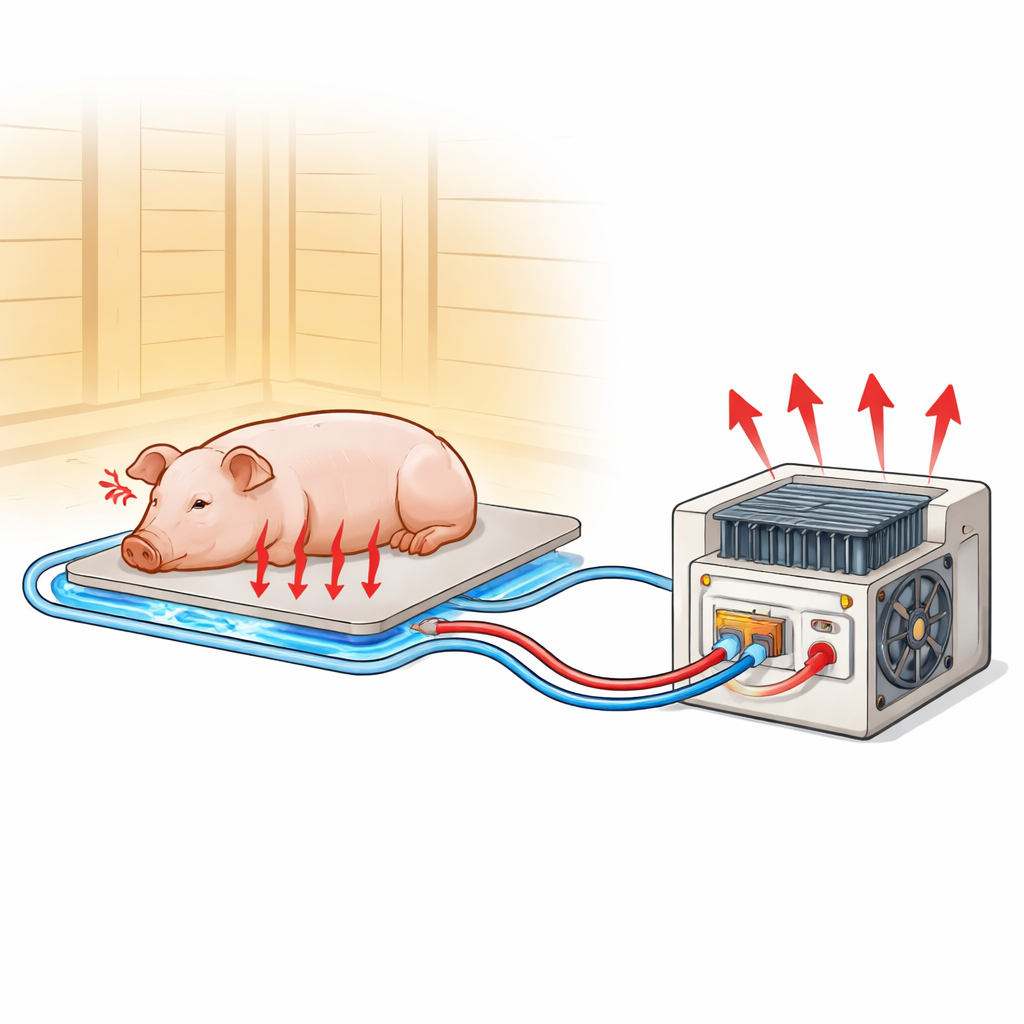
Unlike people, pigs cannot sweat well, and heavy modern sows generate a lot of heat. They spend most of their time lying down to nurse their litters, so the floor becomes a natural place to remove body heat. Earlier work showed that water-cooled metal plates can help, but these systems need chilled water piped throughout the barn. The authors set out to build a stand-alone sow-cooling mat that could be dropped into existing stalls without new plumbing. Their design circulates water under a metal tread plate where the sow lies, then cools that water using compact thermoelectric devices—known as Peltier modules—attached to a heat sink and fan assembly.
How the New Cooling Mat Was Built and Tested
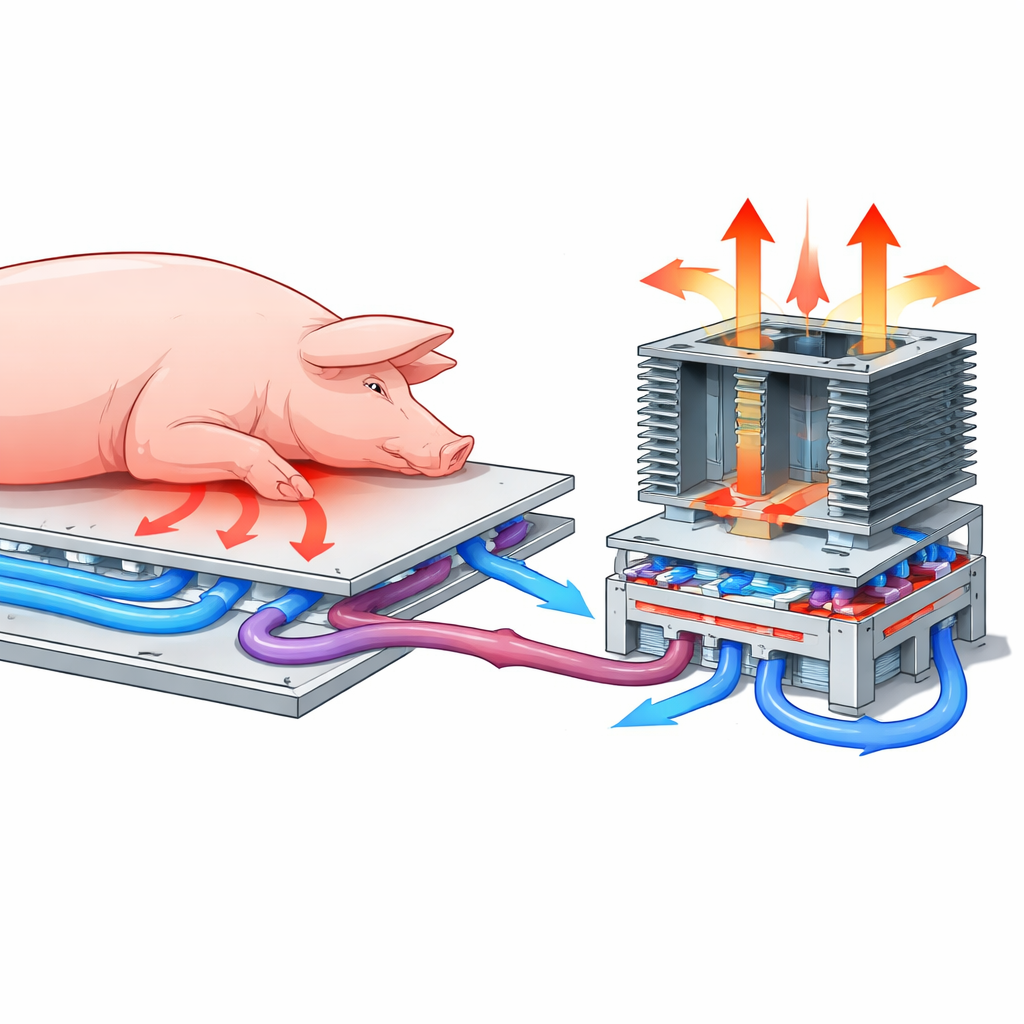
The team first identified which part of the sow’s body heated the floor most by taking thermal images of sows lying on rubber mats in a warm farrowing room. They found that the mid-abdomen and udder region was the hottest, so the aluminum mat was sized and positioned to target that area. Beneath the textured metal surface, aluminum tubing carries water in several passes. This water flows to a compact cooling unit mounted at the side of the stall. Inside that unit, Peltier modules pull heat from a cold metal plate in contact with the water, send it into a finned heat sink, and fans blow the warmed air into the room. Because the system is localized, it cools the sow directly without needing to chill the whole barn.
Real-Barn Trials with Heat-Stressed Sows
The researchers ran two small trials in a farrowing room, each using one sow with a cooling mat and one nearby sow without a mat as a control. In both trials, the mat operated during hot weather while temperatures and water flows were continuously recorded. The mat removed on the order of 366–395 watts of heat using about 110 watts of electrical power, giving a coefficient of performance similar to or better than some earlier water-based floor-cooling systems. Under typical assumptions about sow heat production, the mat could remove a large share of the heat produced by a 260-kilogram sow. Some signs were encouraging: in one trial, the cooled sow maintained body weight better and her piglets weaned at a higher average weight. However, because there was only one sow per treatment, differences in body temperature, breathing rate, and feed intake could not be interpreted as firm proof of benefit.
Controlled Chamber Tests to Probe the Details
To better understand how the mat behaves without the complexities of a working barn, the team moved it to a climate-controlled chamber set at a hot, humid summer condition. Instead of a live animal, they used two electric heating pads to mimic a sow’s body heat. They ran two scenarios: one with the bottom of the mat exposed to the chamber air, and one with the bottom insulated. In both cases, when the cooling unit was switched on, the mat surface and water temperatures dropped quickly. With the bottom insulated, the mat surface cooled by nearly 12 degrees Celsius compared to about 5 degrees without insulation, because less heat leaked into the room. The overall heat removal in these chamber tests was lower than in the barn, simply because the artificial heat source was smaller than a real sow.
What This Means for Farmers and Animals
This proof-of-concept study shows that a stand-alone, thermoelectrically cooled mat can pull substantial heat from the area where a sow’s body contacts the floor, using modest electrical power and without requiring chilled water lines. The mat delivered cooling performance in the same range as more complex chilled-water plates while fitting easily into existing stalls. Early signs suggest it may help maintain sow body condition and support piglet growth, but the animal-welfare results are still mixed and based on too few animals to be conclusive. The authors conclude that larger, replicated field trials are needed to confirm whether this technology can reliably improve sow comfort, productivity, and piglet performance—and to refine the design through modeling so it can be practical for everyday farm use.
Citation: Pan, J., Shah, S.B., Leonard, S.M. et al. Proof-of-concept thermoelectrically cooled sow-cooling mat. Sci Rep 16, 11821 (2026). https://doi.org/10.1038/s41598-026-42237-0
Keywords: sow cooling, heat stress, thermoelectric mat, pig welfare, barn climate