Clear Sky Science · en
Task-specific compensatory joint control strategies in adolescent idiopathic scoliosis during dynamic balance tasks
Why teen spine balance matters
Many teenagers with scoliosis live active, everyday lives, yet their curved spines quietly change how their whole body keeps its balance. This study looks beneath the surface to see how different joints – from the neck to the ankles – work together when young people with adolescent idiopathic scoliosis (AIS) stand on an unstable surface. By comparing them with peers who do not have scoliosis, the researchers show that teens with AIS keep their balance in a more widespread, effortful way, which may have long-term consequences for comfort, fatigue, and joint health.
How the study was set up
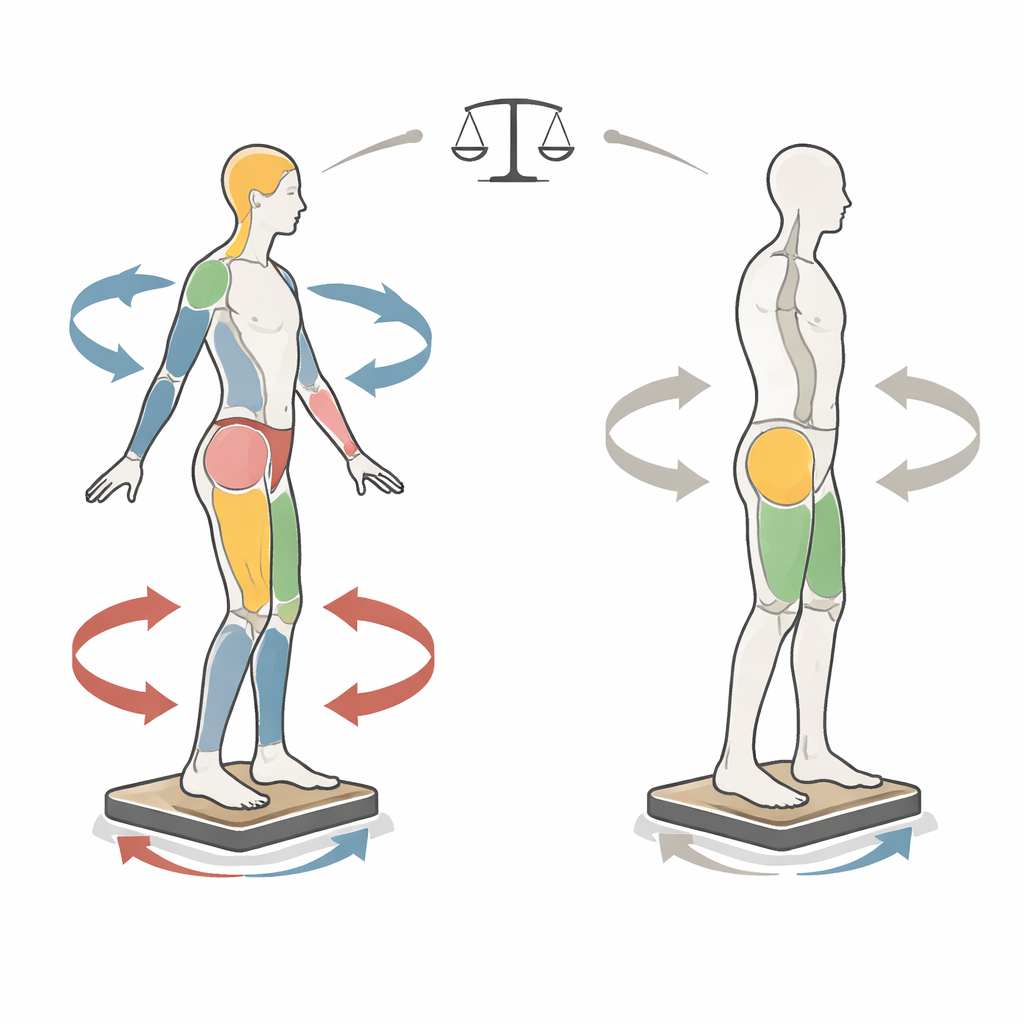
The researchers recruited 35 young adults with a history of adolescent-onset scoliosis and 29 similar-aged students without spinal curves. Everyone stood barefoot on a moving platform that could rock front-to-back and side-to-side. A force plate beneath their feet tracked tiny shifts in the pressure under their soles – a standard way of measuring how steady someone is while balancing. At the same time, small wearable motion sensors were strapped to multiple body segments, including the head and neck, chest, shoulders, elbows, pelvis, hips, knees, and ankles. These sensors recorded how far each joint moved, how different the left and right sides were, and what average posture each segment adopted during short, 10‑second balance trials.
What the researchers measured
To judge balance performance, the team focused on two main numbers: how far the body’s pressure point wandered away from a target line on the screen, and how much that point wobbled overall. Larger values meant poorer control. From the joint sensors, they calculated the range of motion, the side-to-side asymmetry, and the average angle for each joint. They then used statistical tools to compare scoliosis and control groups, and – more importantly – to see how strongly each joint’s behavior was linked to balance quality. Rather than looking only for big, obvious differences in how much joints moved, the scientists examined patterns of coordination: which body parts tended to "move together" with changes in balance stability.
Many joints working harder in scoliosis
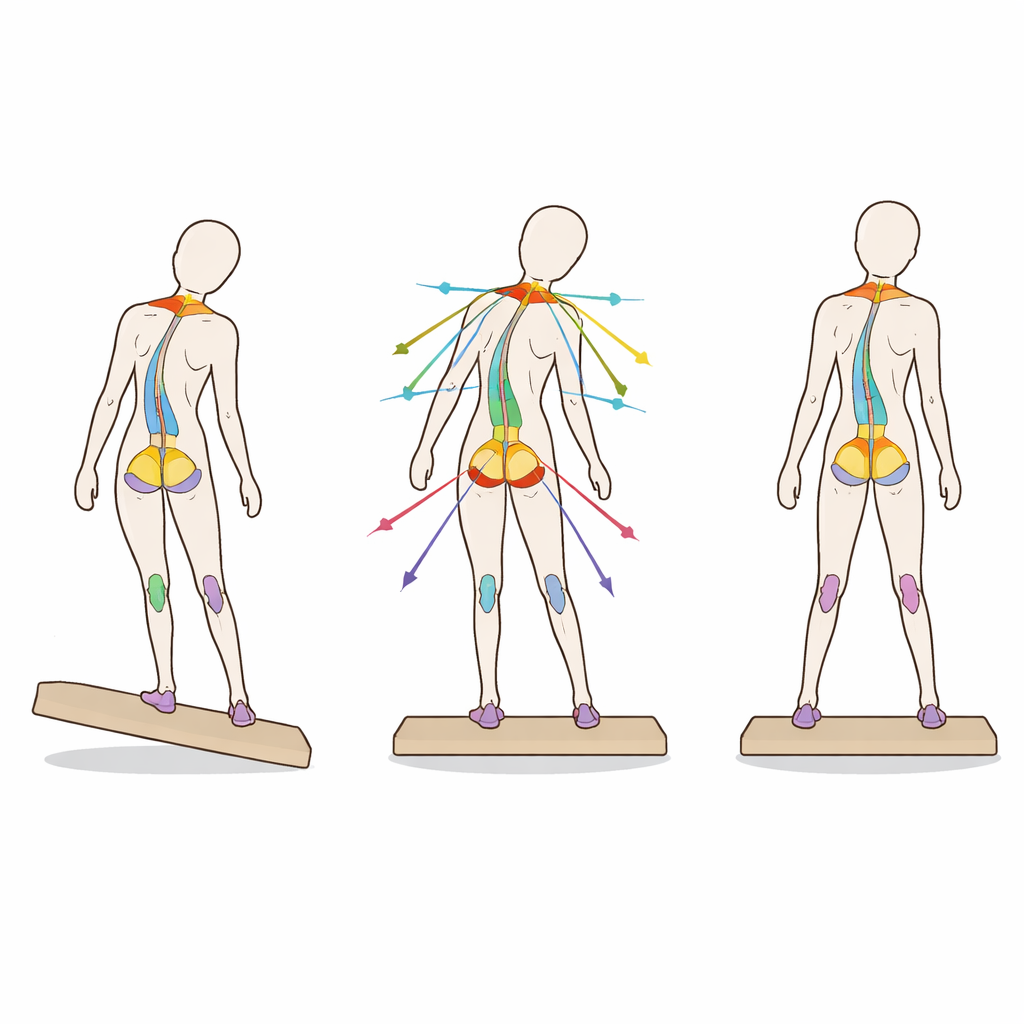
As expected, the scoliosis group showed less accurate and more variable balance than their peers, especially when the platform moved side-to-side. Surprisingly, however, most single-joint differences were small once strict statistical corrections were applied. The real contrast appeared in how widely different joints were tied to balance performance. During front-to-back tasks, only one joint–balance link stood out in each group. But during side-to-side tasks, teens with scoliosis showed 52 significant connections between joint motion and balance measures, spanning the neck, shoulders, elbows, pelvis, hips, knees, and ankles. In the control group, only seven such links appeared, concentrated mainly at the hips and pelvis. This suggests that, in AIS, many more body segments are recruited to keep lateral balance under control.
What this means for the body
The pelvis emerged as a key hub in both groups, acting as the bridge between the spine and the legs during side-to-side balance. But young people with scoliosis seemed to lean more heavily on pelvic adjustments, and at the same time called in extra help from the neck, shoulders, arms, and lower legs. Their upper spine and head positions were more tightly tied to balance, hinting that they use head and neck motion to fine-tune posture when trunk stability is limited. The legs also showed a more "chain‑like" involvement from hips down to ankles in AIS, indicating that when core control is reduced, the body spreads the workload along the limb. While this widespread recruitment helps them stay upright, it likely costs more energy and may place extra strain on joints and muscles far from the spine.
Why these findings matter for care
In plain terms, teens and young adults with scoliosis can keep their balance, but they do so by asking many more joints to help, especially in side-to-side situations. This distributed strategy is adaptive – it prevents falls – yet it is also inefficient and could contribute to fatigue or discomfort over time. The study suggests that exercise and rehabilitation for AIS should look beyond the spine alone. Training that improves coordination between the head, trunk, pelvis, and hips, and that specifically challenges side-to-side balance, may help reduce the extra burden on the shoulders, arms, knees, and ankles. By understanding how the whole body works together in scoliosis, clinicians can design more targeted, whole-person approaches to protect posture and movement as these young people grow into adulthood.
Citation: Wang, D., Tsang, R., Li, Q. et al. Task-specific compensatory joint control strategies in adolescent idiopathic scoliosis during dynamic balance tasks. Sci Rep 16, 14217 (2026). https://doi.org/10.1038/s41598-026-42234-3
Keywords: adolescent idiopathic scoliosis, balance control, joint coordination, wearable motion sensors, postural compensation