Clear Sky Science · en
Breakup of strong cratonic lithosphere causes extensive magmatism at continental margins
Why continents sometimes erupt at their edges
When continents slowly tear apart, the process can be surprisingly explosive. Some newborn ocean margins are lined with thick piles of lava, while others are almost magma‑free. This paper explores why those differences occur and argues that the hidden strength of Earth’s outer shell—the rigid “lid” beneath continents—can be just as important as hot mantle plumes rising from below. Understanding this helps explain dramatic volcanic episodes in Earth’s past and guides how we read today’s geological and geophysical records.
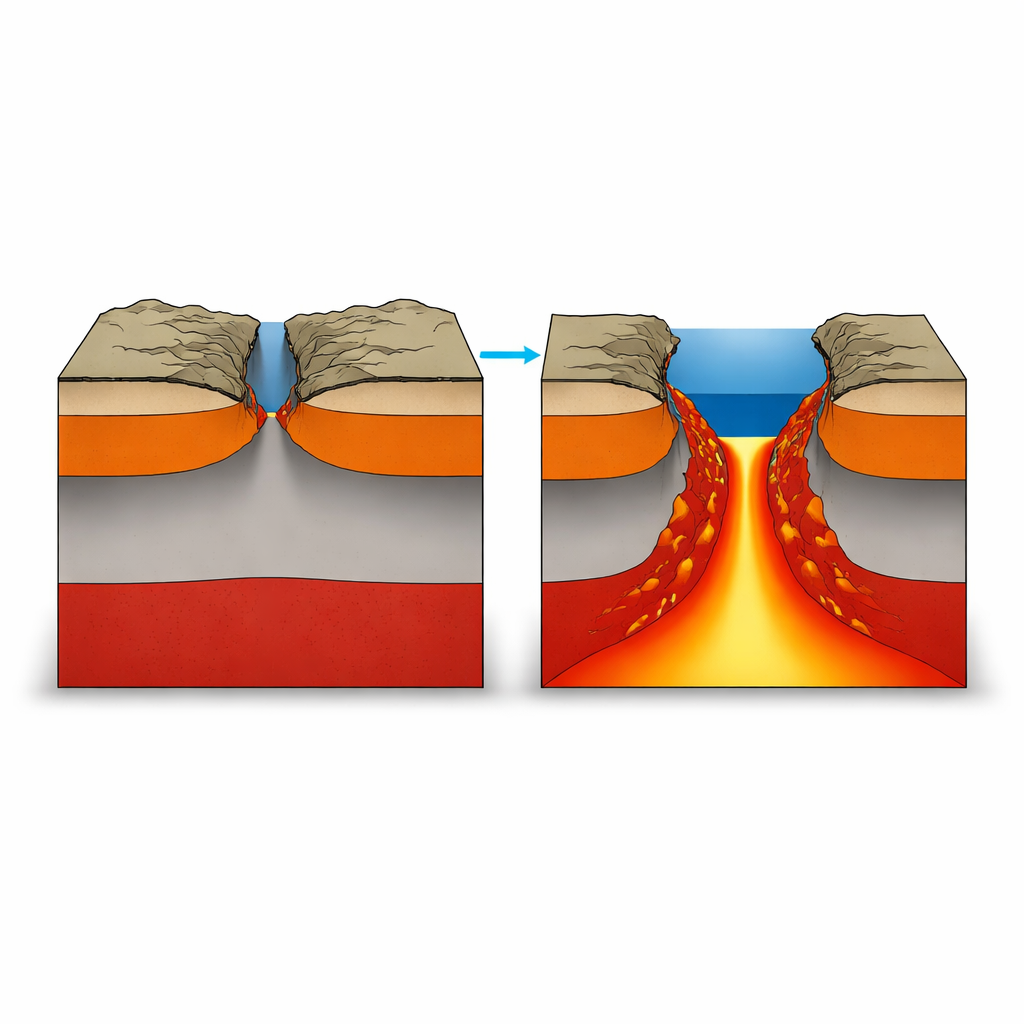
How continents break and why lava appears
As a continent stretches, the rocky crust and underlying rigid shell gradually thin until they split, forming a new ocean basin. As this happens, hot, softer rock from deeper inside the Earth rises to fill the gap and partially melts, producing magma. For decades, geologists have mainly blamed unusually hot regions in the mantle, called plumes, for the most extreme outpourings of lava along these rifts. Yet there are many volcanic margins and giant lava plateaus that do not sit above obvious plumes, that show only normal mantle temperatures, or that change abruptly from lava‑rich to lava‑poor over short distances. These puzzles suggest that something else must be controlling how much magma is made.
The hidden role of a strong continental lid
The authors focus on the mechanical strength of the lithosphere, the stiff outer shell that includes the crust and the uppermost mantle. In ancient continental cores, called cratons, this shell is unusually thick and strong, like a heavily reinforced beam. Using two‑dimensional computer models that couple rock flow, temperature, and melting, they compare rifting in a typical, weaker continent with rifting in a thick, cratonic lid. In the weaker case, stretching is spread out, the rift margins are broad and gently sloping, and magma production slowly increases to levels similar to normal oceanic crust. In contrast, when the lid is strong and thick, stretching localizes into a narrow valley bordered by very high shoulders, and the eventual breakup happens quickly and dramatically.
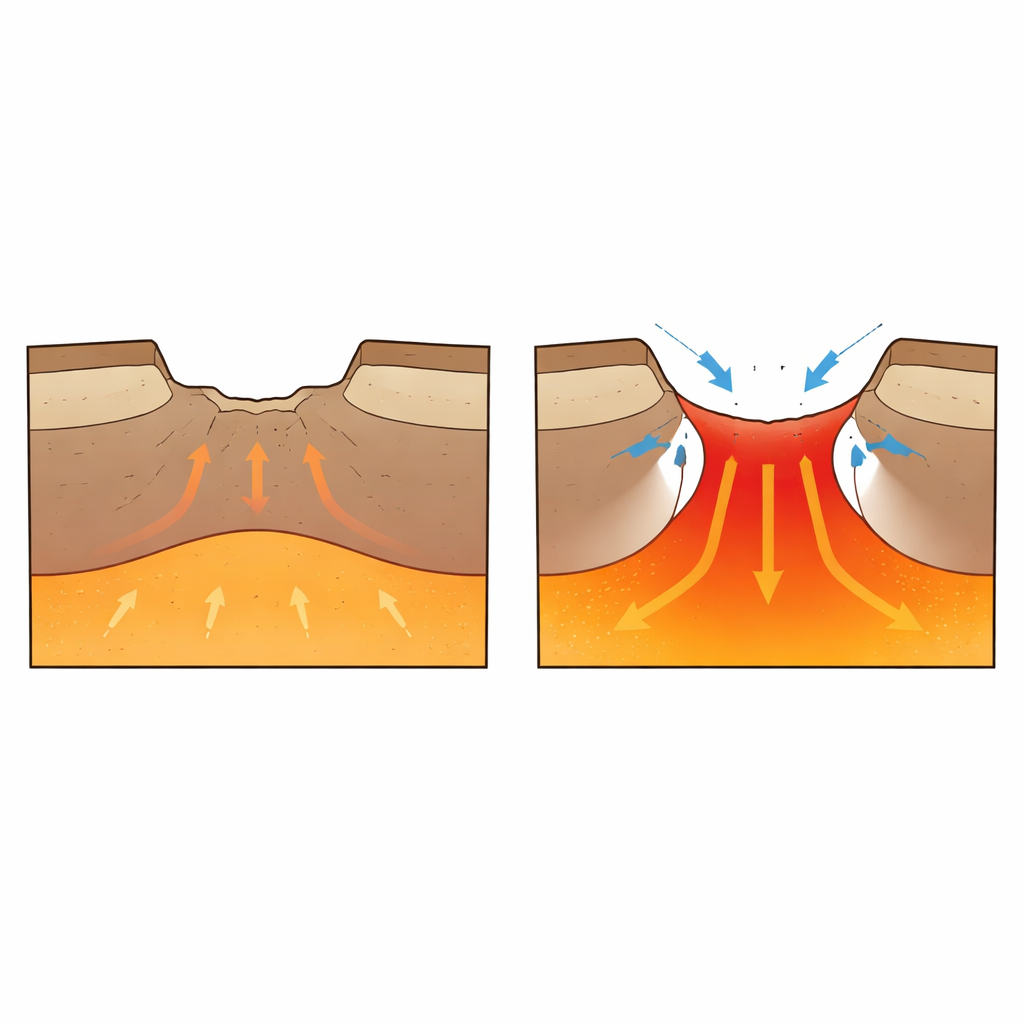
A brief volcanic burst driven from above, not below
In the strong‑lid scenario, the models reveal a short but intense surge of magma right as the continent finally splits. The key is the behavior of the tall rift shoulders. While the continent is still intact, these high flanks are held up by the flexural strength of the lithosphere, much like a bent but unbroken ruler. At the moment of breakup, that support fails and the shoulders suddenly sag toward the new ocean basin. Their rapid downward motion acts like a pump, drawing hot, soft mantle upward beneath the rift at speeds far greater than the slow horizontal stretching alone. This enhanced upwelling pushes more material across the pressure conditions where it can melt, briefly producing a very thick layer of new igneous crust without requiring any extra heat or special mantle chemistry.
Clues from the North Atlantic gateway
The Labrador Sea–Baffin Bay region between Greenland and northeastern Canada offers a real‑world test of this idea. Along this boundary, the northern segments are volcanic, with abundant lava flows and intrusions, while the southern segments are relatively magma‑poor. Independent seismic studies show that the northern part undercuts old, thick cratonic roots, whereas the southern part lies within younger, thinner, and weaker lithosphere. Estimated uplift and subsidence histories on the Greenland and Baffin Island margins record an episode of late rift‑stage uplift followed by rapid sinking and volcanism in the north, but not in the south. The size of the volcanic pile there also matches what the models predict for a strong, cratonic lid with only modest, if any, extra mantle heating. This pattern is hard to explain with a simple plume model but follows naturally from strength‑controlled rifting.
Rethinking giant volcanic events at continental edges
By tying magma production to lithospheric strength, the study offers a new lens for viewing Large Igneous Provinces and volcanic continental margins formed during supercontinent breakup. It suggests that when rifting cuts through strong, thick cratons, the collapse of high rift flanks can by itself generate large but short‑lived volcanic outbursts, and that the extra mantle heating traditionally invoked may be smaller than assumed—or in some cases unnecessary. For a lay reader, the takeaway is that not all dramatic eruptions at continent edges need a deep, focused plume; sometimes, the way the rigid outer shell bends and breaks is enough to wring magma from the mantle in a sudden burst.
Citation: Wang, S., Leng, W. Breakup of strong cratonic lithosphere causes extensive magmatism at continental margins. Sci Rep 16, 12978 (2026). https://doi.org/10.1038/s41598-026-42222-7
Keywords: continental rifting, volcanic margins, cratonic lithosphere, large igneous provinces, Labrador Sea Baffin Bay