Clear Sky Science · en
Effect of inclusions on polished Si removal mechanism via MD
Why tiny flaws in silicon matter
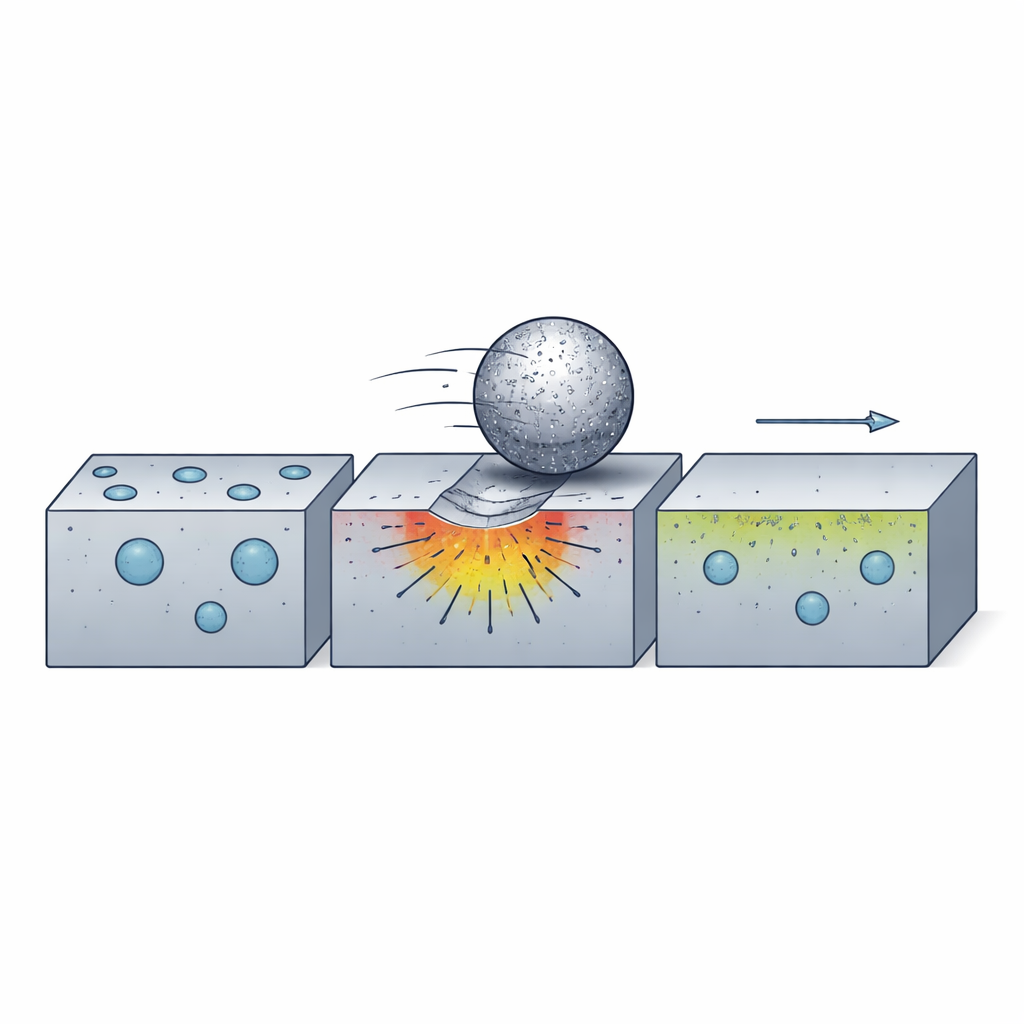
From smartphones to solar panels, many modern gadgets rely on silicon crystals polished so smoothly that even tiny bumps can spell trouble. Yet real silicon is never perfect: it contains hard specks of other materials, called inclusions, buried beneath the surface. This study uses computer simulations at the atomic scale to ask a practical question with big technological impact: when we polish silicon with these hidden specks inside, do they quietly help the process, or do they secretly damage our chips?
Looking inside polishing one atom at a time
The researchers built a virtual polishing experiment using molecular dynamics, a method that follows the motion of hundreds of thousands of atoms step by step. They modeled a block of single-crystal silicon containing one circular inclusion made of silicon carbide—a very hard compound commonly found as a defect in real wafers. Above this block, they placed a rigid diamond particle that slides and spins across the surface, mimicking nano-scale polishing used to make ultra-flat, ultra-smooth components.
Tuning the size of hidden specks
To see how defect size matters, the team changed only one thing in their simulations: the diameter of the circular inclusion, from 3 to 5 nanometers (a nanometer is a billionth of a meter). They then tracked a rich set of quantities during polishing: the forces on the diamond, the friction between tool and silicon, the local temperature, the energy stored in the crystal, and the creation and healing of defects under the surface. Because the model followed individual atoms, the researchers could watch how the orderly silicon lattice warped, broke, and in some cases re-formed as the abrasive swept by.
How inclusions reshape damage and friction
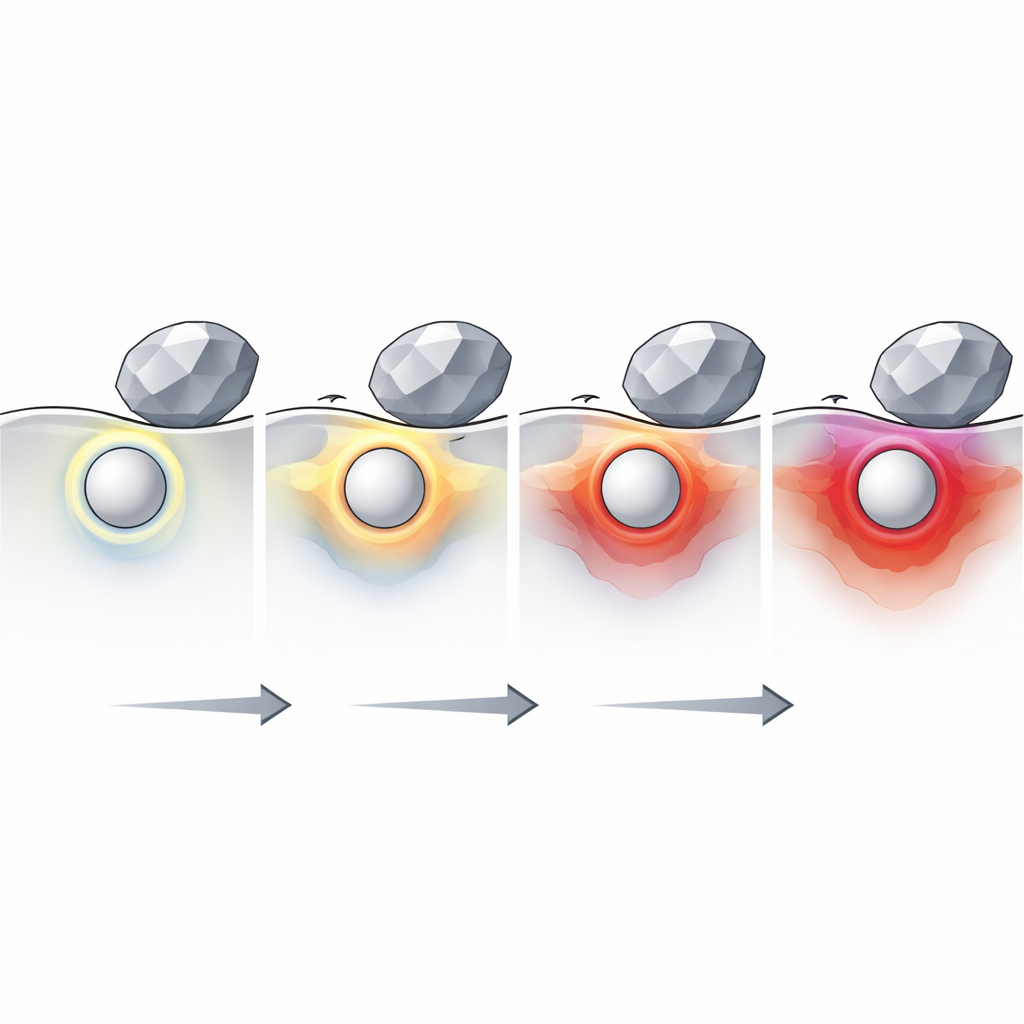
The simulations revealed a subtle picture. Larger inclusions concentrated more stress in the surrounding silicon, creating a deeper zone of subsurface damage and disturbing more of the material’s original diamond-like atomic pattern. They also raised the polishing and normal forces, which in turn increased friction. However, these hard specks did not significantly alter the overall temperature profile of the process, because most of the heat still came from the rubbing and squeezing between the diamond and the silicon surface as a whole.
Surprising help from small imperfections
At the same time, the presence of inclusions changed the types of defects that formed. Many atoms transformed into a slightly distorted, five-fold coordinated state that tends to cluster around and beneath the inclusion. Larger inclusions produced more of these atoms but surprisingly fewer of the highly compressed, severely distorted states that are usually linked to poor surface quality. In some conditions, small inclusions around 3 nanometers did not increase friction at all compared with a flawless crystal and even showed more favorable sliding behavior. The simulations also uncovered an “annihilation–regeneration” pattern in the tiny dislocation lines—thread-like defects in the crystal—that first disappeared as the surface elastically recovered and then reappeared as polishing progressed, especially when inclusions were bigger.
Balancing smoothness and hidden stress
Overall, the study shows that buried hard specks in silicon are not always bad news. Large inclusions do deepen hidden damage and disrupt the crystal more strongly, but they can also limit the worst high-pressure states and promote recovery of some defects after polishing. Smaller inclusions can maintain good surface quality and acceptable friction, suggesting that deliberately managing the size and distribution of such defects could become a new “knob” for engineers. By revealing how inclusions steer stress, friction, and damage at the atomic level, this work offers guidance for designing polishing processes that deliver smoother, more reliable silicon components despite the imperfections they inevitably contain.
Citation: Yue, H., Tang, S., Chen, X. et al. Effect of inclusions on polished Si removal mechanism via MD. Sci Rep 16, 12106 (2026). https://doi.org/10.1038/s41598-026-42219-2
Keywords: silicon polishing, molecular dynamics, crystal defects, silicon carbide inclusions, ultra-precision machining