Clear Sky Science · en
Enhancing interfacial bond performance of waste textile-reinforced geopolymer mortar for masonry retrofitting
Turning Old Clothes into Stronger Walls
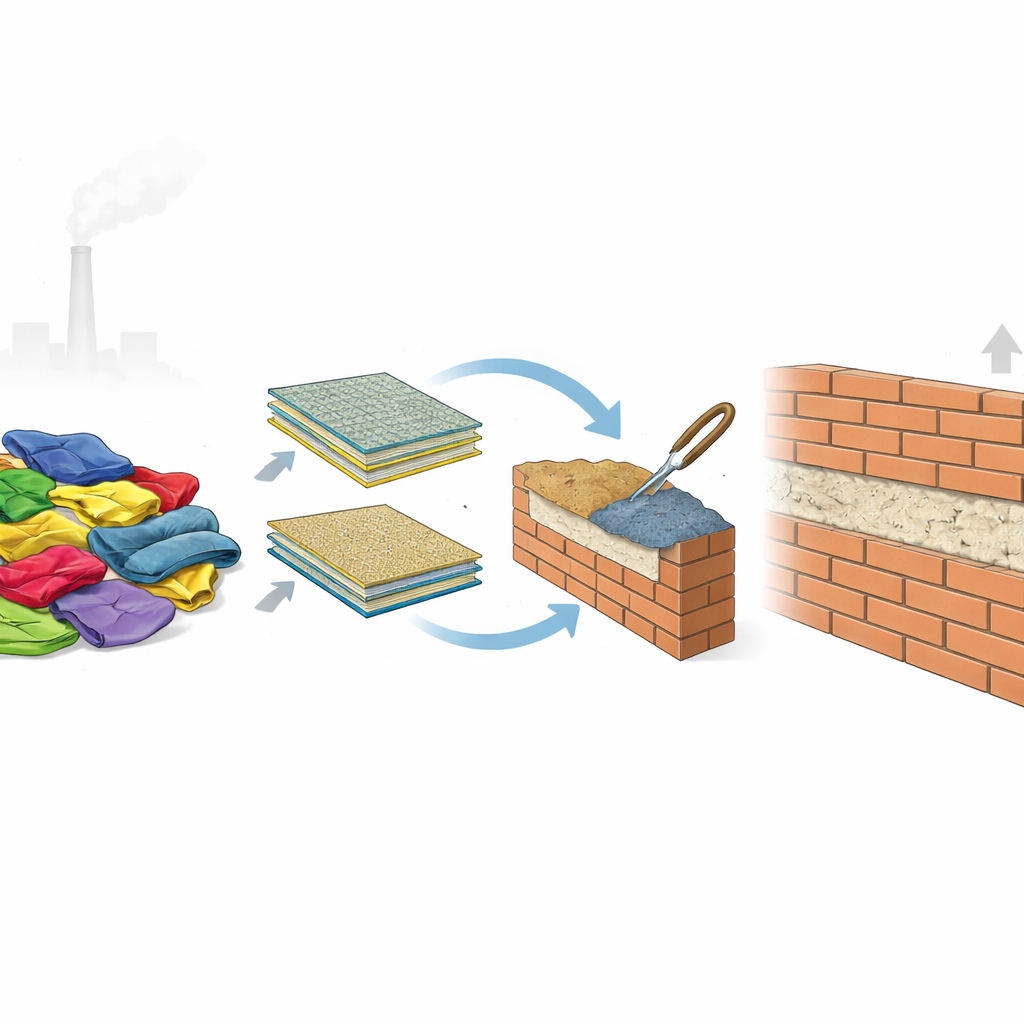
Every year, tens of millions of tons of clothing end up as waste, while the cement used to build our homes and bridges is responsible for a large share of global carbon emissions. This study explores an unexpected way to tackle both problems at once: using discarded fabric, strengthened with a thin resin coating, together with a low‑carbon "geopolymer" mortar to reinforce brick walls. The work shows how waste textiles can be transformed from a landfill burden into a high‑performance material for making old masonry buildings safer and more durable.
Why Brick Walls Need a Helping Hand
Brick and block masonry has formed the backbone of buildings for thousands of years, prized for its durability and ability to carry heavy loads. Traditionally, the bricks are glued together with a cement-based mortar made from Portland cement, sand, and water. While effective, Portland cement is very energy‑hungry to manufacture and accounts for roughly 8% of global carbon dioxide emissions. At the same time, conventional mortars and older brickwork can struggle under earthquakes or other extreme loads, so engineers increasingly look for ways to strengthen existing walls without rebuilding them from scratch.
Giving Waste Fabrics a New Job
In parallel with these structural challenges, the world is drowning in textile waste, with more than 90 million tonnes produced each year. The researchers set out to turn part of this waste stream into a useful reinforcement for masonry. They took polyester–cotton fabric similar to everyday clothing and either left it as‑is or coated it with a carefully measured amount of epoxy resin using a brushing technique. This thin coating stiffens the fabric, improves how it grips the surrounding mortar, and helps the individual threads work together when they are pulled.
A Greener Glue for Bricks
Instead of relying only on ordinary cement mortar, the team also developed an alternative binder called geopolymer mortar. Geopolymers are made from industrial by‑products such as fly ash and blast furnace slag, which are activated by alkaline solutions rather than by the usual cement chemistry. These mixes can achieve high strength, resist heat and chemicals, and significantly reduce carbon emissions. The researchers prepared geopolymer mortars at three different chemical strengths—called 8M, 10M, and 12M—alongside a conventional cement mortar, and embedded strips of both untreated and resin‑treated textiles within them to form reinforced brick specimens.
How the New System Was Tested
To understand how well the fabric and mortar worked together, the team measured both the basic strength of the mortars and, crucially, how strongly the textiles bonded to the masonry. They cast small cubes and prisms to assess compressive and bending strength, finding that higher‑strength geopolymer mixes generally outperformed the traditional cement mortar, especially at later ages. For the bond behavior, they used a single‑lap shear test: part of each textile strip was glued between mortar layers on a brick surface, while the free end was pulled by a testing machine. By recording the force and the amount of sliding of the textile, they could see how effectively the mortar gripped the fabric and how the system failed.
What Happened When the Fabrics Were Pulled
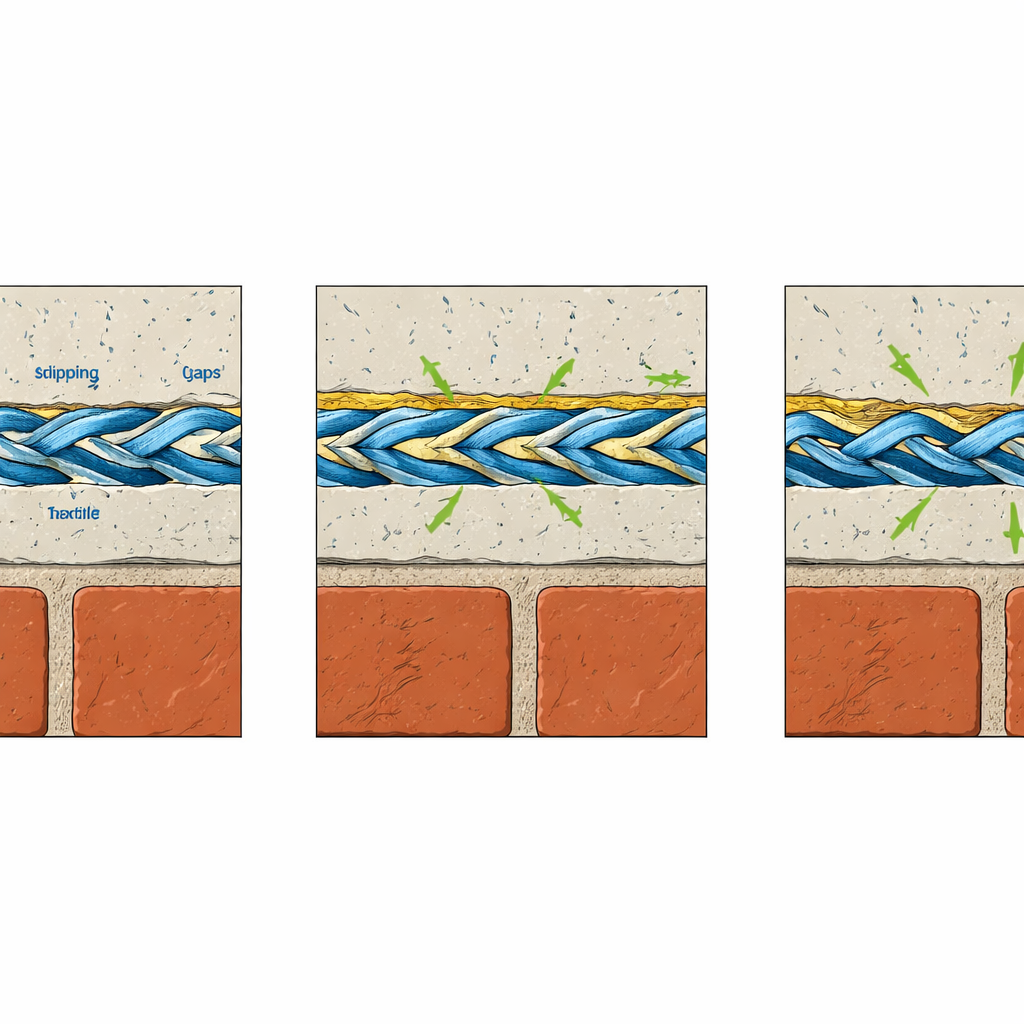
The results showed a clear advantage for the resin‑treated textiles. In all types of mortar, treated fabrics carried much higher tensile stresses—about 48 to 60% more—before breaking. At the same time, the amount of slip between fabric and mortar at peak load was cut roughly in half, from around 9–9.5 mm for untreated textiles to about 4.3–4.8 mm for treated ones. In practical terms, this means the improved interface allows the fabric to engage more fully and share the load instead of simply sliding out. Notably, every specimen failed by rupture of the textile within the bonded zone, while the mortar and brick remained firmly attached, a desirable mode that shows the connection between layers is stronger than the fabric itself.
Finding the Sweet Spot in the New Mortar
Among the geopolymer mixes, the 10M version offered the best overall balance. It was strong and dense enough to anchor the fabric firmly, but still workable enough that the mortar could flow into the gaps between threads and around the resin‑coated bundles. The highest‑strength 12M mix gave excellent basic strength but was stiffer and more brittle, which slightly limited further gains in bond performance. Even so, the resin‑treated textiles in all geopolymer mortars developed bond strengths and efficiency comparable to, or better than, many systems that rely on expensive high‑tech fibers such as carbon or basalt.
What This Means for Buildings and Waste
For non‑specialists, the bottom line is straightforward: by lightly coating waste fabrics and embedding them in a greener type of mortar, engineers can significantly boost the strength and reliability of brick walls while reusing materials that would otherwise be thrown away. The strengthened walls deform in a controlled way, with the fabric working to its full capacity before breaking, and the brick–mortar connection staying intact. This approach hints at a future where upgrading aging masonry for earthquakes or general wear need not depend on high‑carbon cement or costly synthetic fibers. Instead, carefully engineered combinations of industrial by‑products and discarded textiles could offer a safer, more sustainable path to keeping our built heritage standing.
Citation: Sai Krishna, A., VishnuPriyan, M. & Khan, N.A. Enhancing interfacial bond performance of waste textile-reinforced geopolymer mortar for masonry retrofitting. Sci Rep 16, 11513 (2026). https://doi.org/10.1038/s41598-026-42217-4
Keywords: geopolymer mortar, waste textiles, masonry retrofitting, textile reinforcement, sustainable construction