Clear Sky Science · en
A real-world retrospective analysis comparing the effectiveness of Azvudine and Nirmatrelvir/Ritonavir in COVID-19 patients with diabetes
Why this research matters to people with diabetes
For people living with diabetes, catching COVID-19 has often meant facing a higher chance of landing in intensive care or even dying. Doctors in China now have two main pills to offer—Azvudine and a combination drug called Nirmatrelvir/Ritonavir—but it has not been clear which works better for patients who also have diabetes. This study looks back at the real experiences of hundreds of such patients in several hospitals to see how these medicines compare in everyday practice, beyond the controlled setting of a clinical trial.

Who was studied and what the doctors did
The researchers examined medical records from six hospitals in the Guangxi region of China during a major COVID-19 wave between December 2022 and January 2023. Out of more than 13,000 adults with COVID-19, they focused on 400 patients who also had type 2 diabetes, were in stable condition when admitted, and received either Azvudine or Nirmatrelvir/Ritonavir. Most of these people were older than 65 and had other health problems such as heart or lung disease. Doctors chose which drug to prescribe based on each patient’s overall health, kidney and liver function, possible drug interactions, cost, and medicine availability. Everyone had their blood sugar managed with insulin during their hospital stay.
How the comparison was made
Because this was not a randomized trial, the two groups of patients were different in important ways at the start—especially in age and how sick their lungs and other organs already were. To make the comparison fairer, the team used a statistical technique called propensity-score matching. This method pairs patients from each drug group who look similar in terms of age, sex, other diseases, and lab results. After matching, 185 patients remained for the main analysis. The researchers then tracked whether patients died, needed intensive care, or required a breathing machine. They also checked for fresh complications such as heart damage, heart failure, kidney injury, and severe breathing problems.
What the study found about risks and benefits
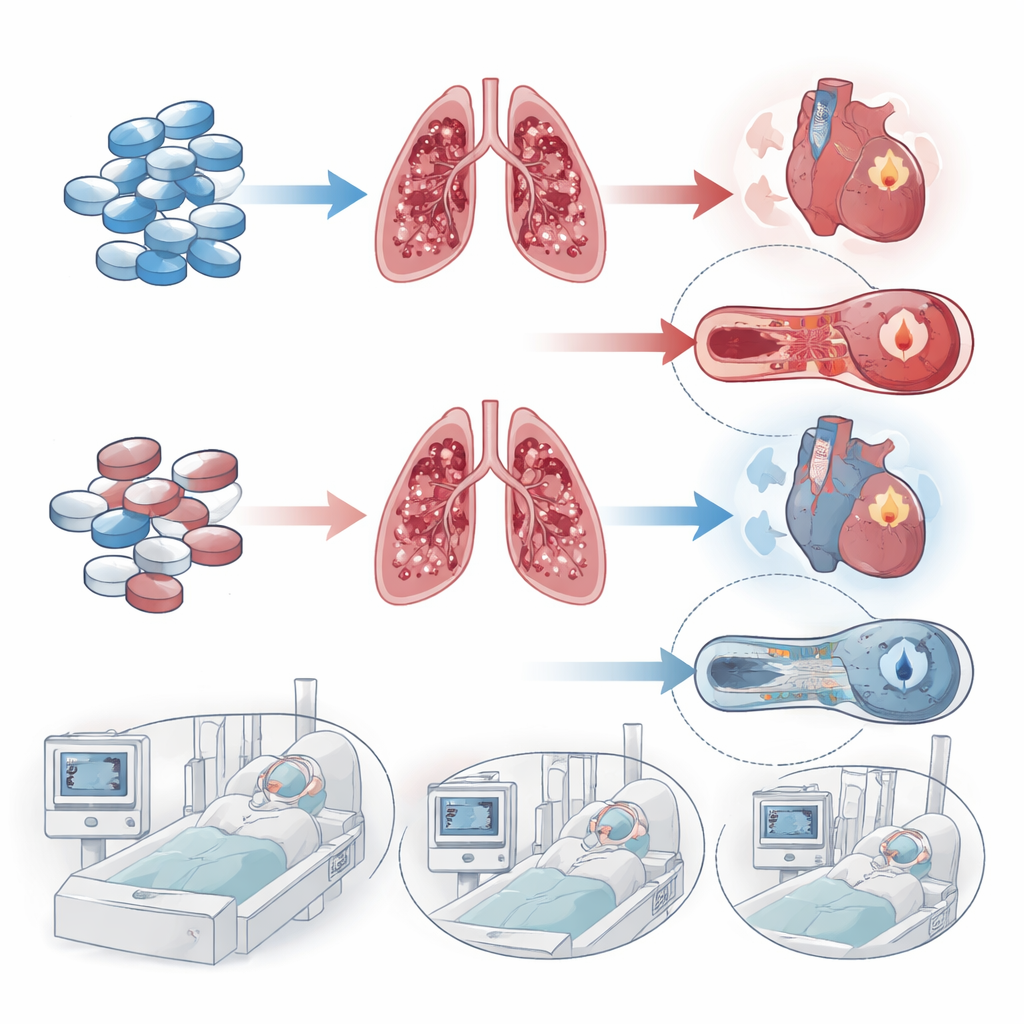
Overall, the study did not find a clear difference between the two drugs in the combined outcome of getting sicker—defined as death, admission to intensive care, or use of a mechanical ventilator. In both groups, a similar share of patients reached this combined endpoint. However, when the researchers looked separately at death from any cause, they saw a trend that favored Nirmatrelvir/Ritonavir: patients taking this medicine were about half as likely to die as those taking Azvudine. Because the total number of deaths was small, this difference could have been due to chance and did not meet strict statistical cutoffs. A more striking finding was that patients on Nirmatrelvir/Ritonavir had far fewer signs of heart injury during their illness, suggesting it may better protect the heart, which is especially important in people with diabetes.
Hidden influences and special subgroups
Interpreting these results is not straightforward. Even after careful matching, the Nirmatrelvir/Ritonavir group still had much more pre-existing lung disease and more cancer than the Azvudine group—signs that they were sicker to begin with. Doctors may have favored Nirmatrelvir/Ritonavir for patients they thought were at higher risk, a pattern called "confounding by indication." That makes it hard to know how much of the difference in outcomes is due to the drug versus the patient’s starting condition. The researchers also noticed that in patients with the most severe diabetes, Nirmatrelvir/Ritonavir appeared to cut the risk of death by about two-thirds, but again the numbers were small and the finding was borderline. Other treatments mattered too: glucocorticoids were linked to lower death risk, while blood thinners and intravenous immunoglobulin were tied to worse combined outcomes in this group.
What this means for patients and next steps
For now, this study suggests that both Azvudine and Nirmatrelvir/Ritonavir are reasonable choices for hospitalized COVID-19 patients with diabetes, with no firm evidence that one is clearly superior for preventing severe illness overall. There are hints that Nirmatrelvir/Ritonavir may better protect against death and heart damage, especially in those with more advanced diabetes, but the evidence is not strong enough to be definitive. The results highlight how real-world treatment decisions and differences between patients can blur the picture when comparing medicines outside a randomized trial. For people with diabetes, the key takeaway is that early antiviral treatment, tight blood sugar control, and careful management of other drugs remain crucial, and larger, better-balanced studies are needed to guide the choice between these two antivirals.
Citation: Zhu, Z., Chen, Q., Wang, Z. et al. A real-world retrospective analysis comparing the effectiveness of Azvudine and Nirmatrelvir/Ritonavir in COVID-19 patients with diabetes. Sci Rep 16, 8890 (2026). https://doi.org/10.1038/s41598-026-42215-6
Keywords: COVID-19 treatment, diabetes complications, oral antivirals, cardiac injury, real-world study