Clear Sky Science · en
Numerical analysis of dispersion and elastic wave propagation in spatiotemporally modulated spring–mass metamaterials
Waves in designer materials
Many of the technologies we rely on, from noise-cancelling panels to vibration control in buildings and vehicles, depend on how waves move through materials. Engineers are now building “metamaterials” whose tiny internal structures are carefully arranged so that sound and vibrations behave in unusual ways, such as bending backwards or being strongly blocked. This paper introduces a new computer-based method to predict and understand how waves travel in a special class of these materials whose properties are made to vary both in space and in time, opening the door to devices that can steer vibrations on demand.
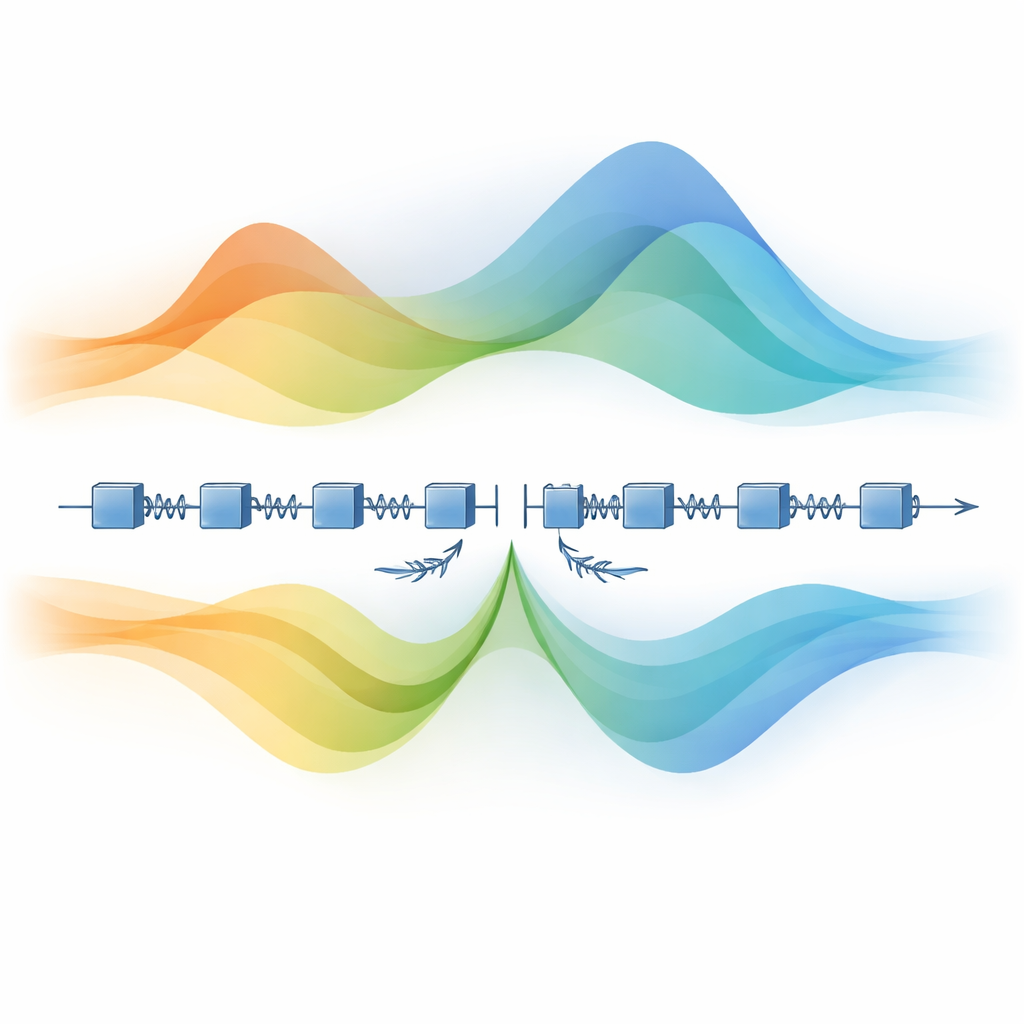
Building a simple model world
The authors study a very stripped-down model of a metamaterial: a one-dimensional line of identical masses connected by springs. Although it looks simple, this setup captures the essential physics of how elastic waves—like small vibrations in a beam or a lattice—move. The twist is that the stiffness of the springs is not fixed. It can vary from place to place along the chain (spatial modulation), change in time everywhere at once (temporal modulation), or do both at the same time (spatiotemporal modulation). By adjusting how the spring stiffness is patterned in space and time, the material can be made to guide waves differently in different directions or shift their frequencies as they travel.
Letting randomness reveal hidden wave paths
Traditionally, working out how waves propagate in such time-varying structures involves heavy mathematics, including long series expansions that are difficult to truncate safely, especially for more complicated unit cells. Instead, the authors borrow an idea from molecular dynamics, where random “thermal” motion is used to probe natural vibration patterns. They give each of more than three thousand masses in the chain a tiny random initial velocity, then simulate how the system evolves over time using a precise time-stepping scheme. This random kick excites all the possible wave modes at once, allowing the system’s inherent wave patterns to emerge on their own as the motion unfolds.
Turning raw motion into clear wave maps
To convert the simulated motion into a clear picture of how waves behave, the researchers apply a two-dimensional Fourier transform to the recorded velocities, analyzing them over both space and time. The result is a map that shows which combinations of frequency and wavenumber actually carry energy in the material—these are the dispersion curves that describe the allowed wave modes. When they compare these numerically extracted curves to traditional analytical predictions based on Bloch-wave theory, they find excellent agreement for purely spatial, purely temporal, and combined spatiotemporal modulations. The method not only recovers the main branches where most of the energy travels, but also reveals weaker “secondary” branches created by the time-varying stiffness that are harder to capture analytically.
How different modulations shape wave travel
Using targeted excitations at chosen frequencies, the authors then examine how waves actually move through the chain. In purely spatially patterned systems, waves travel symmetrically: for frequencies in the allowed bands, wave packets propagate equally well to the left and right, while in band gaps they are strongly suppressed. In purely time-modulated systems, a single input frequency generates additional, weaker components at shifted frequencies, a hallmark of frequency conversion. In the fully spatiotemporal case, the dispersion curves become asymmetric with respect to direction, leading to waves that travel faster one way than the other and that redistribute their energy among several frequencies as they go. However, the system does not achieve true one-way transmission, because there are no “directional bandgaps” that block motion completely in only one direction.
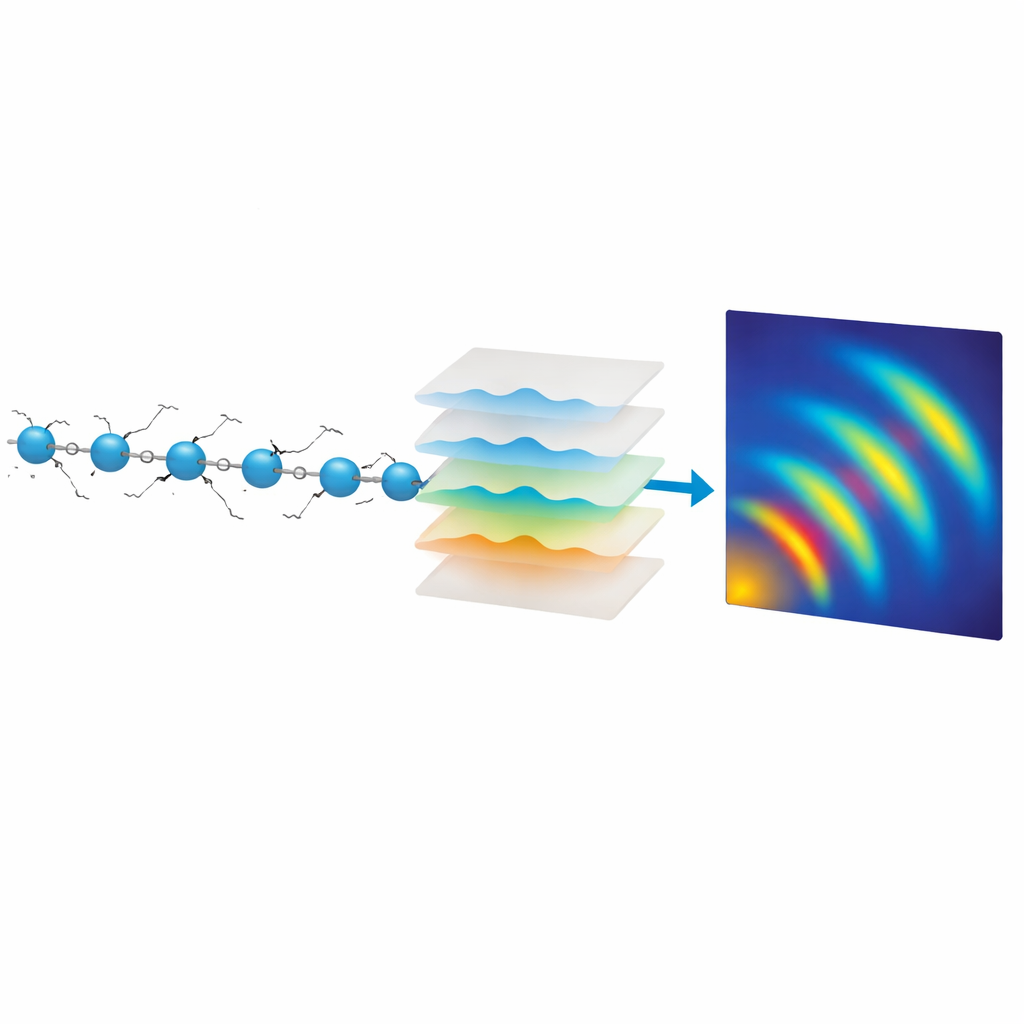
A flexible tool for future wave control
Overall, the study shows that a relatively simple numerical recipe—randomly exciting a model metamaterial and then analyzing its motion with a two-dimensional Fourier transform—can reliably uncover the full landscape of wave behavior in systems whose properties change in space and time. Because the method adapts easily to different unit-cell designs, numbers of masses, and even non-sinusoidal modulation patterns, it provides a practical way to design and optimize dynamic metamaterials without wrestling with cumbersome formulas each time a detail changes. For non-specialists, the key message is that this approach gives engineers a powerful and efficient tool to craft materials that can actively shape, steer, and transform vibrations in ways that rigid, static materials cannot.
Citation: Liao, SC., Ko, CC. & Chang, IL. Numerical analysis of dispersion and elastic wave propagation in spatiotemporally modulated spring–mass metamaterials. Sci Rep 16, 13562 (2026). https://doi.org/10.1038/s41598-026-42208-5
Keywords: metamaterials, wave propagation, spatiotemporal modulation, numerical simulation, dispersion relation