Clear Sky Science · en
SoleFusion-Net: an explainable multimodal deep learning framework for diabetic foot syndrome classification in type II diabetes mellitus
Why your feet matter in diabetes
For people living with type 2 diabetes, small changes in the feet can quietly grow into serious problems, including ulcers and even amputation. Doctors try to spot nerve damage early, but current tests rely on what patients feel and what clinicians judge by hand. This study presents SoleFusion-Net, a computer tool that combines images of how you step on the ground with routine clinic data to sort patients into mild, moderate, or severe risk, while also showing doctors how it reached its decision.
Seeing pressure where the eye cannot
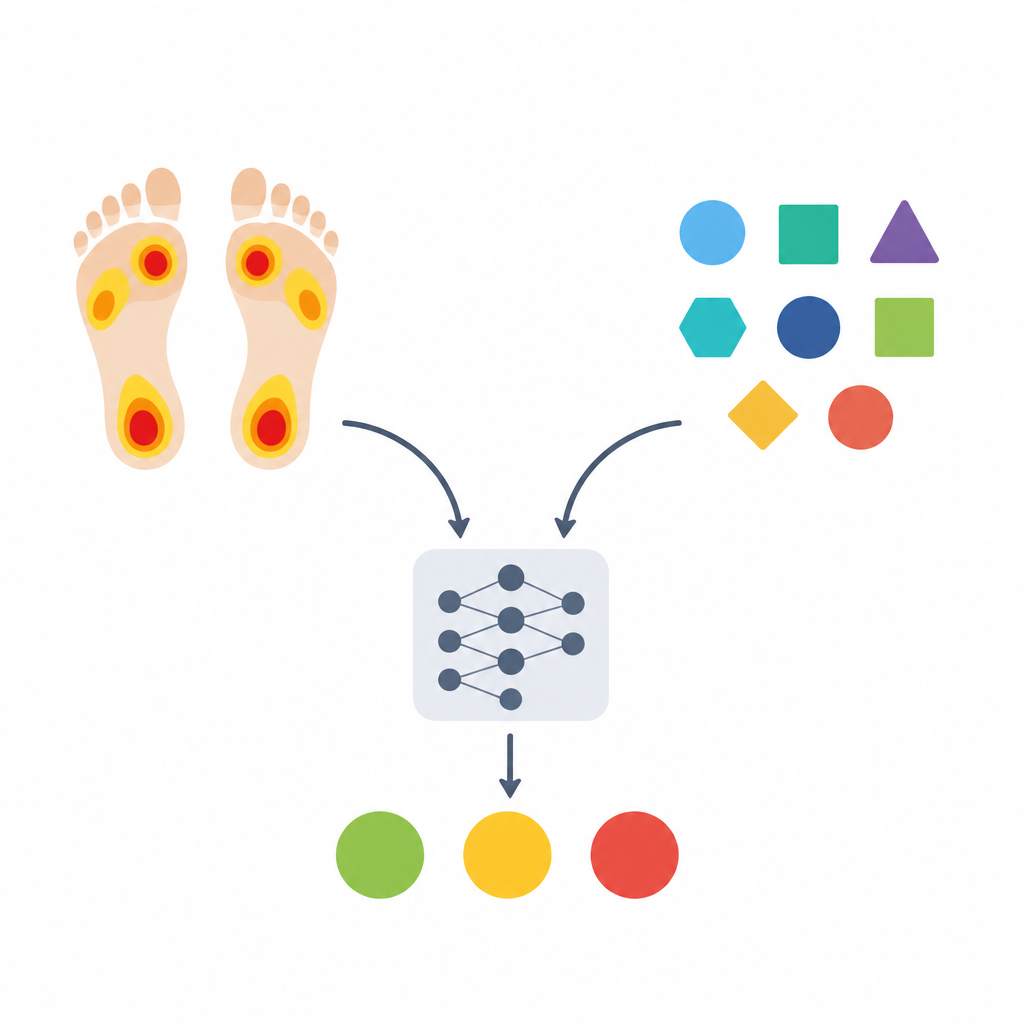
When we walk, different parts of the foot press on the ground with different intensity. In diabetes, nerve damage and subtle changes in posture can shift this pressure before any sore appears. The researchers used a pressure-sensing platform to record colorful maps of the soles of 504 people with type 2 diabetes. Each map shows how weight is spread across the foot during walking. These images were paired with standard clinic measures such as age, body mass index, blood pressure, and simple bedside tests that check how well someone can feel vibration or a light touch on the feet.
Blending pictures and clinic data
SoleFusion-Net is built with two main paths. One path looks only at the pressure maps, using layered image filters to learn where abnormal loading tends to appear in the sole. The other path reads the clinic data, learning patterns in numbers such as vibration thresholds and monofilament scores that reflect nerve health. After each path learns its own summary of the data, the model fuses these summaries and makes a final prediction about whether a person’s neuropathy is mild, moderate, or severe. By training and testing the system on five different splits of the same group, the team checked that its performance was stable rather than a fluke of one particular sample.
How well the system sorts foot risk
Across all tests, SoleFusion-Net correctly classified patients about 83 percent of the time. It separated mild and severe nerve damage particularly well and had slightly more difficulty with the in-between group, which is also challenging for human examiners. Curves that compare true positives versus false alarms showed strong overall discrimination between the three classes. An ablation study, where parts of the system are removed, revealed that using only images or only clinic data leads to noticeably lower accuracy. When both are combined in the late fusion design, the model becomes more balanced and reliable than any single source alone.
Opening the black box for clinicians
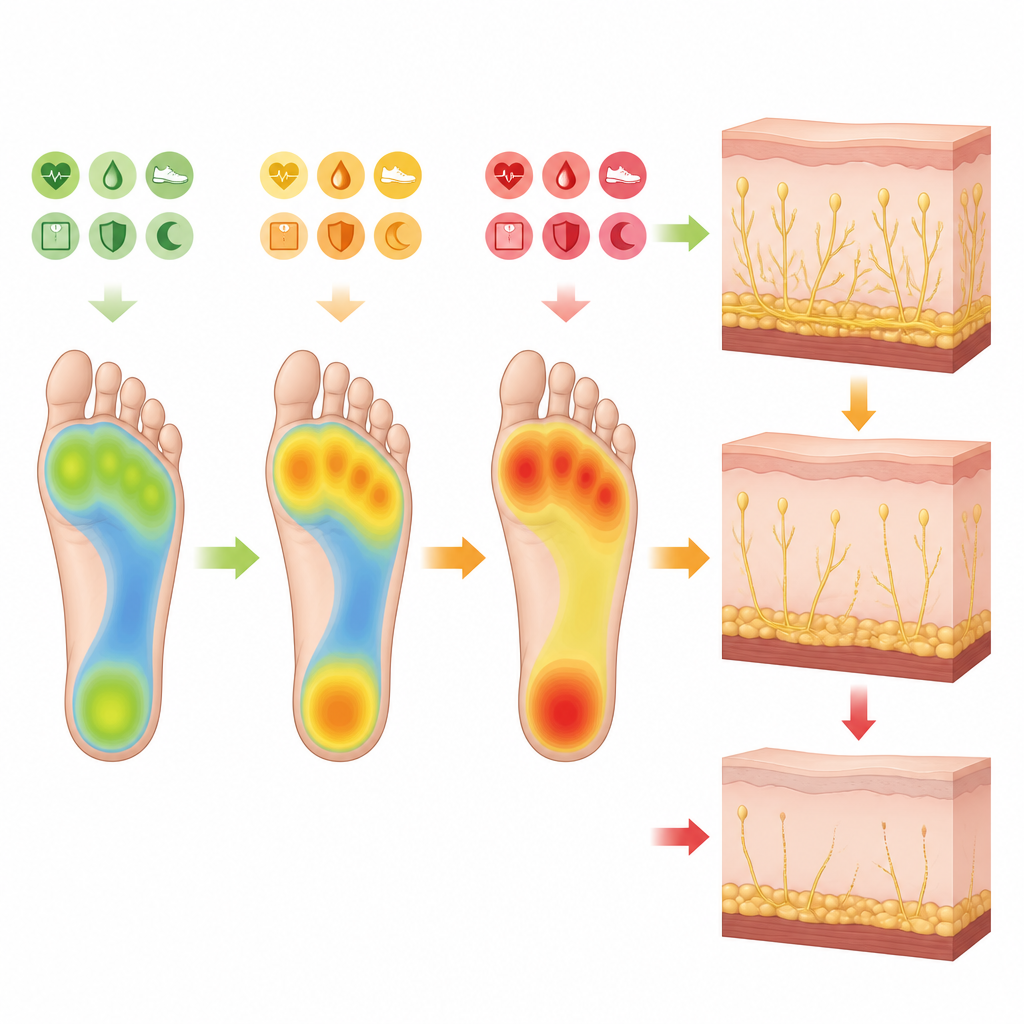
Because trust is crucial in medicine, the authors used several tools to explain how SoleFusion-Net thinks. For the clinic data, they calculated how much each feature contributed to the final decision. Vibration perception and monofilament tests on both feet emerged as the most influential, mirroring current medical practice. For the pressure images, heatmaps highlighted specific regions of the sole that drove the model’s choice, often lining up with areas known to be prone to ulcers. Additional methods, including simple rule trees and example-based explanations, offered alternative, more human-friendly views of the same decisions. Together, these checks showed that the system relies on medically sensible cues rather than arbitrary patterns.
What this means for people with diabetes
The study suggests that a carefully designed computer model can blend how you step and how you test in the clinic to give an objective, transparent view of foot nerve damage. While the work is based on a single hospital and needs testing in other regions and equipment setups, it points toward future tools that could flag high-risk feet earlier, guide closer follow up, and support doctors in deciding who needs more aggressive protection from ulcers. In short, SoleFusion-Net acts as a second pair of eyes and hands, helping to turn scattered measurements into a clearer picture of foot health in diabetes.
Citation: Sheikh, M.M., Balachandra, M., G, N.V. et al. SoleFusion-Net: an explainable multimodal deep learning framework for diabetic foot syndrome classification in type II diabetes mellitus. Sci Rep 16, 15973 (2026). https://doi.org/10.1038/s41598-026-42207-6
Keywords: diabetic foot, peripheral neuropathy, plantar pressure imaging, multimodal deep learning, explainable AI