Clear Sky Science · en
Expertise shapes the kinematic and electromyographic characteristics of on-ice side-cutting in elite versus beginner ice hockey players
Why sharp turns on ice matter
Any fan who has watched a hockey player carve a sudden turn to dodge a defender has seen side-cutting in action. These lightning-fast changes of direction are thrilling, but they also place huge stress on the hips, knees, and ankles. This study asks a deceptively simple question with big implications for players and coaches: how do elite hockey players move differently from beginners when they execute a sharp on-ice cut, and how might those differences protect their joints while boosting performance?
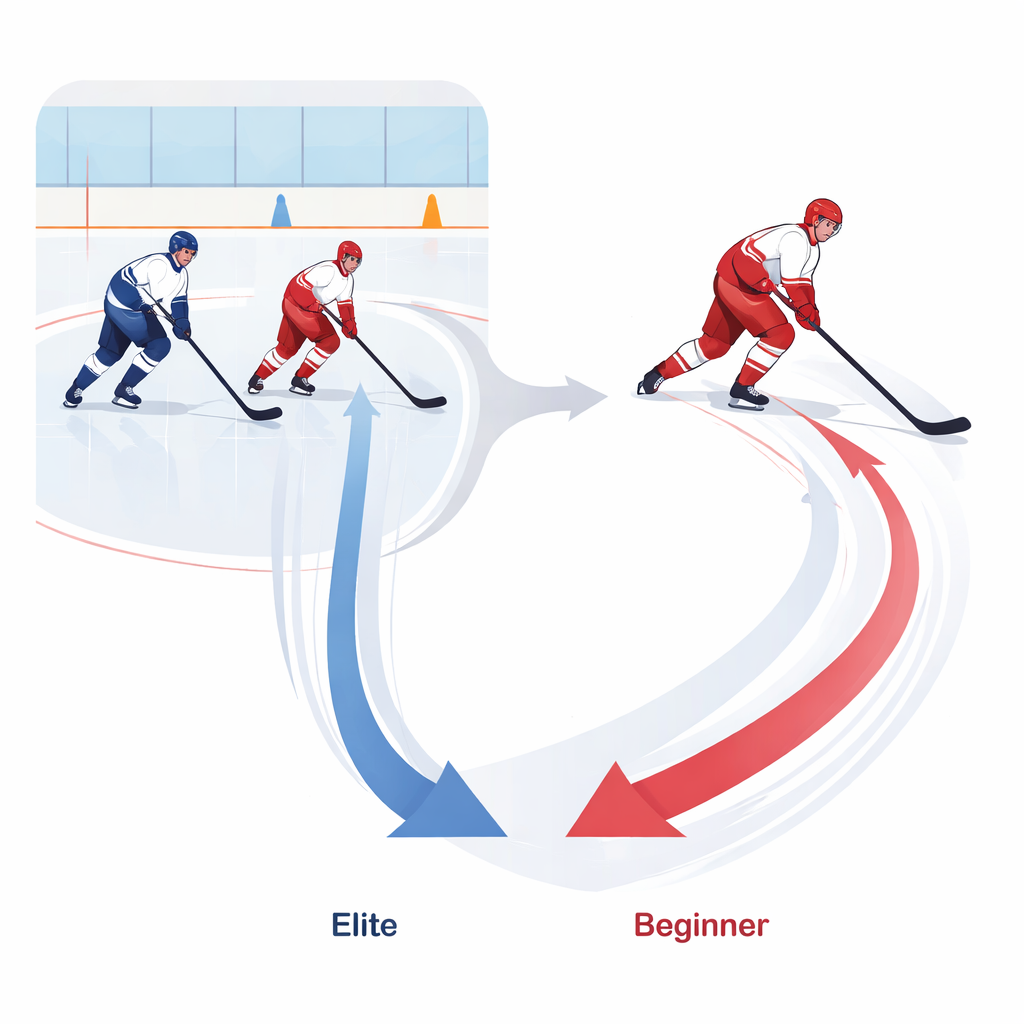
How the study looked inside a turn
To answer this, researchers recruited thirty male hockey players: fifteen seasoned national-level athletes and fifteen recreational beginners. All performed repeated 45-degree side-cuts on real ice at their own fastest controllable speed. While they skated, a network of high-speed cameras tracked tiny reflective markers on their bodies to reconstruct 3D joint motion, and sensors on key leg muscles measured electrical activity, a window into how hard those muscles were working. A computer musculoskeletal model turned the marker data into precise joint angles across the full movement, and advanced statistics were used to compare the entire time course of motion rather than just single peak values.
How experts bend and align their bodies
The clearest difference showed up in how much and when players bent their hips and knees. Elite skaters dropped into significantly deeper flexion during the crucial phase when the body’s weight shifts and the direction change begins. Their hips and knees bent more, and their hips rotated inwards in a tighter, more controlled way. At the same time, they kept the leg closer to the midline of the body rather than letting it drift wide. This posture keeps the body’s center of mass low and better aligned over the skate, which likely helps manage the strong sideways forces needed to change direction while reducing harmful twisting and sideways bending at the knee.
Muscles working smarter, not harder
Despite skating faster and bending more, elite players actually used less effort in several major muscles on the front of the thigh and along the shin, as shown by lower electrical signals. Their quadriceps and tibialis anterior did not “over-fire” the way they did in beginners, suggesting that experts rely less on brute stiffness and more on precise, economical control. At the same time, elite players showed a higher degree of co-contraction around the knee—front and back thigh muscles tightening together—in a way that can stiffen and stabilize the joint during risky positions. This pattern points to a sort of “neuromuscular splint,” where muscles, rather than ligaments alone, bear more of the load when the knee drifts into potentially dangerous angles.
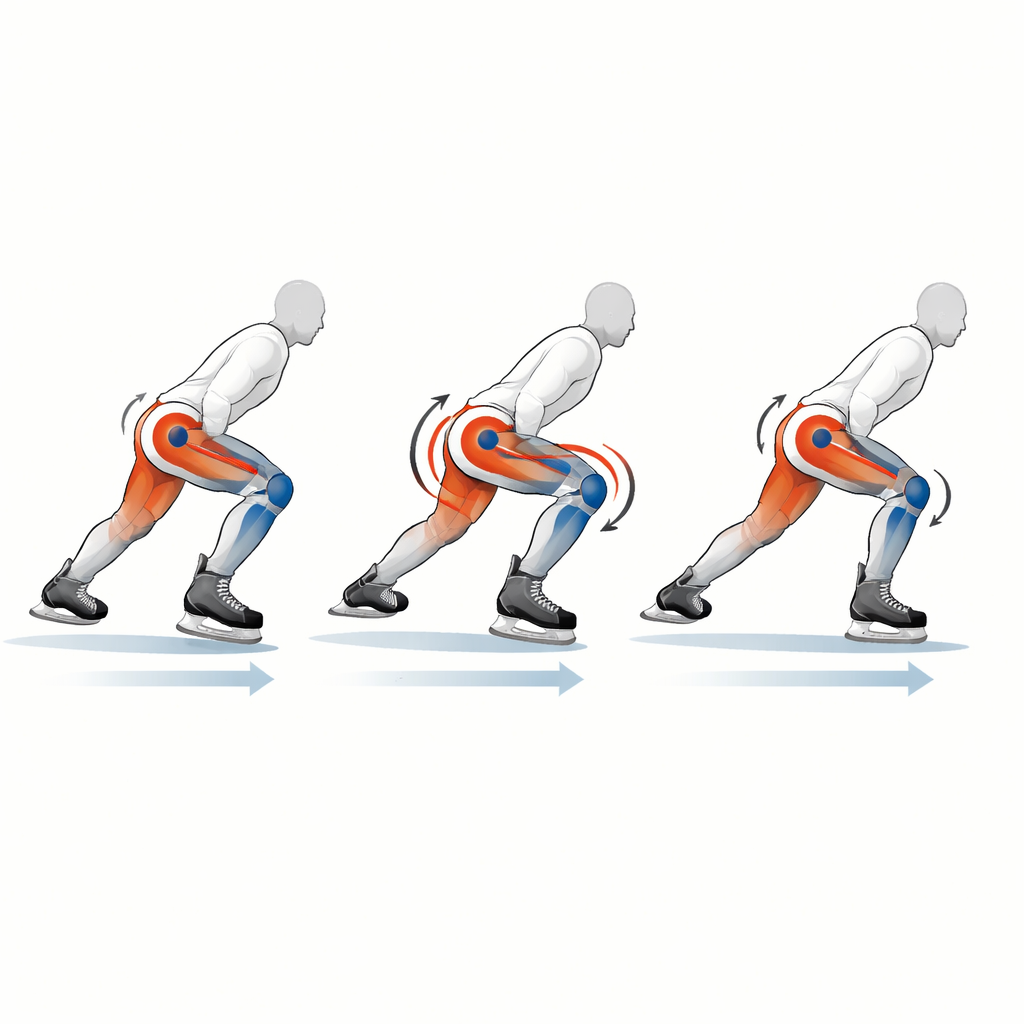
Risky knee angles and how experts cope
Both beginners and elites showed inward collapse at the knee, a motion linked to serious ligament injuries. However, the elites combined this with deeper hip and knee bending and better hip control, which previous work suggests can soften and redirect loads that might otherwise strain the ligaments. Beginners, in contrast, tended to display this inward motion with less coordinated muscle support. The authors argue that in elites this may represent a “functional” use of a risky position, actively supported by muscle co-activation to store and release elastic energy, whereas in beginners it looks more like a passive collapse that could raise injury risk.
What this means for players and coaches
Put simply, the study suggests that elite hockey players do not just push harder; they organize their whole lower body to move in a safer and more economical way during sharp turns. They sink lower through the hip and knee, keep the leg better aligned under the body, and fine-tune muscle use to stabilize the knee without wasting energy. While the research has limits—it did not directly measure forces, involved only young men, and used a modest sample size—it points toward practical training goals. Developing players may benefit from drills that emphasize hip mobility, deep controlled bending, and coordinated activation of front and back thigh muscles, rather than simply building strength. Mastering this “multi-joint synergy” could help skaters cut harder and faster while reducing the chances of a season-ending knee injury.
Citation: Yu, Z., Bi, G., Qin, Y. et al. Expertise shapes the kinematic and electromyographic characteristics of on-ice side-cutting in elite versus beginner ice hockey players. Sci Rep 16, 8913 (2026). https://doi.org/10.1038/s41598-026-42201-y
Keywords: ice hockey biomechanics, change of direction, knee injury risk, muscle activation, sports performance