Clear Sky Science · en
Spin polarized first principles study of electro-magnetic and optical properties of K2NaXI6 (X :Cr Fe) double halide perovskites
New Materials for Turning Light and Heat into Power
Modern technology hungers for materials that can do more than one job at a time: harvest sunlight, manage waste heat, and even store information using tiny magnetic bits. This study explores two newly designed crystalline compounds that promise exactly this kind of multitasking. By probing their behavior on a computer, the authors show that these crystals could act as light absorbers for solar cells, magnetic layers for spin-based electronics, and converters of heat into electricity, all within the same family of materials.
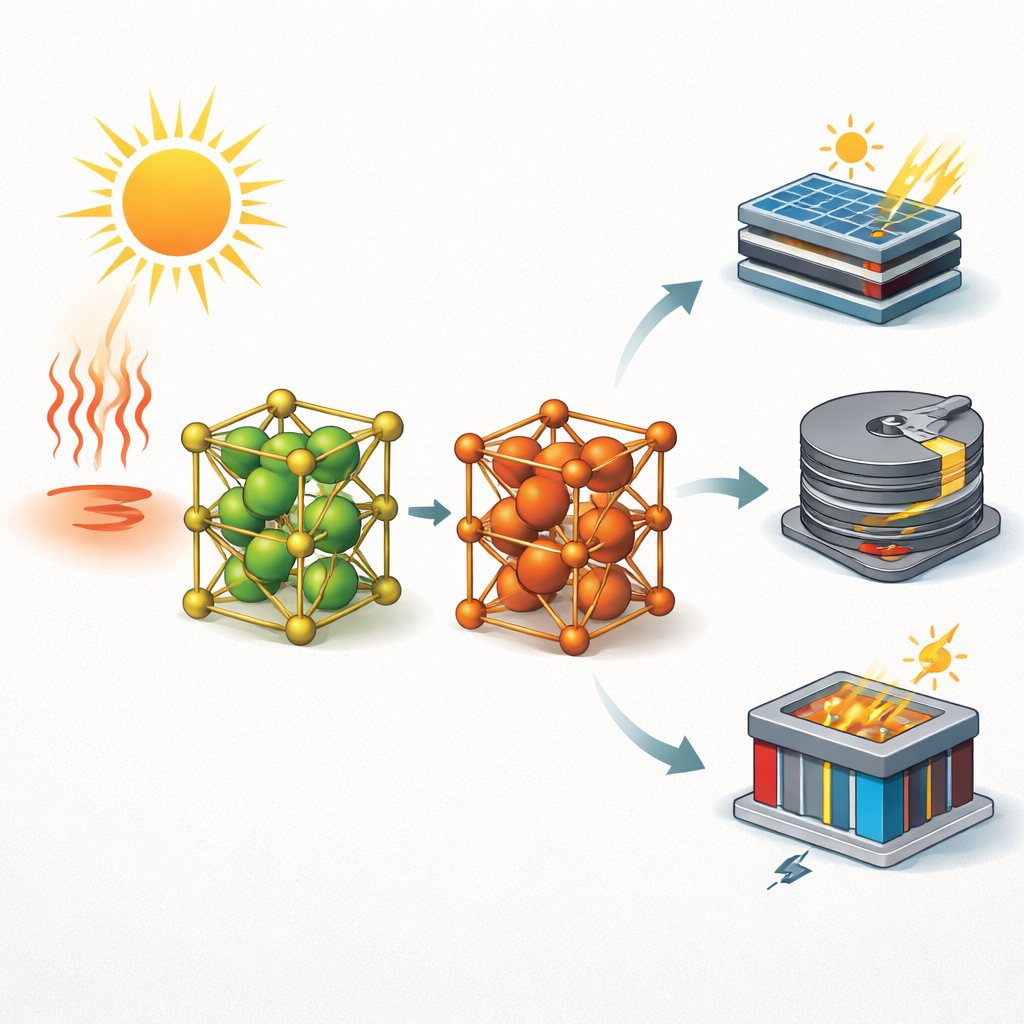
Building Blocks in a Crystal Grid
The materials fall into a broad family known as perovskites, famous for their simple but flexible cube-like structure. In this particular case, the crystals are made from potassium (K), sodium (Na), iodine (I), and a small amount of either chromium (Cr) or iron (Fe), giving the formulas K₂NaCrI₆ and K₂NaFeI₆. The atoms occupy well-ordered positions in a repeating three-dimensional grid. The researchers first checked whether these arrangements would actually be stable. Using atom-by-atom computer simulations that mimic how the structure vibrates with temperature, they found that both crystals remain robust over time, with energies that stay within a narrow range rather than drifting wildly. That stability is essential if such materials are ever to survive inside working devices.
How Electrons Move and Spin
A material’s usefulness in electronics largely depends on how easily its electrons can be nudged from one energy level to another. The team calculated the electronic band structure, which reveals whether a crystal behaves like a metal, an insulator, or a semiconductor. Both compounds turned out to be semiconductors in a special way: their behavior differs for electrons whose spins point in opposite directions. K₂NaCrI₆ shows modest energy gaps for both spin types, while K₂NaFeI₆ combines a wide gap for one spin direction with a very narrow gap for the other. In everyday terms, this means that the crystals could let one spin “channel” of electrons move more readily than the other, a key requirement for spintronics, where information is carried not only by charge but also by spin. The calculations also show that both materials naturally align many tiny magnetic moments in the same direction, making them ferromagnets.
Catching Light Across the Spectrum
To judge how well these crystals might handle light, the authors computed several optical properties, such as how strongly the materials absorb, refract, and reflect incoming radiation. Both compounds absorb light efficiently from the visible into the ultraviolet range, while reflecting relatively little. Peaks in their calculated absorption curves line up with the predicted energy gaps, confirming that incoming photons can kick electrons across those gaps. The chromium-based material responds more strongly at lower energies, making it attractive for visible and near-infrared uses, whereas the iron-based compound shows a stronger response at higher energies, better suited for ultraviolet applications. These traits position the materials as candidates for solar absorbers and other optoelectronic components that must grab as much light as possible while losing little to reflection.

Turning Heat Differences into Electricity
Beyond light, the researchers examined how the materials respond to temperature differences, a field known as thermoelectrics. They calculated the Seebeck coefficient, which measures how much voltage a material produces when one side is hotter than the other, along with electrical and thermal conductivities and heat capacity. K₂NaCrI₆ behaves like an n-type semiconductor, where electrons are the main carriers, while K₂NaFeI₆ behaves like a p-type semiconductor, dominated by positive “holes.” Having both types in the same structural family is useful for designing complete thermoelectric modules. The iron-based compound shows higher electrical and electronic thermal conductivity and a larger heat capacity, suggesting it may perform better at transporting both charge and heat, while the chromium-based material offers complementary behavior.
Why These Crystals Matter
Taken together, the simulations paint a picture of two sturdy, magnetic semiconductors that interact strongly with light and can generate voltage from temperature differences. In plain terms, K₂NaCrI₆ and K₂NaFeI₆ behave like Swiss Army knives at the nanoscale: they can absorb sunlight, manage heat, and support spin-based magnetism within the same crystalline framework. While these results are theoretical and must still be tested in the lab, they highlight a promising route toward multifunctional materials that could simplify the design of future solar cells, spintronic devices, and thermoelectric generators.
Citation: Abdullah, D., Kumar, A., Adupa, C. et al. Spin polarized first principles study of electro-magnetic and optical properties of K2NaXI6 (X :Cr Fe) double halide perovskites. Sci Rep 16, 10826 (2026). https://doi.org/10.1038/s41598-026-42192-w
Keywords: halide perovskites, spintronics, optoelectronics, thermoelectric materials, magnetic semiconductors