Clear Sky Science · en
Intelligent monitoring and anomaly detection for power service processes based on spatiotemporal attention mechanism
Why smarter power service matters
When you apply for a new electricity connection or request grid upgrades, your experience depends on a long chain of behind-the-scenes steps: paperwork, technical checks, construction, and meter installation. Delays or missteps anywhere in this chain can mean days or weeks of extra waiting and mounting frustration. This paper explores a new AI-based monitoring system that watches these complex service processes in real time, spots trouble early, and helps utilities fix issues before they turn into service failures or customer complaints.

The hidden journey of a power service request
Power service processes are more like relay races than simple one-off tasks. A single request moves through multiple stages—receiving the application, checking documents, assessing technical feasibility, scheduling construction, connecting to the grid, and installing the meter. Each stage takes a different amount of time depending on the type of customer, local workload, and regional capacity. On top of this, dozens or hundreds of service centers spread across cities, suburbs, and rural areas share resources and influence one another’s performance. Traditional monitoring tools mostly look at simple averages and fixed limits for each stage, which means they often miss slowly developing problems or complex interactions between locations.
Teaching machines to focus on what matters in space and time
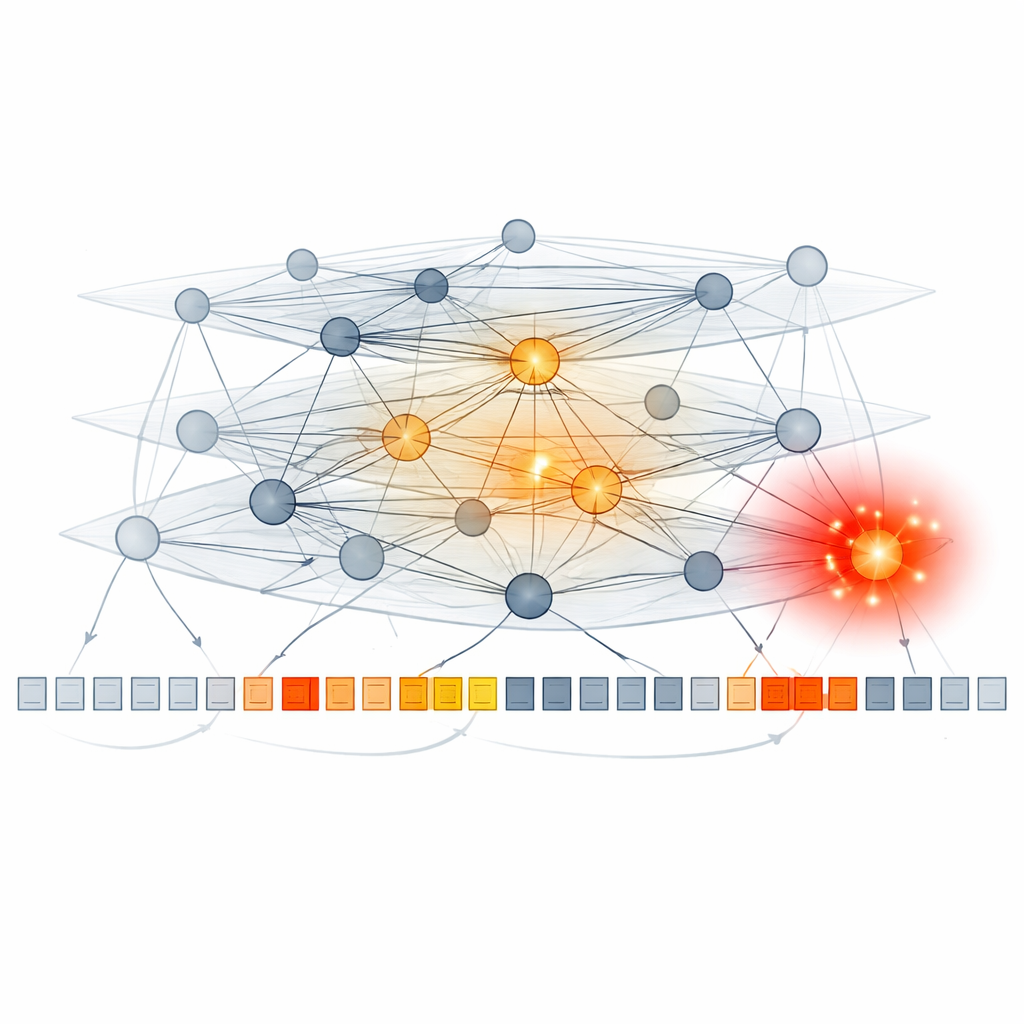
The authors propose an intelligent monitoring system that borrows a key idea from modern language and vision AI: attention. Instead of treating all events and all service centers as equally important, the system learns to “pay attention” to the most informative points in time and space. One part of the model focuses on the sequence of steps and how long each one takes, learning patterns such as typical durations and order of activities. Another part focuses on where things happen, modeling the network of service centers and their relationships—such as centers in the same district or region that share staff and resources. A special fusion module then balances these two views, allowing the system to highlight moments and locations that jointly signal that something is going wrong.
Spotting unusual delays and missteps automatically
Using this joint view of space and time, the system calculates an overall “strangeness” score for each service process. Some anomalies arise when a single stage takes far longer than normal, others when steps happen in the wrong order or are skipped, and still others when work is unevenly distributed across neighboring centers. The model combines multiple clues: how far current behavior deviates from learned norms, how similar or different nearby centers look, and how temporal and spatial effects interact. Instead of relying on a one-size-fits-all rule, the authors introduce adaptive thresholds that adjust to local conditions and seasonal demand swings, such as summer air-conditioning peaks or holiday slowdowns. These thresholds are updated regularly so the system stays in sync with evolving operations.
Putting the system to the test in the real world
To see whether this approach works in practice, the team trained and evaluated it on real data from three provincial power utilities in China, covering nearly 300,000 service cases across 156 centers over three years. They compared their system with a wide range of existing techniques—from classic statistics and machine-learning tools to modern deep-learning models designed for time-series and network data. The spatiotemporal attention system consistently came out ahead, correctly identifying more anomalies while keeping false alarms low. In a six-month field trial across 32 centers, it caught 96% of expert-verified anomalies and maintained high precision. Perhaps most importantly, the results were not just academic: average completion times dropped by about one-fifth, service-level targets were met more often, and customer complaints linked to delays fell by nearly one-third.
What this means for everyday customers
For non-specialists, the key takeaway is simple: smarter, AI-driven monitoring can make everyday interactions with power utilities faster, more reliable, and less stressful. By continuously learning from past behavior, focusing on the most telling patterns in both time and place, and alerting staff before small issues snowball, the proposed system helps utilities shift from reacting after problems occur to preventing them in the first place. While the work targets power services, the same ideas could be applied to many other complex service systems—such as healthcare appointments, logistics, or public services—where long, interconnected processes determine how quickly and smoothly people get what they need.
Citation: Lin, N., Wen, X., Wu, J. et al. Intelligent monitoring and anomaly detection for power service processes based on spatiotemporal attention mechanism. Sci Rep 16, 12479 (2026). https://doi.org/10.1038/s41598-026-42189-5
Keywords: power service monitoring, anomaly detection, spatiotemporal attention, smart grid operations, deep learning systems