Clear Sky Science · en
Investigating a deterministic canonical model for tropical influenza
Why flu in the tropics is so hard to pin down
People often think of flu as a once-a-year winter problem. In many tropical countries, however, flu outbreaks seem to come and go at irregular times, without a clear yearly rhythm. This unpredictability makes it difficult for health officials to plan vaccination campaigns and prepare hospitals. The study described here asks a simple but important question: can a standard, rule-based computer model ever capture these restless, out-of-sync flu patterns in the tropics, or is something more complex going on?
Flu seasons without a regular rhythm
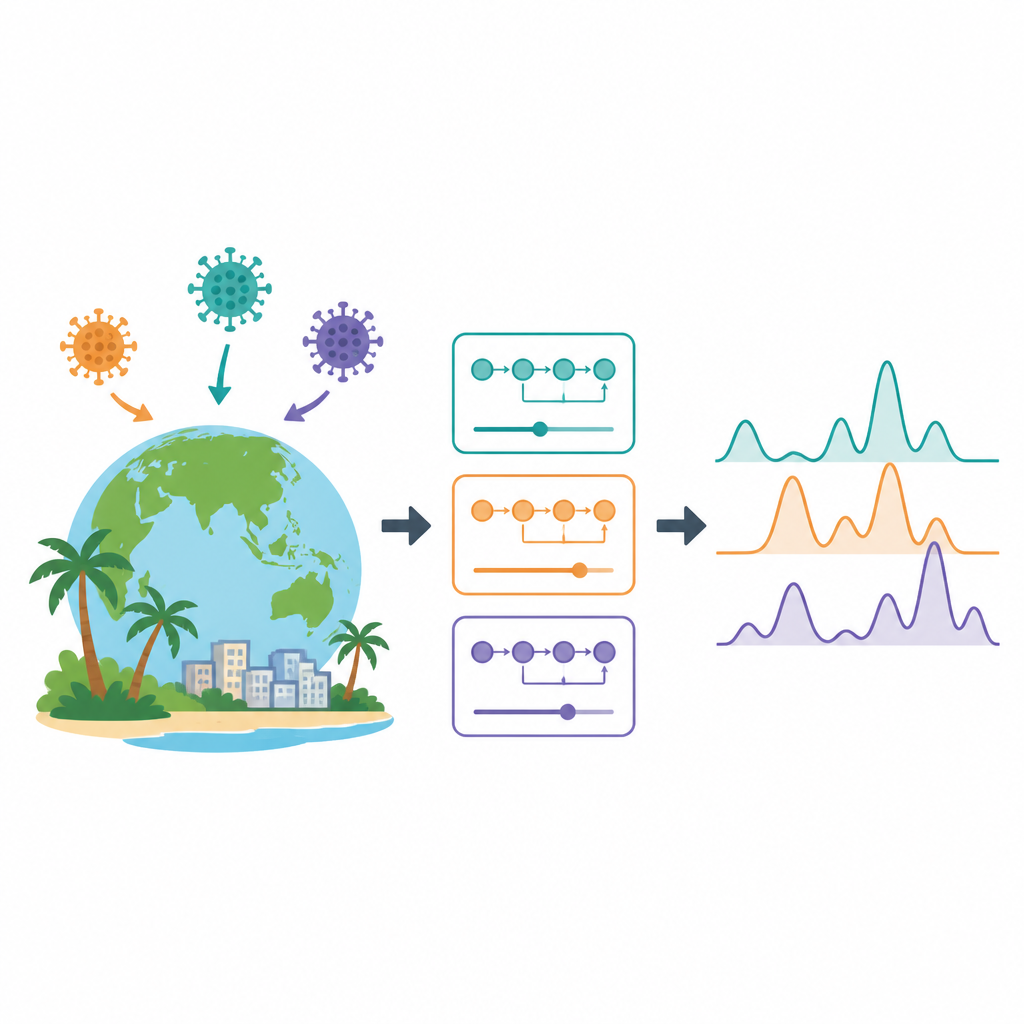
In temperate regions, like North America and Europe, flu typically peaks once each winter. In contrast, studies from tropical areas show a very different picture. Multiple kinds of influenza viruses circulate at the same time, and their peaks often do not line up from year to year or even with one another. Researchers summarize this pattern with the acronym SSMAC: epidemics that are Sustained over time, of Similar Magnitude, Asynchronous across virus types, and Co-circulating. The goal of this work was to see whether a traditional, rule-based epidemic model could be tuned so that its simulated outbreaks consistently look like these real-world SSMAC patterns.
Testing many versions of a flu model
The authors started from a common type of infectious disease model that tracks people as they move from being susceptible, to infected, to recovered, and then back to susceptible as their immunity fades. They included three major influenza strains and allowed past infection with one to give partial protection against the others. On top of this basic setup, they built 30 different model versions. These versions differed in how long immunity lasted and how varied that duration was, whether the population was split into subgroups with different mixing patterns, and whether occasional cases were imported from outside. For each version, the team searched through billions of combinations of key parameters such as how easily each strain spreads, how strong cross-protection is, and how often outside infections arrive.
Strict rules for what counts as “tropical-like” flu
To decide whether a simulated flu history looked tropical, the researchers defined seven clear criteria. The model had to show sizable ups and downs in daily case counts rather than a flat line, and the three strains could not rise and fall in lockstep. Their biggest peaks had to be of similar size but occur at different times, and the mix of high and low daily counts had to resemble actual flu data collected in Vietnam. Overall yearly infection levels also needed to match real observations and avoid slowly drifting upward or downward. Only parameter combinations that passed all seven tests were accepted as producing SSMAC-like epidemics.
Fragile success and hints of chaos
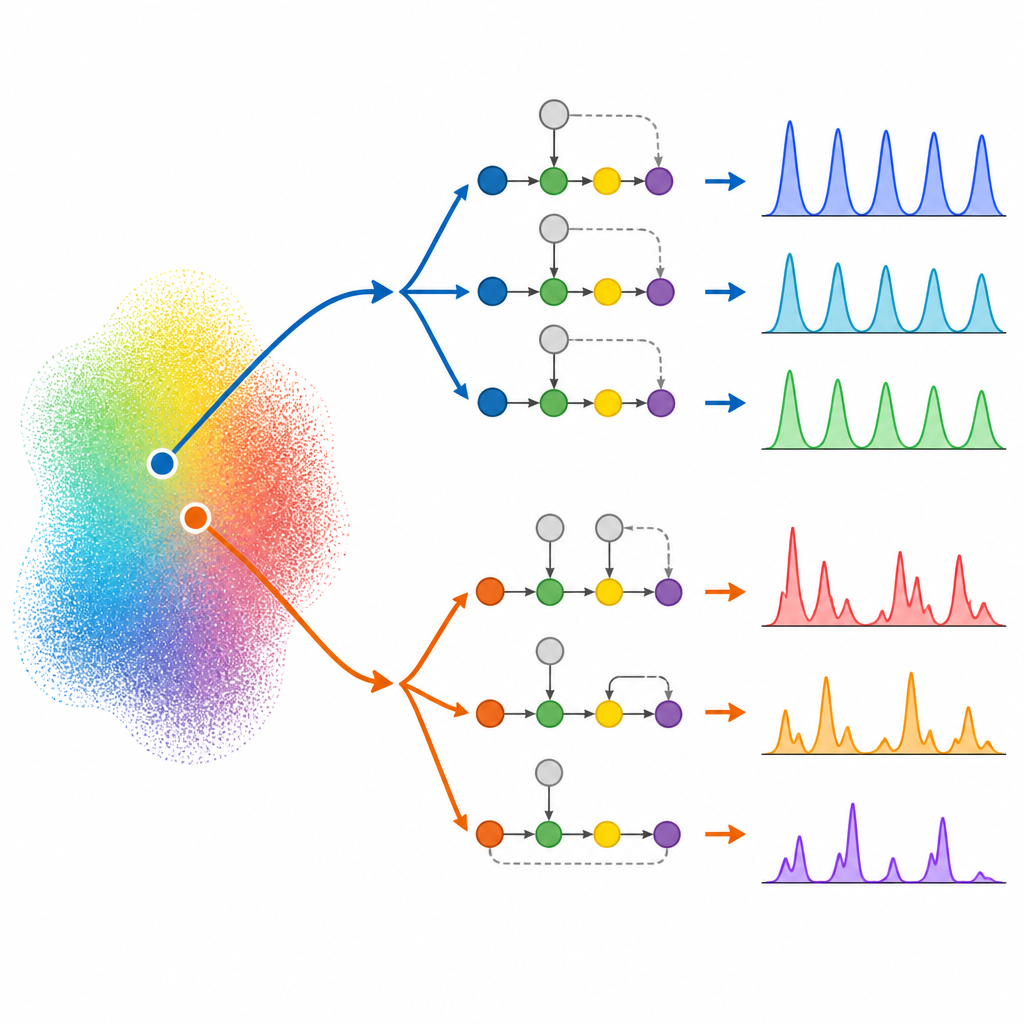
Despite evaluating more than 2.8 billion parameter sets, each model version produced only a tiny fraction that met all SSMAC criteria, and some versions produced almost none. Even more striking, these “successful” settings turned out to be extremely fragile. When the researchers nudged the parameters by as little as 1 percent, the model usually lost its tropical-like behavior. Blending two good parameter sets to form intermediate settings also often broke the SSMAC pattern. The criteria related to having similar but out-of-sync peaks and realistic distributions of daily cases were the easiest to disrupt. When the team disturbed the model’s internal state by shifting a small share of people between health categories, the simulated epidemics usually changed character as well. Together, these results suggest that the model behaves in a very sensitive way, where tiny changes can lead to very different outbreak patterns.
What this means for understanding tropical flu
The study concludes that, within this broad family of models, there is no simple, stable recipe that reliably reproduces the irregular flu patterns seen in the tropics. The rare parameter sets that do match real data sit in narrow, scattered pockets rather than forming wide, forgiving regions. This makes it hard to fit such models to data and to use them for forecasting, because a slight error in estimated values can flip the model from tropical-like behavior to something very different. The authors suggest that chance events or inherently chaotic dynamics may play a major role in shaping tropical influenza. To build useful tools for planning vaccines and healthcare in these regions, future models may need to embrace randomness, richer population structure, or additional factors beyond the standard rule-based approaches tested here.
Citation: Servadio, J.L., Boni, M.F. Investigating a deterministic canonical model for tropical influenza. Sci Rep 16, 14807 (2026). https://doi.org/10.1038/s41598-026-42186-8
Keywords: tropical influenza, epidemic modeling, nonseasonal flu, stochastic dynamics, disease forecasting