Clear Sky Science · en
Experimental evaluation of eco-friendly exfoliation strategies for Tour-method graphene oxide
Why peeling apart carbon sheets matters
From faster batteries to cleaner water, many hopeful technologies rely on graphene oxide, a material made of ultra-thin carbon sheets. How those sheets are peeled apart from bulk graphite quietly controls how well the final material performs. This study explores greener, practical ways to "unstack" these sheets and shows which methods give graphene oxide the most useful surface for real-world devices.
From pencil-like powder to smart materials
Graphene is a single, atom-thick layer of carbon famous for being strong, light and conductive. In practice, industry rarely works with perfect single layers. Instead, many advanced filters, sensors, batteries and medical carriers use graphene oxide, where oxygen atoms are attached to the carbon sheets. These oxygen groups make the material disperse easily in water and provide sites for further chemical tailoring. To obtain graphene oxide, graphite is first oxidized into graphite oxide, then mechanically peeled into thinner stacks or near-single layers. The way this peeling is done largely decides the material’s usable surface area, which in turn governs how much charge, gas or pollutant it can hold.
Gentle sound waves versus grinding forces
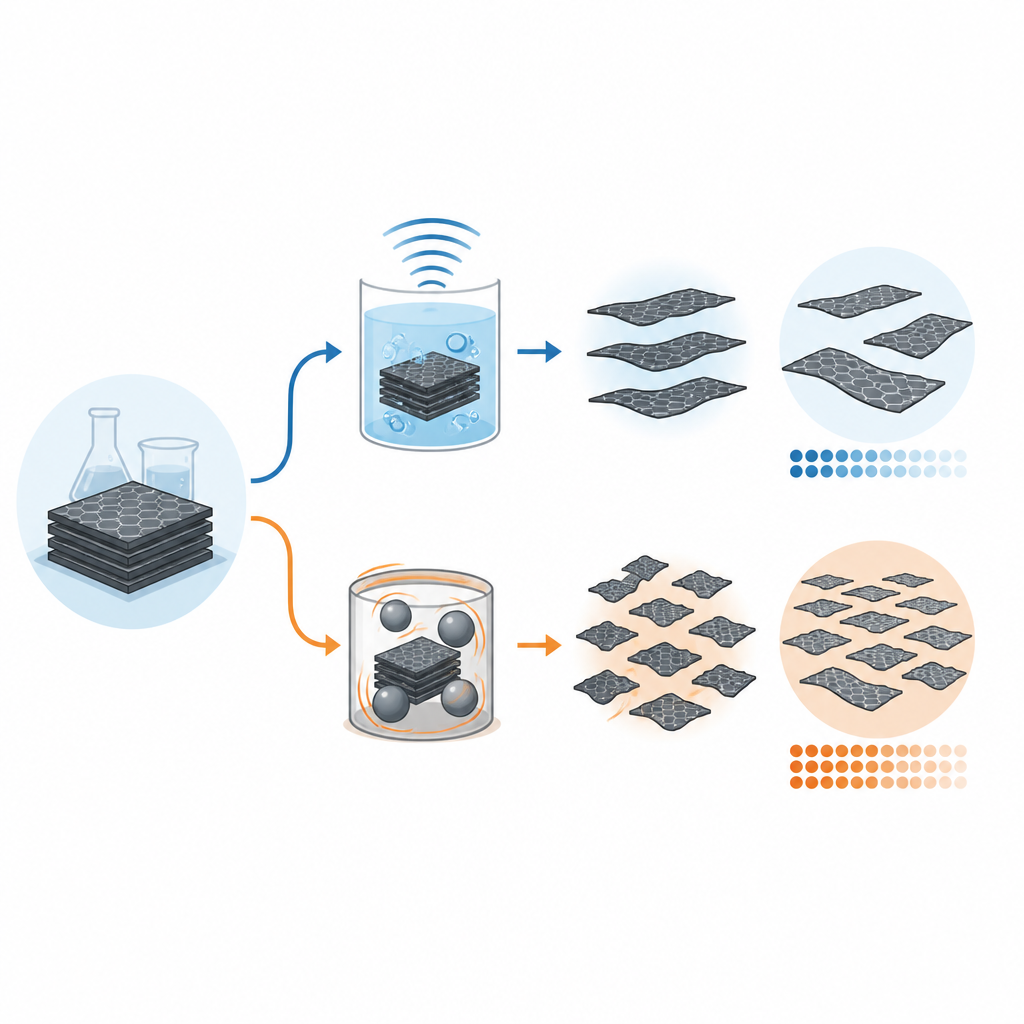
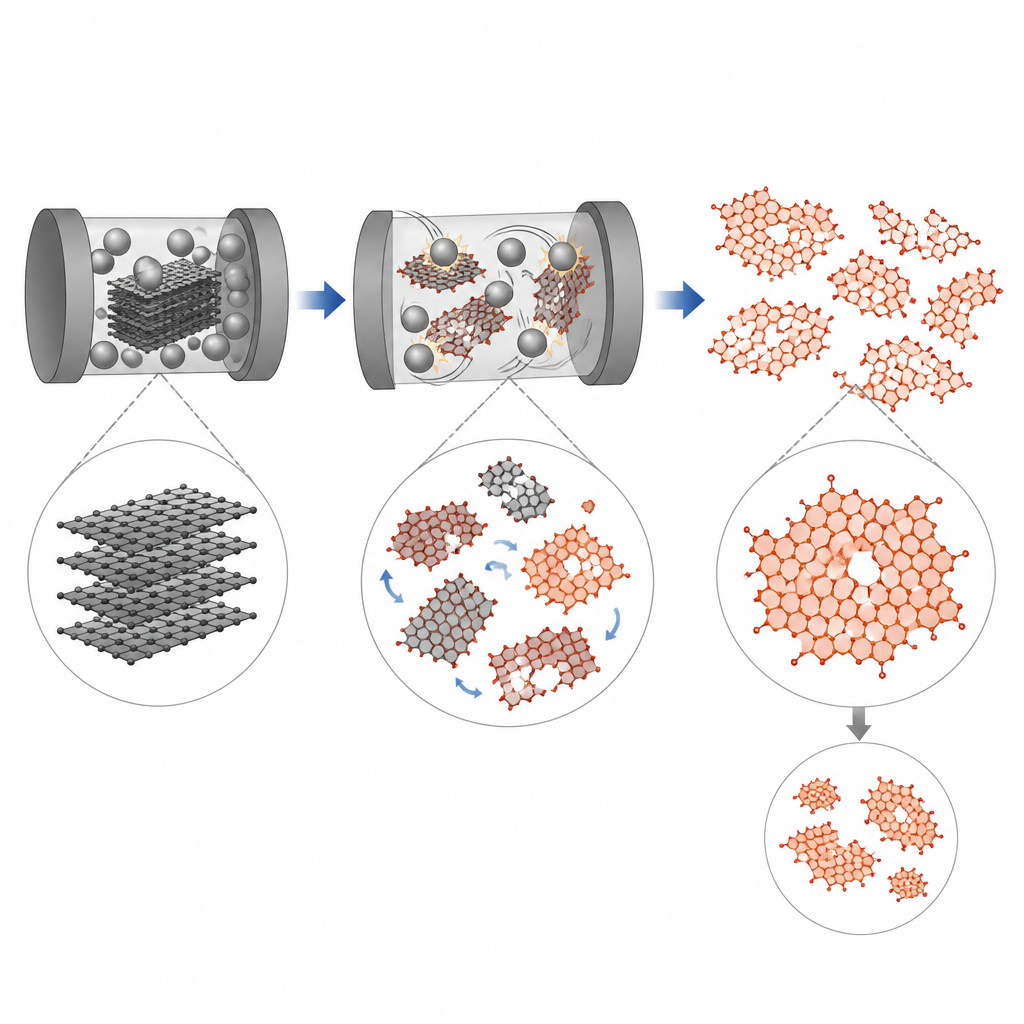
The authors focused on graphite oxide made by the Tour method, a safer and more uniform route than classic recipes. They then compared four eco-friendly mechanical exfoliation strategies: an ultrasonic bath, an ultrasonic probe, a ball mill, and a ball mill aided by ordinary sugar (glucose). In ultrasound methods, high-frequency sound in water creates bubbles that grow and collapse, tugging at the stacked sheets. In ball milling, hard balls inside a shaking container strike and rub the powder, physically prying layers apart. By using a formal design-of-experiments approach, the team systematically varied time, power, vibration frequency, and starting amounts of material and glucose, then tracked how each factor changed carbon content, surface area and layer stacking.
Measuring how well the sheets are peeled
To judge success, the researchers measured specific surface area, which reflects how much active surface is exposed per gram of material, and they used X-ray diffraction to estimate how many layers remained stacked together. They also checked how much oxygen was still present and examined the sheet structure with infrared spectroscopy and electron microscopy. Ultrasound methods produced surface areas between roughly 6 and 30 square metres per gram, with shorter treatment times and higher starting concentrations generally giving better results. However, prolonged sonication tended to fragment the sheets into smaller pieces, increasing defects and limiting useful surface area even when fewer layers were present.
Grinding wins on usable surface area
Ball milling turned out to be far more effective at opening up surface area. Without any additives, the ball mill produced graphene oxide with surface areas up to about 71 square metres per gram, the highest in the study, although the sheets still formed somewhat thicker stacks than in the ultrasound cases. Adding glucose gave intermediate surface areas, around 54 square metres per gram, and slightly altered the chemistry: sugar helped protect the carbon framework from losing oxygen groups too quickly, acting a bit like a mild chemical shield. Overall, the amount of starting graphite oxide strongly influenced both surface area and layer count, while milling time and frequency needed to be balanced to avoid over-grinding the sheets into overly damaged fragments.
What this means for future devices
For engineers designing graphene-based materials, this work offers a practical map. If the goal is to maximize exposed surface area for tasks like energy storage, gas capture or pollutant removal, ball milling of Tour-method graphite oxide, without extra additives, is the most efficient of the tested methods. Ultrasound, especially in a simple bath, is gentler and can yield thinner stacks with fewer layers but at the cost of lower usable surface. By showing how specific processing choices tune the balance between sheet thickness, defect density and chemistry, the study lays out clear guidelines to tailor graphene oxide to the demands of different technologies.
Citation: Bukovska, H., Gómez-Mancebo, M.B., García-Pérez, F. et al. Experimental evaluation of eco-friendly exfoliation strategies for Tour-method graphene oxide. Sci Rep 16, 15194 (2026). https://doi.org/10.1038/s41598-026-42185-9
Keywords: graphene oxide, graphite exfoliation, ultrasonic processing, ball milling, specific surface area