Clear Sky Science · en
Ag2O-decorated TiO2 for ultrasensitive SERS detection of crystal violet
Why tiny traces of a purple dye matter
Crystal violet is a vivid purple dye once popular in textiles and even food, but it can damage DNA, disrupt cell chemistry, and harm organs when people are exposed over time. Although many countries now restrict its use, the dye still shows up in waterways and farmed fish at extremely low levels that are hard to monitor. This study introduces a new, low‑cost sensing surface that can spot crystal violet in water at trillionths of a mole per liter, helping regulators and producers keep contaminated products off our plates.
A safer way to see hidden pollution
Detecting trace amounts of chemicals usually requires large instruments and time‑consuming sample preparation. Surface‑enhanced Raman scattering (SERS) offers a faster route: a laser shines on a material, and the way the light scatters back carries a unique "fingerprint" of any molecules stuck to its surface. Traditional SERS sensors rely on gold or silver, whose electrons collectively vibrate in response to light, amplifying the signal. However, these precious metals are expensive, can tarnish, and often give inconsistent results. The authors instead focus on semiconductors—more stable and cheaper materials—but boost their usually weaker signals by carefully engineering how electrons move at their surfaces.
Building a smart sensing bead
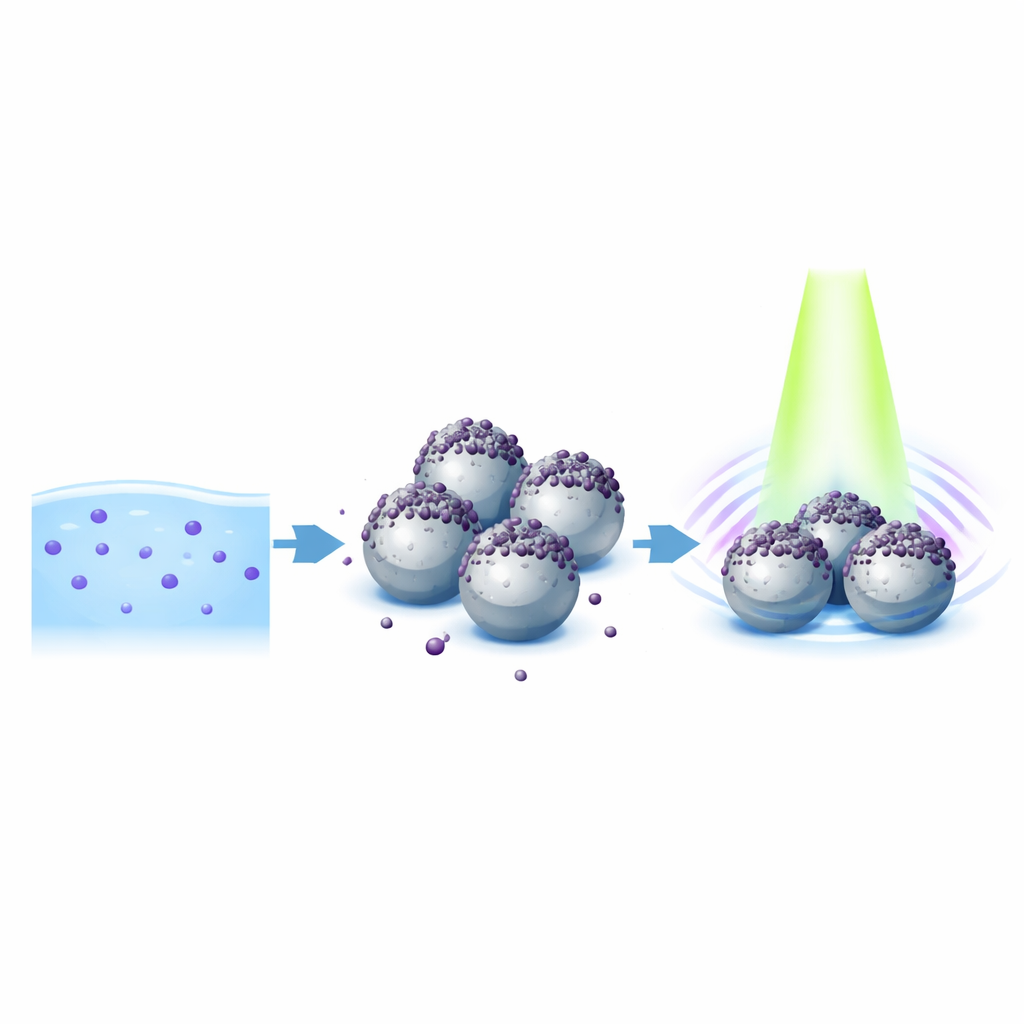
The team first created tiny, highly uniform spheres of titanium dioxide (TiO2), a common white pigment also found in sunscreen. They then gently coated these spheres with even smaller particles of silver oxide (Ag2O), producing a tightly linked pair of materials known as a p–n heterojunction. Scanning electron microscope images show that the once‑smooth TiO2 beads become rough and textured as Ag2O dots cover their surfaces, increasing the area where dye molecules can land. Other techniques, including X‑ray diffraction, infrared spectroscopy, and measurements of how the materials absorb light, confirm that both ingredients keep their crystalline identity but now share electronic properties that differ from either one alone.
Turning faint whispers into loud signals
When the researchers dipped the Ag2O/TiO2 beads into solutions of crystal violet and then dried them into thin layers, they found that the Raman fingerprint of the dye remained clearly visible down to a concentration of 1.0 nanomolar. Below this, the signal disappeared into the noise. Over a wide range of dye levels, the intensity of key peaks in the spectrum changed in a straight‑line fashion with concentration, which is crucial for accurate quantification. Compared with bare TiO2 or a simple silver‑on‑TiO2 composite, the Ag2O‑decorated version offered a much stronger and more reliable response, rivaling that of noble metal substrates while using cheaper and more stable components. Tests in tap water, which contains salts and chlorine that often interfere with sensors, still produced recognizable dye signals, demonstrating real‑world promise even though the intensity dropped somewhat.
How the smart interface boosts sensitivity
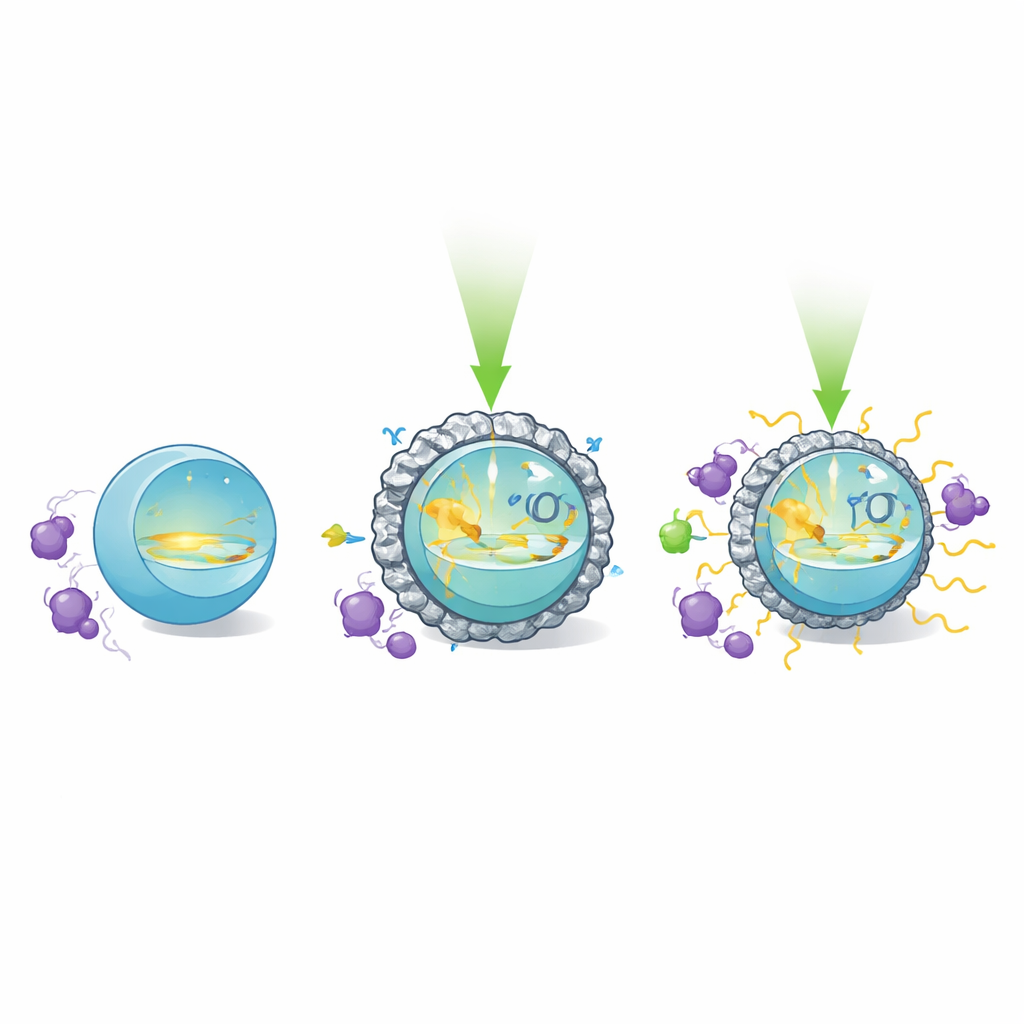
To understand why the new material works so well, the authors studied how it behaves under light and electrical probing. The Ag2O/TiO2 beads generated larger photocurrents and showed lower resistance to charge flow than pure TiO2, evidence that the junction between the two components helps separate and shuttle electrons more efficiently. By mapping out the energy levels of the materials, they propose several pathways by which light from the laser can push electrons from one part of the system to another—from silver oxide to titanium dioxide and then into the crystal violet molecules themselves. This cascade of movements slightly reshapes the electron clouds of the dye, making its vibrations interact more strongly with the light and dramatically amplifying the Raman signal without relying on traditional metal plasmon effects.
What this means for clean water and safe food
Overall, the Ag2O‑decorated TiO2 beads form a robust SERS platform that combines high sensitivity, stability, and simple, room‑temperature fabrication. The sensor can repeatedly detect crystal violet at extremely low levels, with very little variation from spot to spot across the surface. Because the design is based on inexpensive, scalable chemistry and avoids easily corroded noble metals, it could be adapted to monitor many other harmful dyes and pollutants in water and food. In practical terms, this work brings routine, on‑site screening for trace contaminants a step closer, helping ensure that the bright colors in our environment do not hide invisible risks.
Citation: Wang, J., Hou, P., Yao, Q. et al. Ag2O-decorated TiO2 for ultrasensitive SERS detection of crystal violet. Sci Rep 16, 11496 (2026). https://doi.org/10.1038/s41598-026-42173-z
Keywords: crystal violet, SERS sensors, semiconductor heterojunction, water pollution monitoring, Raman spectroscopy