Clear Sky Science · en
A comprehensive analytical study of solitons and nonlinear dynamics in a concatenated DNLS-type model
Why waves that refuse to spread out matter
From pulses of light in fiber‑optic cables to disturbances in plasma around stars, many waves behave in surprisingly stubborn ways. Instead of spreading and fading, they can bunch into compact packets that travel long distances without changing shape. These structures, called solitons, can coexist with far more irregular, chaotic motions. This article develops a unified mathematical model that captures both orderly soliton behavior and the route toward chaos in a single framework, offering insights that connect optics, plasma physics, and other wave‑based technologies.
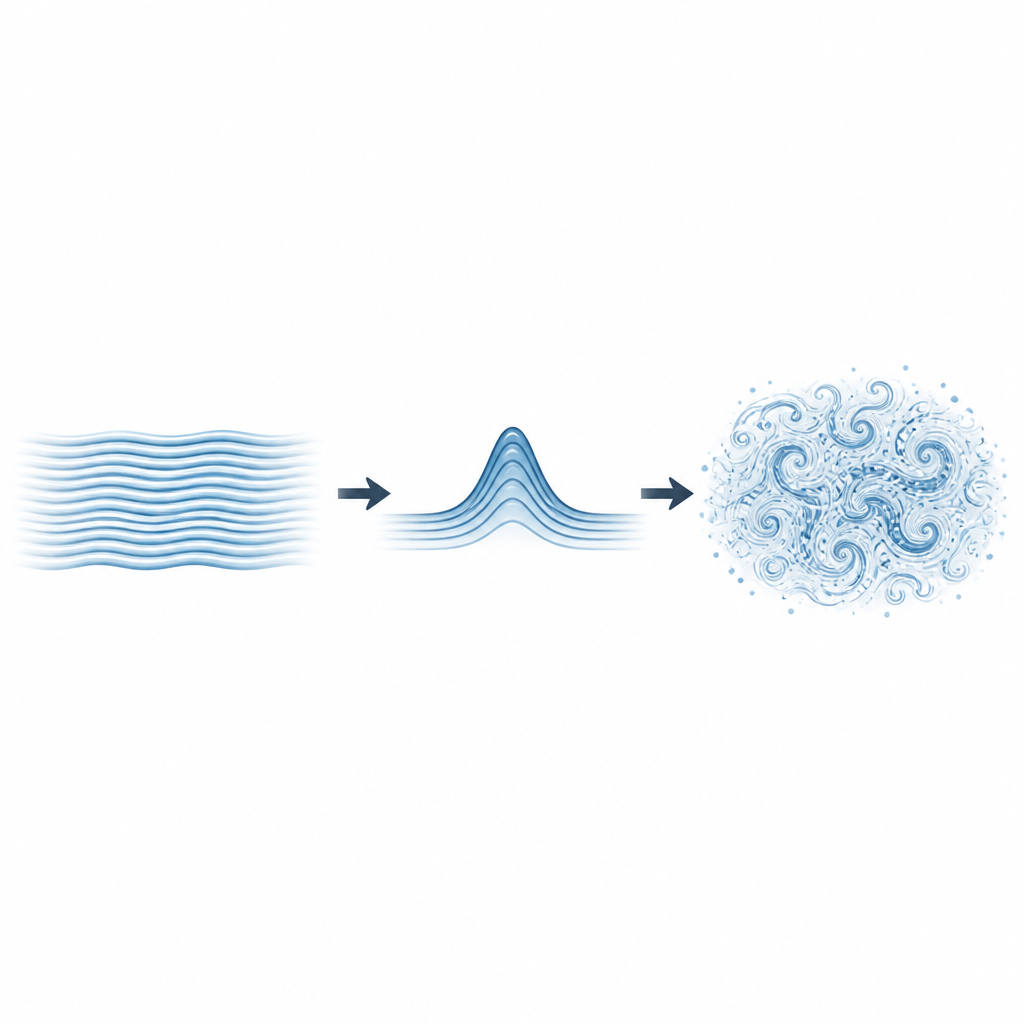
Bringing several wave stories into one picture
Many classic equations describe how solitary waves move in different settings, from optical fibers to magnetic materials. Each of these equations focuses on a particular balance between nonlinearity, which tends to sharpen a wave, and dispersion, which spreads it out. The authors build a generalized model that stitches together three well‑known forms into a single “concatenated” equation. By tuning a few parameters, this new model can mimic each of the older ones or explore regimes in between, where several types of nonlinear effects act at once. This makes the framework flexible enough to represent a wide range of physical systems in one mathematical language.
Finding clean wave shapes inside a complex equation
To understand what kinds of waves the new model supports, the authors search for traveling patterns that keep their shape while moving. They convert the original equation, which depends on both space and time, into a simpler one that follows the profile of a moving pulse. Using a technique called the Modified Sardar Sub‑Equation method, they systematically construct exact solutions for these profiles. The result is a full menagerie of wave forms: smooth bright pulses that peak above a background, bell‑shaped envelopes, dark and kink‑like dips on a steady background, and even singular structures where the intensity becomes extremely large. These solutions give clear “snapshots” of how energy can localize and travel in the model.
When regular waves give way to chaos
Exact wave shapes tell only part of the story; real systems can also slip into irregular behavior. To probe this, the authors treat the reduced equation as a dynamical system and study how its trajectories move in an abstract state space. They analyze steady states and classify them as centers, saddles, or cusp points, then introduce a weak external disturbance to see how the motion responds. Using numerical tools such as Poincaré maps, return maps, power spectra, and Lyapunov exponents, they track how the system transitions from simple periodic oscillations, to quasi‑periodic motion, and finally to fully developed chaos. Fractal dimensions and three‑dimensional “strange attractors” reveal that the irregular patterns are not random noise but structured, deterministic chaos.
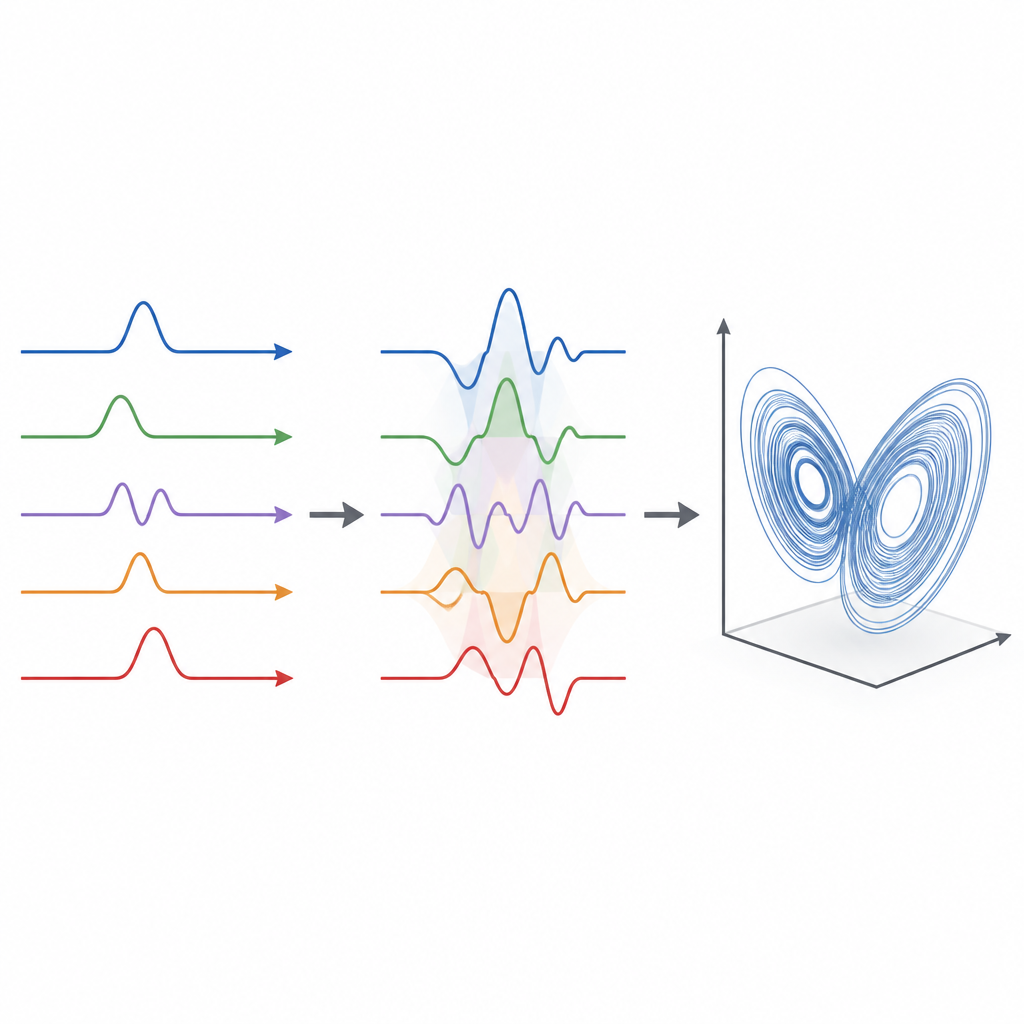
Linking solitons and chaos in one framework
By combining exact analytical solutions with a detailed dynamical analysis, the study shows that the same concatenated model can host long‑lived solitary pulses and highly sensitive chaotic behavior, depending on how its parameters are tuned. For a lay reader, the key message is that the fate of a wave in a complex medium is not fixed; with slight changes in conditions, a neat, self‑contained pulse can morph into tangled, unpredictable motion. This unified view of solitons and chaos may help researchers design better ways to guide, stabilize, or deliberately exploit wave behavior in optical communication, plasma devices, and other technologies where controlling energy flow is crucial.
Citation: Farooq, F.B., Raza, N., Ejaz, A. et al. A comprehensive analytical study of solitons and nonlinear dynamics in a concatenated DNLS-type model. Sci Rep 16, 15557 (2026). https://doi.org/10.1038/s41598-026-42168-w
Keywords: solitons, nonlinear waves, chaotic dynamics, bifurcation, plasma physics