Clear Sky Science · en
Cloud-based collaborative CNC manufacturing framework integrating tool wear monitoring and scheduling support
Smarter machines behind everyday products
From car engines to aircraft parts, many everyday products depend on metal pieces shaped by computer-controlled cutting machines. These machines are precise but can still waste time and material when their cutting tools silently wear out. This article explores a new way to connect such machines through the cloud so they can share health information about their tools, helping factories plan work better, avoid surprise breakdowns, and cut waste without handing full control over to robots.
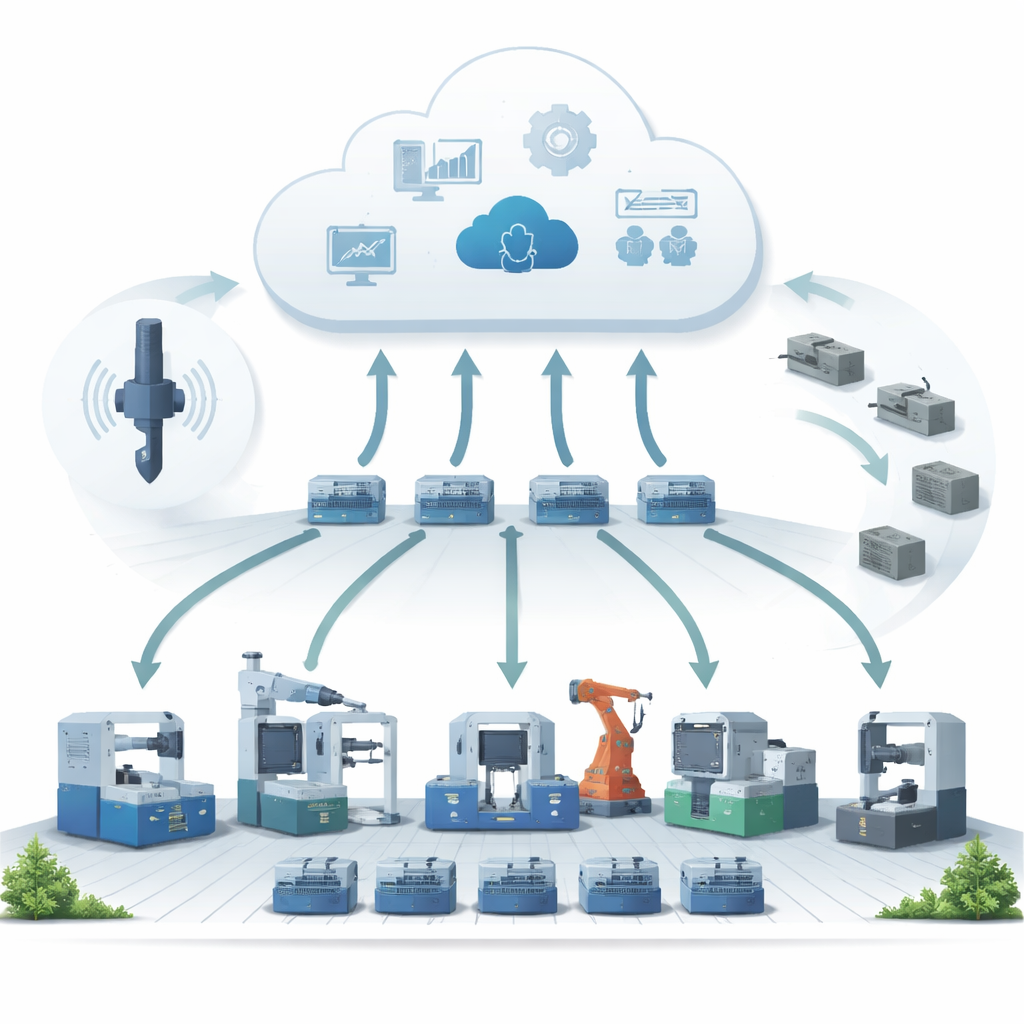
Bringing scattered machines into one connected shop
In many factories, each computer numerical control (CNC) machine behaves like a stand‑alone island: it cuts parts reliably but rarely “talks” to neighboring machines or to higher‑level planning systems. The authors propose a cloud‑native framework that turns these islands into a coordinated network. Individual machines and other shop‑floor equipment send data to nearby edge devices, which forward processed information to cloud services. In the cloud, shared software services analyze this data and feed results back to a central scheduler that can adjust job queues and recommend actions to human operators. Instead of simply watching dashboards, decision‑makers receive concrete, timely suggestions about where to send the next job or when to change a worn tool.
Listening to tool wear without touching the machine
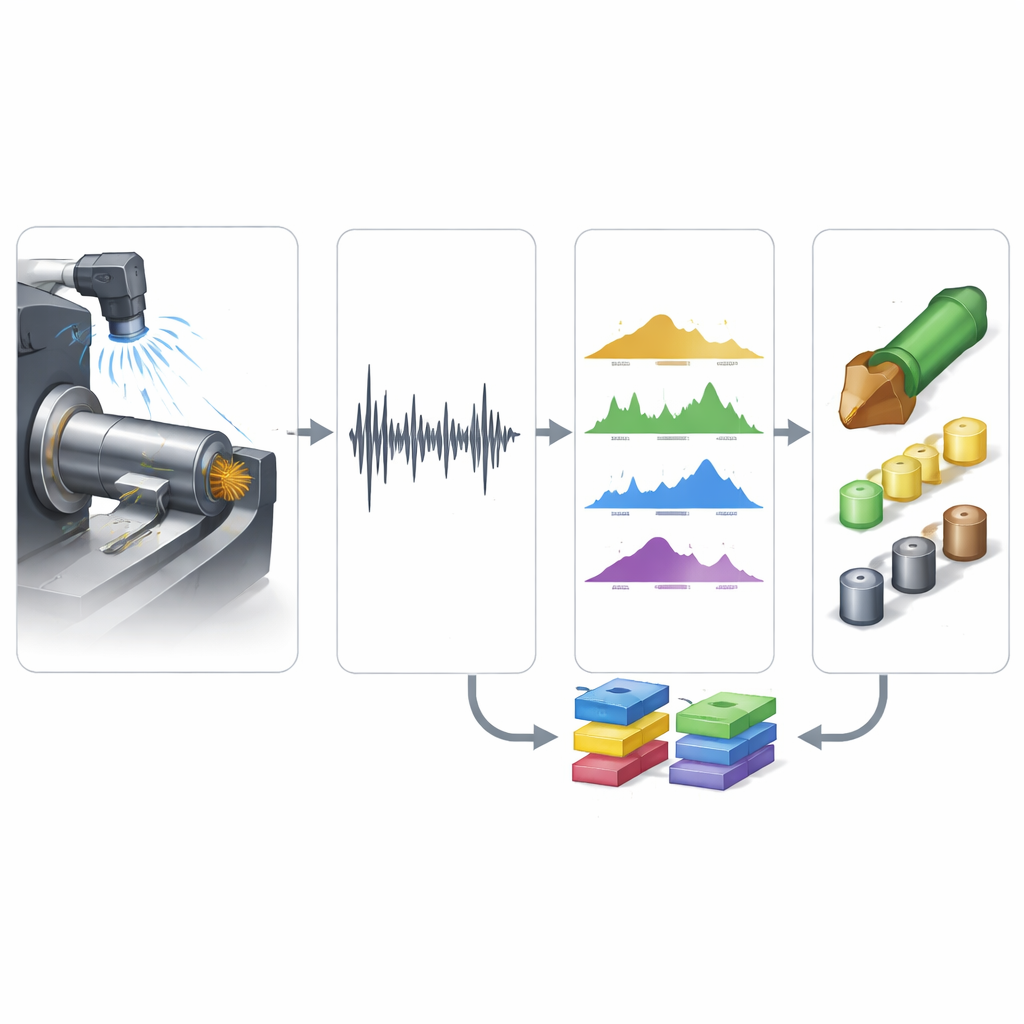
To show how this connected setup can work in practice, the team focuses on one key problem: cutting tools that gradually wear down. Worn tools leave rougher surfaces, risk damaging parts, and force unplanned downtime when they finally fail. Rather than attaching sensors directly to the machine, the researchers use a laser that “listens” to tiny vibrations in the tool holder without making contact. This laser Doppler vibrometer records high‑resolution vibration signals while a carbide insert turns steel bars. By staying off the machine structure, the laser avoids adding weight or altering the cutting conditions, giving a clean view of how the tool’s behavior changes as it wears.
Turning noisy vibrations into a health score
Raw vibration signals are complex and noisy, so the authors apply a mathematical technique that breaks each signal into several simpler vibration bands, each tied to a distinct range of frequencies. From these bands they extract features that capture how energy is distributed across frequencies. An automated machine‑learning pipeline then searches through many possible models and settings to find a combination that best links these vibration features to the actual amount of flank wear observed under a microscope. One vibration band in a mid‑frequency range turns out to be especially sensitive to wear, likely because it reflects how the tool, workpiece, and holder vibrate together as the cutting edge degrades. The resulting model estimates wear with high accuracy on the test data.
From tool health to better scheduling decisions
What makes this work stand out is not only the accuracy of the wear estimates but also how they are used. The tool health predictions are packaged as simple “events” and sent to the cloud scheduler. When estimated wear crosses certain thresholds, the scheduler can reshuffle jobs, route work toward machines with healthier tools, or prompt operators to prepare a tool change before surface quality slips. In demonstrations with multiple CNC machines connected through a message broker, communication delays stayed well below a quarter of a second—fast enough for live planning and monitoring. At the same time, the framework includes a basic security architecture with encrypted links and access controls, acknowledging that industrial‑grade cybersecurity will require additional layers such as intrusion detection and formal audits.
What this means for factories today
The study shows that it is possible to turn detailed tool‑wear sensing and advanced analytics into practical, cloud‑based decision support for CNC machining. Instead of guessing when a tool should be replaced or reacting only after quality problems appear, factories can base their scheduling and maintenance on measured tool health, reducing scrap and unnecessary tool changes. The current system is still a demonstrator: it has been tested under controlled conditions, focuses on one tool‑material pair, and stops short of fully automatic machine‑level control. Even so, it offers a realistic path toward factories where connected machines quietly share their condition, and planners use that insight to keep production flowing smoothly and efficiently.
Citation: Imran, Nouioua, M. & Mekid, S. Cloud-based collaborative CNC manufacturing framework integrating tool wear monitoring and scheduling support. Sci Rep 16, 12753 (2026). https://doi.org/10.1038/s41598-026-42165-z
Keywords: cloud manufacturing, CNC machining, tool wear monitoring, predictive maintenance, Industry 4.0