Clear Sky Science · en
Exploring central star variability of planetary nebulae using gaia photometry
Why dying stars leave such surprising shapes
When Sun-like stars die, they shed their outer layers and light up colorful clouds of gas called planetary nebulae. Many of these nebulae are not simple bubbles but striking butterflies, rings, and ovals. This study asks a deceptively simple question with big implications for how our own Sun might end its life: how often is the star at the center of a planetary nebula actually a close pair of stars, and how does that partnership help carve these strange shapes?
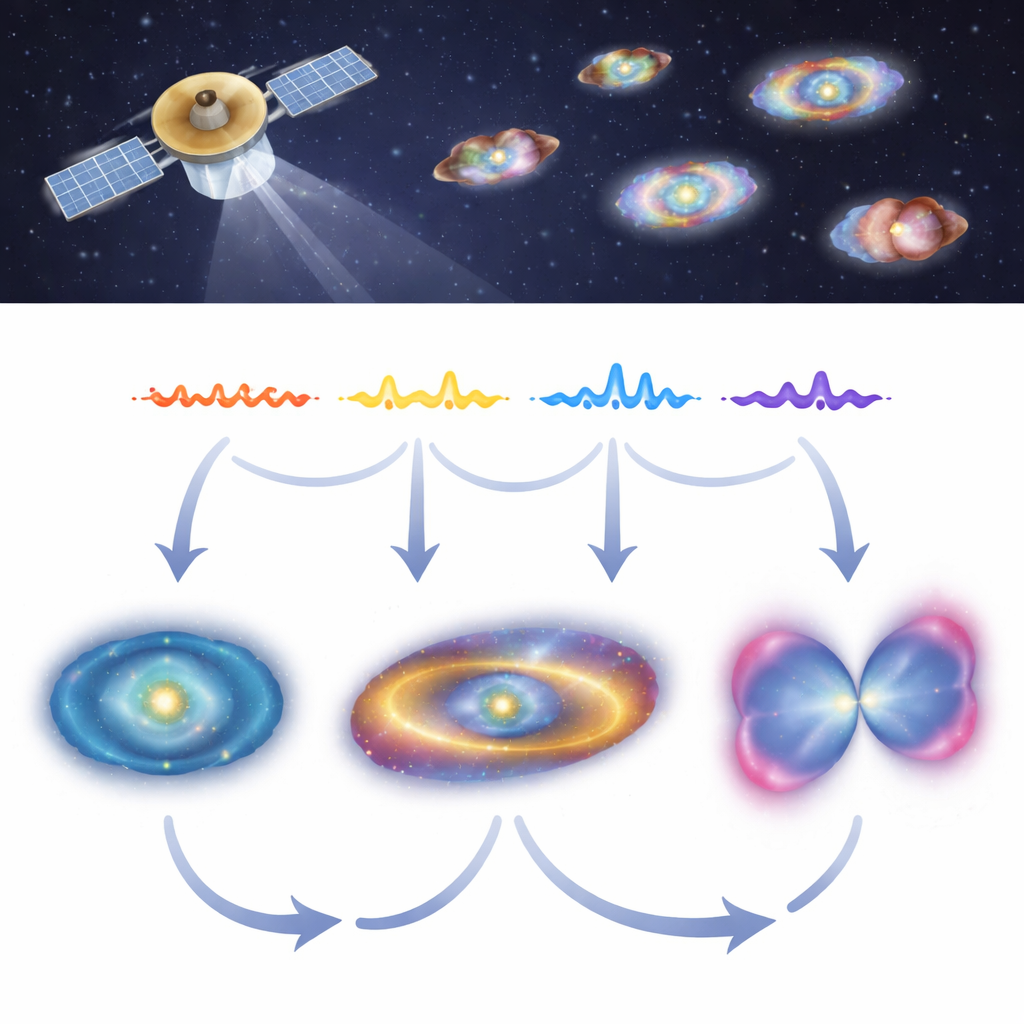
Looking for flickers in stellar hearts
The researchers focused on 81 “central stars” that sit in the middle of planetary nebulae and were already flagged as variable—stars whose brightness changes over time—in the European Space Agency’s Gaia mission data. They then pulled together a powerhouse set of space and ground-based observatories: Gaia, which repeatedly scans the sky; NASA’s TESS and Kepler satellites, built to measure tiny dips in starlight; and the long-running OGLE survey from Earth. By tracking how each star brightened and dimmed, and folding these changes over repeating cycles, they could uncover hidden rhythms that betray orbiting companions.
How brightness rhythms reveal hidden partners
A close stellar companion can reveal itself in several ways. If one star passes in front of the other, we see eclipses—sharp dips in brightness. If gravity stretches a star into a rugby-ball shape, its changing orientation produces a smooth, double-peaked wave. And if a hot star heats the side of a cooler partner that faces it, we see a single brightening and fading as that warm face turns toward and away from us. The team used specialized mathematical tools to sift through the light curves—plots of brightness over time—and pick out reliable repeating periods from hours to many months, while carefully cross-checking uncertain cases and possible contamination from nearby stars.
New binary stars and a strong link to nebular shape
From this detective work, the study uncovered 17 previously unrecognized periodic systems among the 81 central stars. Most of the new finds are close, short-period binaries orbiting in less than a day or a few days, showing signatures of eclipses, tidal distortion, or heating effects. Five systems instead display slow, large-amplitude variations typical of pulsating giant stars in long-period binary arrangements. One especially intriguing object, the central star of the nebula Al 2-R, shows both a roughly one-day cycle and a 500-day cycle, suggesting it is both a close binary and a pulsating star at the same time. In parallel, Gaia data provided the first uniform confirmation of binarity in 15 other central stars that had been suspected binaries from earlier work.
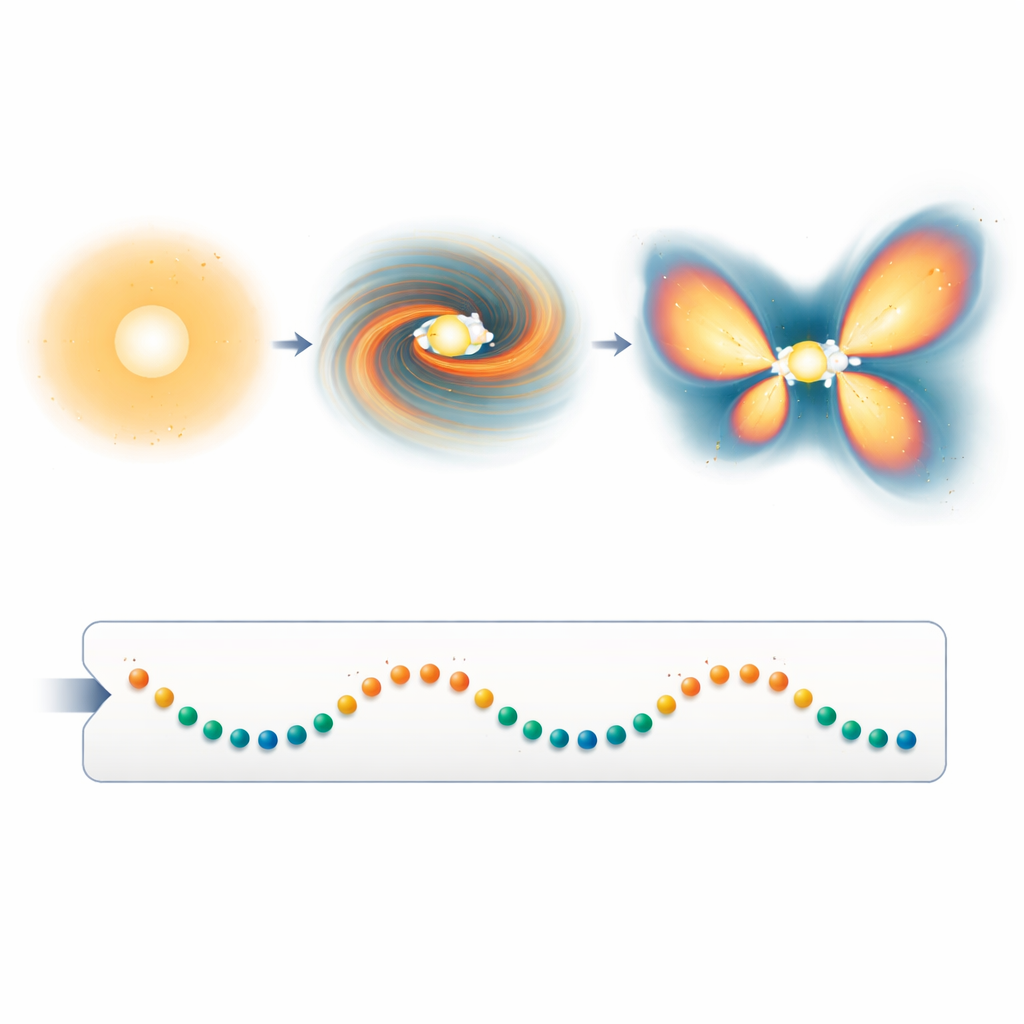
Why many nebulae look like cosmic butterflies
The shapes of the surrounding nebulae turned out to be a crucial clue. Independent catalogues classify planetary nebulae as roughly round, elongated (elliptical), or strongly two-lobed (bipolar). Among the newly identified close binaries, nearly 80 percent of the nebulae with resolved shapes are bipolar or elliptical—significantly more asymmetric than the general planetary nebula population. When the authors compared this with systems where the companion star orbits much farther out, they found that wide binaries also favor asymmetric nebulae, but less strongly. This pattern fits the picture in which close stellar partners interact intensely—sharing and stripping gas, forming dense equatorial rings and jets—that then guide the dying star’s outflow into strikingly non-spherical forms.
What this means for the fate of stars like our Sun
Putting all of their detections together, the authors estimate that nearly half of the variable central stars in their Gaia-selected sample are short-period binaries—a higher fraction than earlier surveys that did not pre-select for variability. This highlights how the way we choose stars to study can strongly influence the numbers we derive, but it also underscores that close companions are common at the hearts of planetary nebulae. As Gaia continues observing and future data releases extend the time coverage, astronomers expect to uncover even more subtle and longer-period systems. For a general reader, the message is clear: many of the universe’s most beautiful stellar “death shrouds” are not the work of single stars dying quietly, but of close stellar couples whose gravitational dance sculpts the gas into cosmic butterflies and rings.
Citation: NegmEldin, M.A., Ali, A., Hamid, G.M. et al. Exploring central star variability of planetary nebulae using gaia photometry. Sci Rep 16, 9830 (2026). https://doi.org/10.1038/s41598-026-42163-1
Keywords: planetary nebulae, binary stars, Gaia photometry, stellar evolution, variable stars