Clear Sky Science · en
A stress-controlled reservoir formation model for ultra-deep sandstones in foreland thrust belts: case study of the cretaceous bashijiqike formation, bozi-dabei area, kuqa depression, tarim basin
Why deep rocks matter for our energy future
Far beneath the deserts of western China, more than 7 to 8 kilometers down, tightly packed sandstones hold enormous stores of natural gas. At such extreme depths, heat and pressure have squeezed most of the empty space out of the rock, making it difficult for gas to move. Yet some zones still produce gas well, while others do not. This study asks a simple but powerful question: how does the way rocks are squeezed and strained by mountain-building forces decide where good reservoirs form, and where they do not?
A squeezed basin at the foot of the mountains
The research focuses on the Kuqa Depression, a foreland basin that formed as the South Tianshan Mountains pushed southward. Over time, rivers and deltas deposited sand that later became the Cretaceous Bashijiqike Formation. Much later, renewed compression crumpled these layers into a series of folds and thrust faults. This folding did not simply tilt the rocks; it created distinct structural zones at different depths and stress levels. Some blocks are pushed up and sit relatively shallow, others are buried deeper and squeezed harder, and a few lie in positions where stress is focused or relieved. These differences in tectonic setting, the authors argue, are the key to understanding why some ultra-deep gas reservoirs work better than others.
What the pores and cracks look like up close
Using cores from 19 wells, thin sections, and electron microscope images, the team describes the tiny spaces that store and transmit gas. The sandstones are mostly quartz and feldspar grains with moderate to poor sorting and relatively low original “openness.” Today, the main pores are the leftover gaps between grains and small holes carved out by chemical dissolution of feldspar and rock fragments. At the same time, tectonic forces have produced networks of micro-fractures that cut across grains. Overall, porosity averages only about 6%, and permeability is extremely low. However, some samples with many fractures manage to transmit fluids surprisingly well even though they have little pore volume, revealing that cracks can partially compensate for lost pore space. 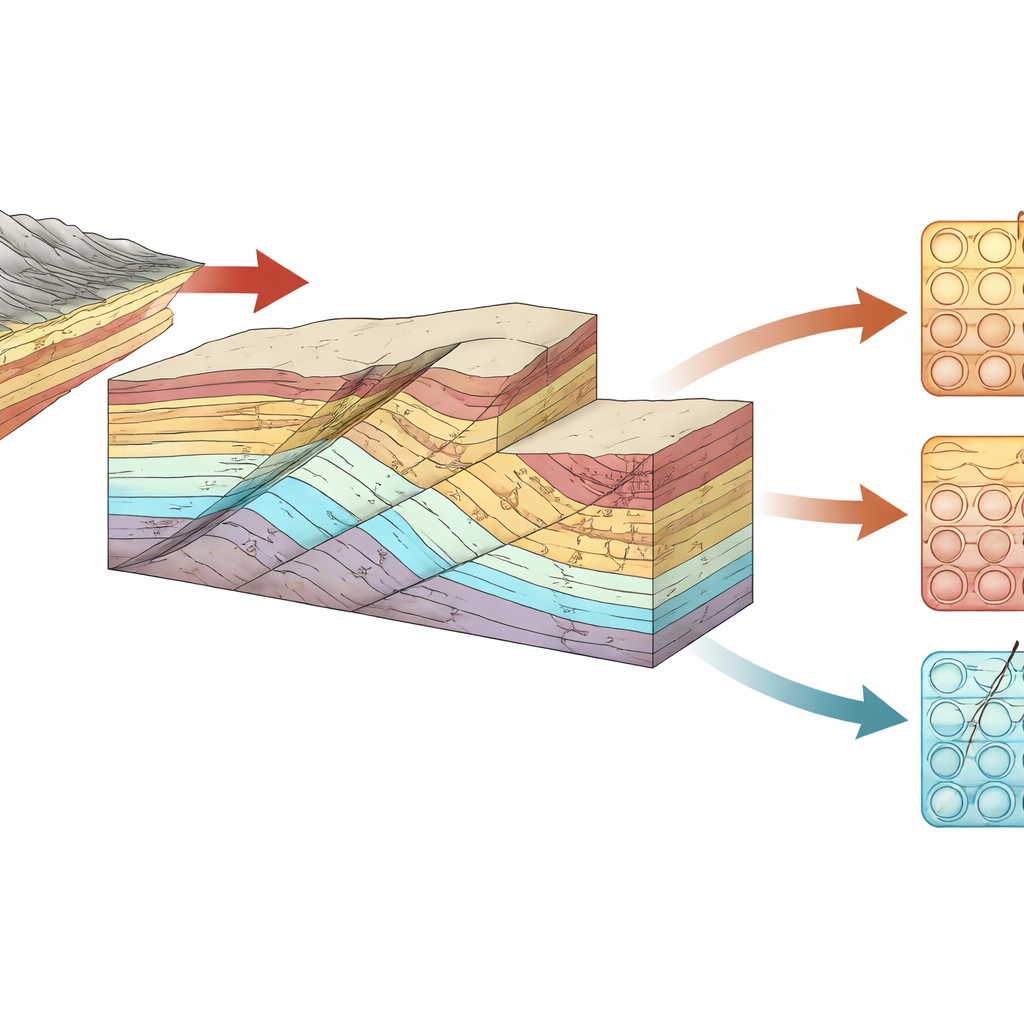
How long-term burial and squeezing reshaped the rock
The Bashijiqike sandstones have passed through a complex history of burial, uplift, and renewed burial tied to major tectonic episodes. During early burial, compaction and carbonate cement choked pores, while later uplift allowed some cement and feldspar to dissolve, briefly improving storage space. From roughly the last 5 million years onward, deep burial combined with strong north–south compression turned the area into a true “pressure cooker.” In this latest stage, compaction became intense, closing many remaining pores, but at the same time generating fractures and allowing acidic fluids to etch new dissolution pores. The result is a delicate balance: too little stress and the rock stays relatively open but poorly fractured; too much and pores collapse faster than fractures can help.
Measuring stress and strain inside the Earth
To move beyond a simple burial story, the authors quantified how hard the rocks have been squeezed. They used acoustic emission tests on core plugs, well logs, and numerical simulations to estimate present and past stress in three directions. They also measured rock stiffness (Young’s modulus) and the tendency to deform sideways (Poisson’s ratio). These mechanical properties act as a kind of “memory” of the stress history. Across four structural zones arranged from north to south, they found that maximum horizontal stress first increases and then decreases, and that zones with higher stress and greater strain tend to show denser rocks and lower porosity. Crucially, the relationship is not uniform: some areas with high stress but small stress differences retain better pore systems, while zones where stress is strongly focused develop tight, highly fractured rocks.
Where the best deep reservoirs hide
By combining mechanical measurements with pore and fracture observations, the team outlines three main evolutionary stages, from moderately compact rocks with mostly pores, through a mixed stage where pores shrink but fractures start to help flow, to highly compact rocks where fracture networks dominate. They then map these stages onto different structural positions within the fold-and-thrust belt. Shallow hanging-wall and distal footwall blocks, under weaker effective compression, keep relatively high porosity (often near or above 10%) but have fewer fractures. In contrast, central footwall zones experience concentrated stress, leading to very low porosity (often below 5%) yet dense fracture systems. This pattern explains why some ultra-deep gas fields behave as classic pore reservoirs, while others function as fracture-controlled systems despite similar rock types and ages. 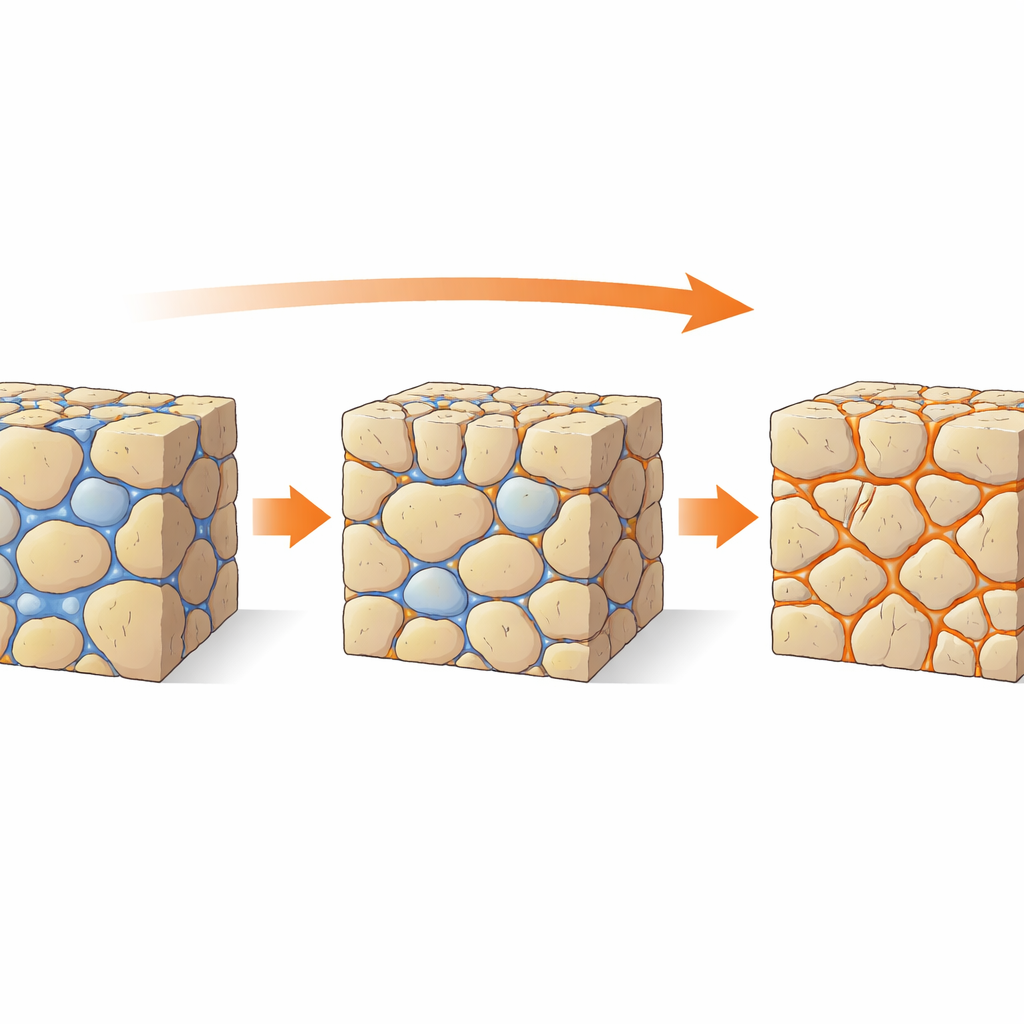
What this means for finding future gas
For non-specialists, the key lesson is that depth alone does not determine whether an ultra-deep rock layer will be a good gas reservoir. What matters just as much is how, where, and for how long the rocks have been squeezed by the growth of nearby mountains. By turning measurements of rock stiffness and in-situ stress into a “stress–strain controlled” model, this study shows how to predict zones dominated by open pores versus those dominated by fractures. That insight gives exploration teams a new way to use standard well logs and mechanical data to target the most promising sweet spots in some of the deepest and most challenging gas fields on Earth.
Citation: Wang, C., Zhong, D., Mo, T. et al. A stress-controlled reservoir formation model for ultra-deep sandstones in foreland thrust belts: case study of the cretaceous bashijiqike formation, bozi-dabei area, kuqa depression, tarim basin. Sci Rep 16, 11432 (2026). https://doi.org/10.1038/s41598-026-42156-0
Keywords: ultra-deep sandstone reservoirs, tectonic compression, Kuqa Depression, pore and fracture evolution, geomechanics