Clear Sky Science · en
An automated decision making framework for modern vehicles CO2 emissions using multi modal engine telemetry and feature interpretability
Why cleaner car predictions matter
Cars and trucks are among the biggest contributors to climate‑warming carbon dioxide, yet it is surprisingly hard to say exactly how much any one vehicle will emit on the road. This study presents a new way to predict those emissions far more accurately by learning from large amounts of real vehicle data. Better prediction tools can help city planners design cleaner transport systems, automakers build lower‑carbon vehicles, and governments craft policies that actually match what comes out of tailpipes in everyday driving.
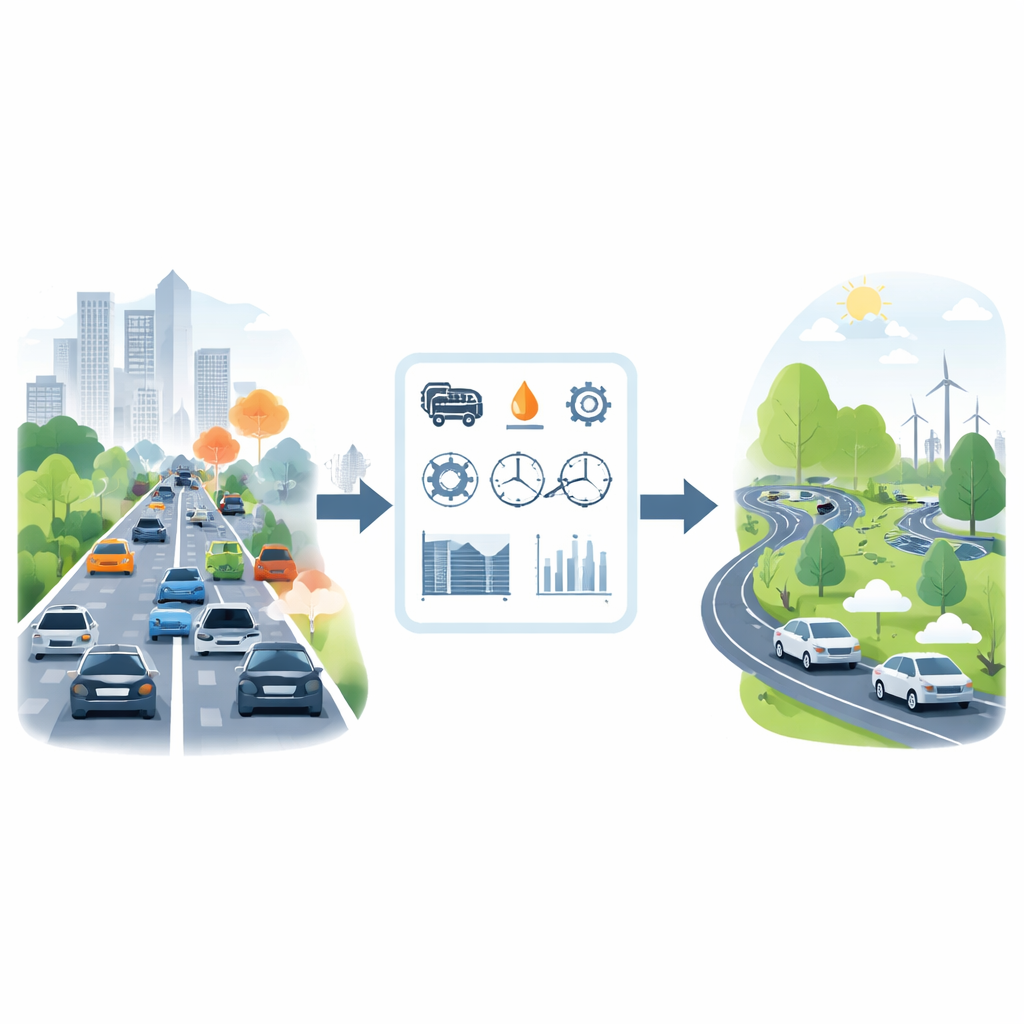
Looking under the hood of real cars
The researchers began with a rich dataset from the Government of Canada covering more than seven thousand vehicles over seven years. For each vehicle they had basic traits—such as engine size, number of cylinders, fuel type, and transmission—as well as how much fuel it used in city, highway, and mixed driving, plus the resulting carbon dioxide per kilometer. Using statistical tools, they first sorted out which of these traits really matter. They found that how much fuel a car uses in combined driving, and the related measure of fuel efficiency, are by far the strongest clues to its emissions. Engine size and city fuel use matter next, while highway fuel use and cylinder count add relatively little extra information.
Teaching a digital brain to read engine signals
To turn these clues into precise predictions, the team used a type of artificial neural network called a multi‑layer perceptron. This is a flexible mathematical “brain” that learns patterns by adjusting many internal connections. Yet choosing the best shape for this brain—the number of layers, how many units in each, and how fast it learns—can be a trial‑and‑error process. Instead of relying on standard, local search methods that can get stuck in mediocre solutions, the authors turned to two nature‑inspired search strategies named after desert horned lizards and giant armadillos. These methods explore many candidate network designs at once, nudging them toward better performance much like animals explore and refine their foraging paths.
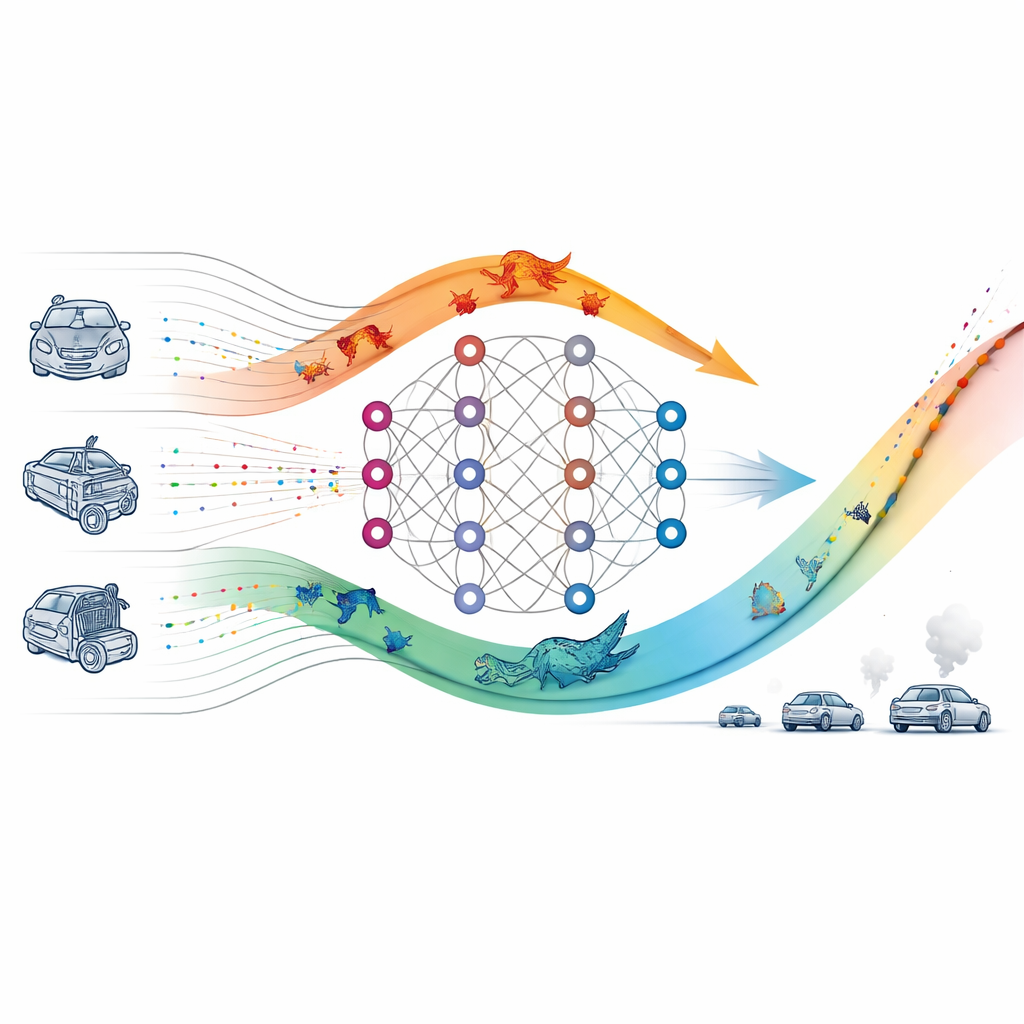
Nature‑inspired tuning for sharper forecasts
The two animal‑inspired search methods play different roles. The armadillo‑based approach roams widely at first, scanning the landscape of possible network settings, while the lizard‑based method zooms in to polish promising candidates. When used to tune the neural network, both strategies improved performance over traditional setups and over other popular machine‑learning tools such as boosted trees, random forests, and support vector machines. The standout model combined a three‑layer neural network with the armadillo‑style optimizer. It matched measured emissions so closely that it explained almost all of their variation, with only a small average error—a level of accuracy suitable for serious planning and policy use.
Opening the black box of the model
High accuracy alone is not enough if decision‑makers cannot see what is driving the numbers. To keep the system transparent, the researchers coupled their model with modern explanation techniques that trace which inputs push predictions up or down. Two complementary tools highlighted how each feature—such as combined fuel use, city fuel use, engine size, and fuel type—shapes the final emission estimate. These analyses confirmed that combined fuel use and engine size dominate the picture, together accounting for more than half of the model’s explanatory power, and revealed how emissions climb in nonlinear ways as these values rise. By aligning with basic physical expectations—that bigger, thirstier engines emit more—the explanations help build trust in the model’s recommendations.
From smarter predictions to greener streets
In plain terms, this work shows that feeding detailed engine and fuel‑use data into a carefully tuned digital brain can yield very accurate forecasts of how much carbon dioxide vehicles will emit. The strongest message is simple: vehicles that burn more fuel in everyday mixed driving, especially those with larger engines, are the main culprits. Because the model is both powerful and interpretable, it can serve as a decision aid for designing cleaner cars, managing fleets, and planning low‑carbon transport networks. As similar tools are expanded to use real‑time data and physical engineering rules, they could become a backbone of fact‑based efforts to cut climate pollution from the world’s roads.
Citation: Saraswat, S.K., Abdullah, M., Habelalmateen, M.I. et al. An automated decision making framework for modern vehicles CO2 emissions using multi modal engine telemetry and feature interpretability. Sci Rep 16, 12570 (2026). https://doi.org/10.1038/s41598-026-42137-3
Keywords: vehicle CO2 emissions, machine learning models, engine telemetry, transport decarbonization, intelligent transportation systems