Clear Sky Science · en
High efficiency far-field mmWave-based wireless power transfer system using Cu/Co metaconductor
Power Through the Air
Imagine charging your phone, drone, or even a satellite without ever plugging it in. Wireless power transfer promises exactly that, sending energy through the air instead of along copper cables. But today’s long-distance wireless power links are bulky and waste most of the energy on the way. This paper explores a new kind of ultra-thin metal wiring that makes far‑field wireless power transfer much more efficient, potentially shrinking future power‑beaming hardware for portable gadgets and space systems.
Why Long‑Distance Wireless Power Is Hard
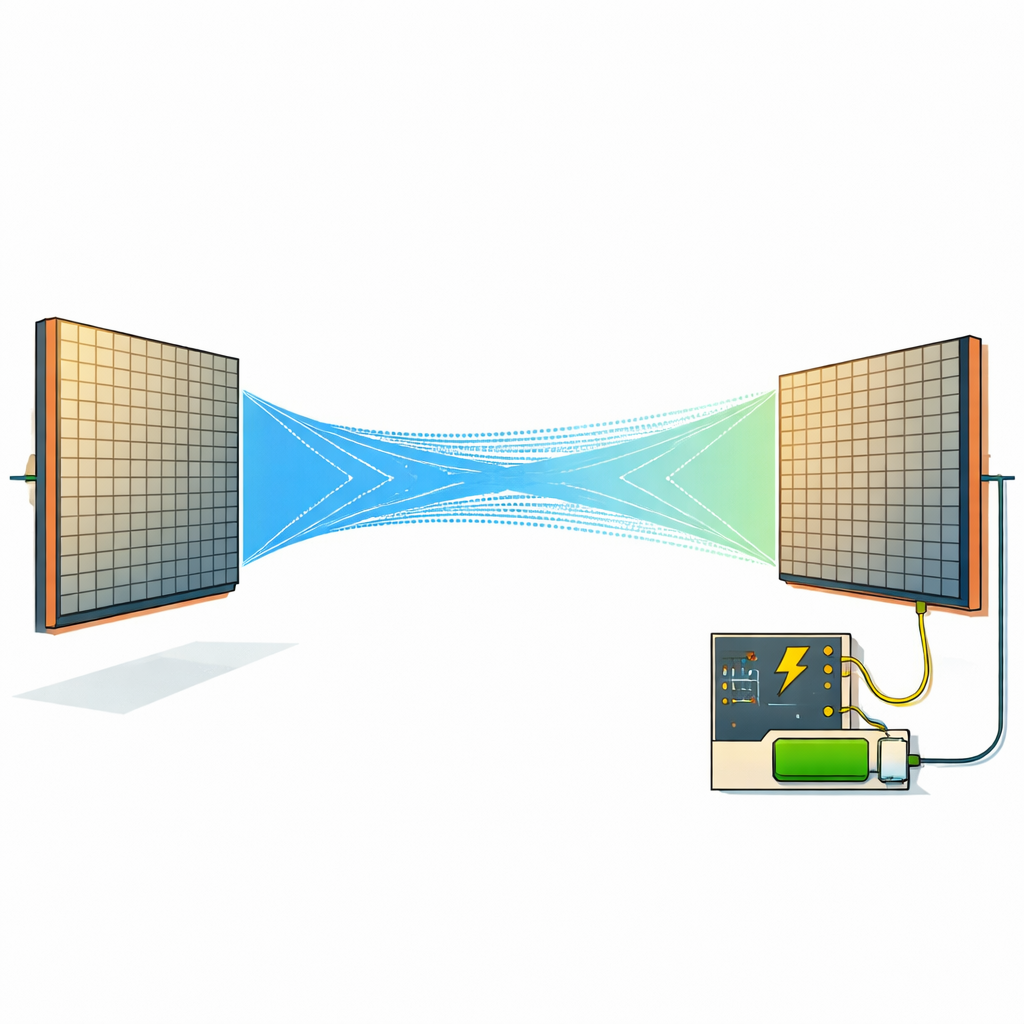
Most commercial wireless chargers today rely on short‑range magnetic coupling: two coils have to sit almost on top of each other. At larger distances, engineers instead use antennas that radiate energy as radio waves and then recapture it with a receiving antenna and a rectifier that turns the waves back into direct current. This “far‑field” approach can span meters or even kilometers, but current systems only turn a few percent of the transmitted power into usable electricity. One problem is that, at the relatively low radio frequencies often used, the antennas become physically large. Another, more subtle problem appears at much higher “millimeter‑wave” frequencies, where small, sharply focused beams are possible: here, energy is lost inside the metal feed lines and antenna structures themselves.
A New Kind of Metal for High‑Frequency Power
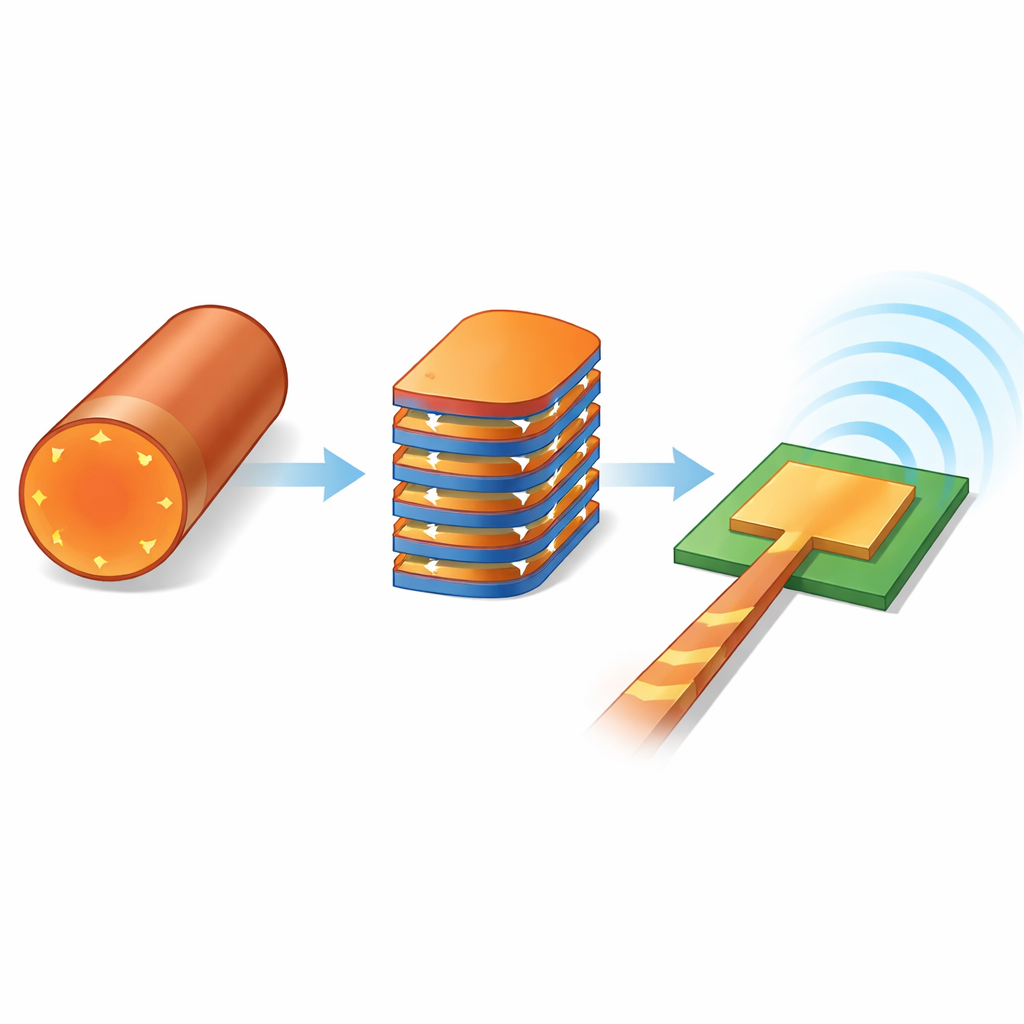
Those internal losses come from the “skin effect”: at high frequencies, electric current crowds into a very thin layer at the surface of an ordinary conductor such as copper, sharply increasing its resistance. To tackle this, the authors build on the idea of a “metaconductor,” a carefully engineered stack of ultra‑thin magnetic and non‑magnetic metal layers. In their design, many repeating layers of copper and cobalt—each only tens to hundreds of nanometers thick—are deposited on a low‑loss glass substrate. The magnetic behavior of cobalt and the non‑magnetic copper layer are tuned so that swirling eddy currents cancel one another out. In effect, the current can flow throughout the entire thickness of the stack instead of being squeezed into the outer skin, lowering resistance at millimeter‑wave frequencies.
Building a Complete Wireless Power Link
The researchers put this concept to the test in a full wireless power transfer system operating at 28 gigahertz, a frequency band similar to that explored for 5G networks. They designed compact 4×4 patch‑array antennas for both transmitter and receiver, along with the metal feed networks that distribute power to each patch. A rectifier circuit based on a fast Schottky diode converts the captured radio signal into DC power. Crucially, all of these key paths—the transmitting antenna, receiving antenna, and rectifier interconnects—were fabricated using the copper–cobalt metaconductor. For comparison, they also built a twin system where all metal parts were made from ordinary solid copper with the same total thickness.
Measuring the Gain in Real‑World Performance
In laboratory tests, the team measured how efficiently energy traveled from the transmitting antenna to the receiving antenna and how well the rectifier turned that signal into DC power. Across distances from 10 to 30 centimeters, the metaconductor version consistently delivered stronger received signals than the copper version. At 20 centimeters, the overall “end‑to‑end” efficiency—starting from DC power, radiating through the air, and ending again as DC—jumped from about 0.42 percent with solid copper to 7.5 percent with the copper–cobalt stack, a 17.85‑fold improvement. The rectifier alone also benefitted, with its RF‑to‑DC efficiency rising from roughly 64 to 71 percent at the design power level. Because the metaconductor wiring wastes less power, the antennas can be made smaller while maintaining high gain, cutting the area and weight by about 81 percent compared to a copper design with similar performance.
What This Could Mean for Future Devices
For non‑experts, the takeaway is simple: by re‑engineering the metal itself at the nanoscale, the authors have found a way to move high‑frequency electric currents more smoothly, wasting less energy as heat. When this improved wiring is built into a complete wireless power system, far more of the transmitted energy makes it to the recipient, even over tens of centimeters, and the hardware can be much lighter and more compact. While this is still a laboratory prototype, copper–cobalt metaconductors point toward practical long‑distance wireless power links that could one day recharge portable electronics, sensor networks, or even spacecraft hardware without heavy cables or oversized antennas.
Citation: Lee, W., Jang, H. & Yoon, YK. High efficiency far-field mmWave-based wireless power transfer system using Cu/Co metaconductor. Sci Rep 16, 12340 (2026). https://doi.org/10.1038/s41598-026-42136-4
Keywords: wireless power transfer, millimeter wave, metaconductor, copper cobalt multilayer, rectenna