Clear Sky Science · en
Significance of amino acid recycling from vacuoles for viability and sporulation of yeast cells under starvation conditions
Why recycling helps cells survive hard times
When food runs low, cells face a stark choice: adapt or die. This study looks at how baker's yeast, a classic workhorse of biology, survives long stretches without nitrogen, one of the key ingredients for building proteins. The researchers focus on how cells "recycle" their own proteins into building blocks and how those recycled pieces are moved around inside the cell. Their findings reveal that yeast relies on a surprisingly robust and overlapping set of tiny transport machines to keep going during starvation and to produce hardy spores for the next generation.
How cells eat themselves to stay alive
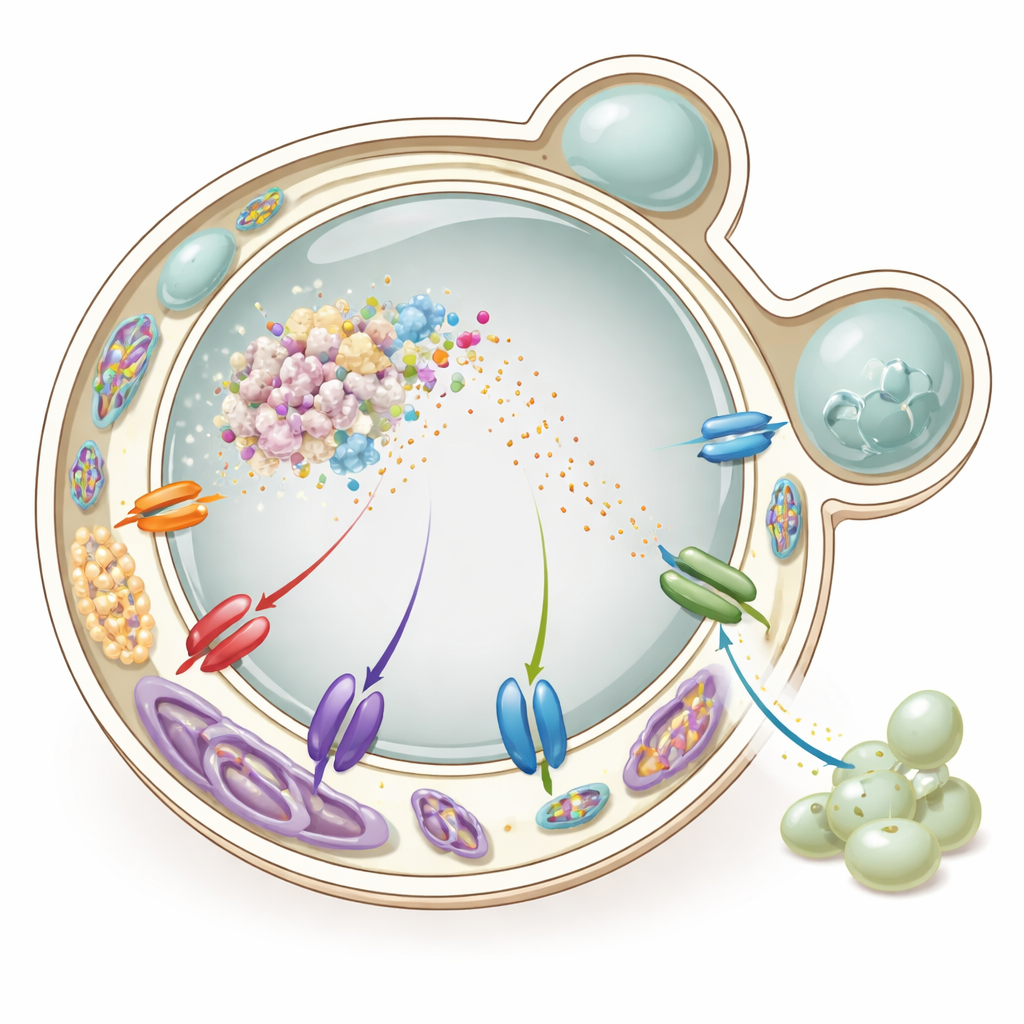
Yeast cells, like our own, use a process called autophagy to cope with poor nutrition. In this process, the cell packs parts of itself, including proteins and even whole structures such as mitochondria, into internal bags that fuse with a central container called the vacuole. Inside this compartment, the contents are broken down into small pieces, including amino acids, the basic units of proteins. For these recycled pieces to be useful, they must then leave the vacuole and return to the main fluid of the cell, where new proteins are made. Until now, the exact importance of this export step, and which transporters handle which amino acids, had not been clearly tested.
Many doors for moving building blocks
The team studied several known transporters that sit in the vacuole membrane and act like doors for amino acids. Earlier work had shown that some of these doors, called Avt3, Avt4, and Avt7, help move neutral and basic amino acids out of the vacuole, while another, Avt6, specializes in acidic amino acids. By creating yeast strains lacking different combinations of these doors and then measuring amino acids trapped in vacuoles, the researchers discovered that Avt6 is more versatile than previously thought. When Avt6 was removed alongside Avt3, Avt4, and Avt7, large amounts of several neutral amino acids built up in the vacuole, especially under nitrogen starvation. Forcing cells to make extra Avt6 had the opposite effect, lowering vacuolar neutral amino acids. These patterns show that Avt6 also helps export neutral amino acids and works redundantly with other transporters.
Recycling feeds protein production and protects survival
To see whether this export really matters for cell function, the scientists tracked how well yeast could make new proteins during nitrogen starvation. Cells unable to perform autophagy showed a strong drop in the production of a test protein and in the incorporation of a labeled amino acid into proteins. Cells missing the four Avt transporters displayed a similar, though somewhat milder, reduction in protein synthesis, even though they could still activate the relevant genes. This suggests that the recycled amino acids stuck in the vacuole are not fully available for building new proteins. Surprisingly, these transporter-deficient cells still survived nitrogen starvation almost as well as normal cells, indicating that other routes and transporters can partially compensate. However, when the researchers also blocked a key step in making the amino acid leucine, survival dropped sharply, revealing that recycling and new synthesis work together to keep cells alive.
Recycled amino acids power spore formation
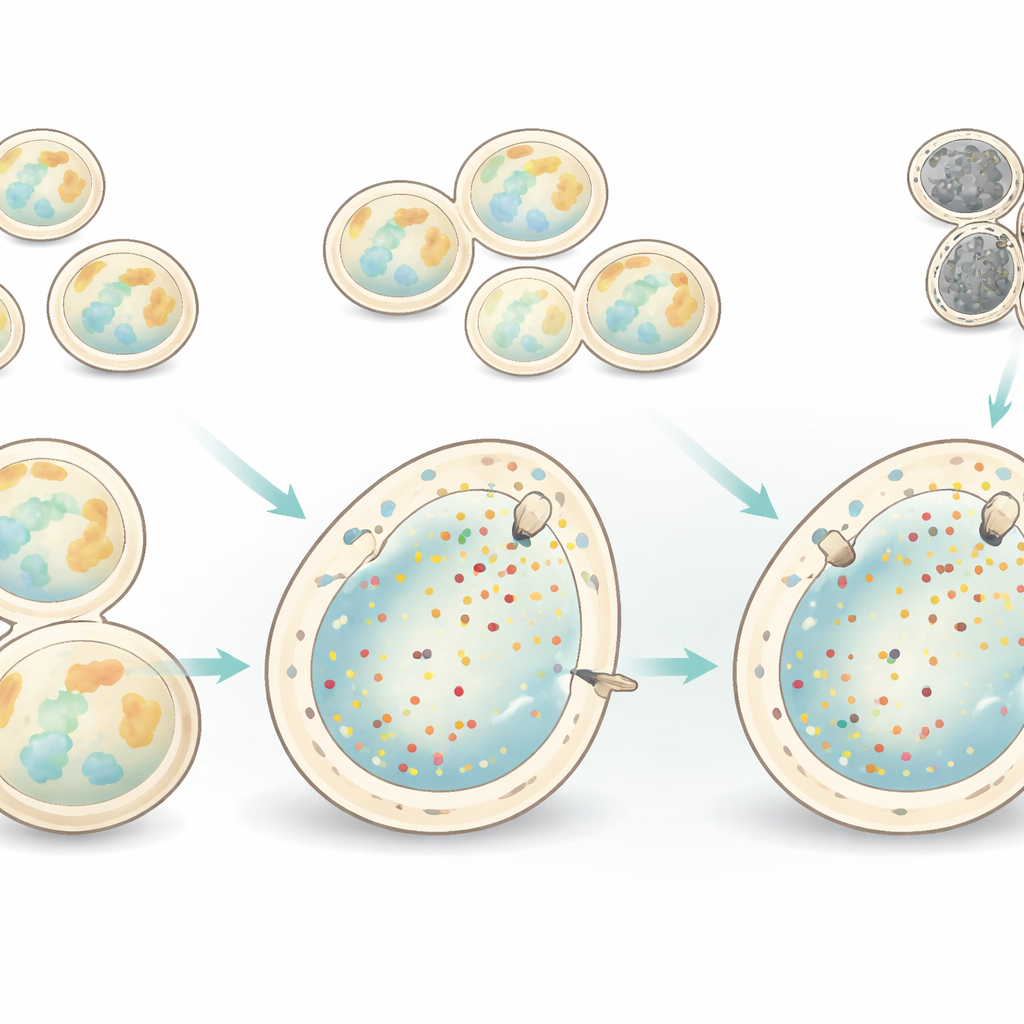
Yeast diploid cells can form spores—tough, dormant forms that help them endure harsh environments. This process depends on autophagy, hinting that recycled amino acids should be important. The study confirmed that idea. Under sporulation conditions, normal cells produced mainly four-spored sacs, while cells lacking autophagy formed no spores. Cells missing the four Avt transporters produced fewer spores per sac, often only one or two. In these mutant cells, key proteins needed for building the spore-forming machinery rose less than in normal cells, even though the initial master regulator of sporulation was still turned on. Measurements of total amino acids showed that many neutral amino acids accumulated in these cells, meaning they were being generated by autophagy but trapped in the vacuole instead of reaching where new proteins were assembled.
What this means for life under stress
Overall, the work shows that yeast relies heavily on multiple overlapping vacuolar transporters to recycle amino acids efficiently during starvation. When several of these doors are removed, amino acids pile up in the vacuole, protein synthesis is dampened, survival becomes more fragile in certain genetic backgrounds, and the ability to form spores is compromised. For a general audience, the message is that cells survive lean times not only by breaking down their own parts but also by carefully routing the resulting pieces back into circulation. Because similar transport systems exist in plants and animals, understanding this recycling network in yeast provides clues to how our own cells manage stress, help tissues develop, and may even influence diseases such as cancer where nutrient handling goes awry.
Citation: Nakajo, H., Sekito, T., Okamura, R. et al. Significance of amino acid recycling from vacuoles for viability and sporulation of yeast cells under starvation conditions. Sci Rep 16, 12243 (2026). https://doi.org/10.1038/s41598-026-42129-3
Keywords: autophagy, amino acid recycling, yeast vacuole, starvation stress, sporulation