Clear Sky Science · en
A numerical framework for fractional and fractal-fractional analysis of the Pehlivan chaotic system using Caputo derivative
Why chaos with memory matters
Many natural and engineered systems behave unpredictably: small nudges can lead to wildly different outcomes. These so‑called chaotic systems show up in weather, electronics, and even secure communication. This paper explores a particular chaotic circuit, known as the Pehlivan system, and asks what happens when we let it "remember" its past and evolve on a kind of jagged, fractal sense of time. The authors build new mathematical tools and computer methods to study this richer form of chaos and show how it could be harnessed more reliably in technology.
From simple equations to wild motion
The Pehlivan system is defined by just three linked equations, yet it can produce swirling trajectories in three‑dimensional space that never repeat, a hallmark of chaos. In its standard form, time flows smoothly and the system responds only to its current state. Earlier work showed that similar systems, like the Lorenz model of weather, become even more flexible when their equations are generalized so that change depends partly on the whole history of the system. This idea—called fractional calculus—lets the system carry memory, which can be tuned continuously rather than switched on or off.
Adding fractal time to chaotic circuits
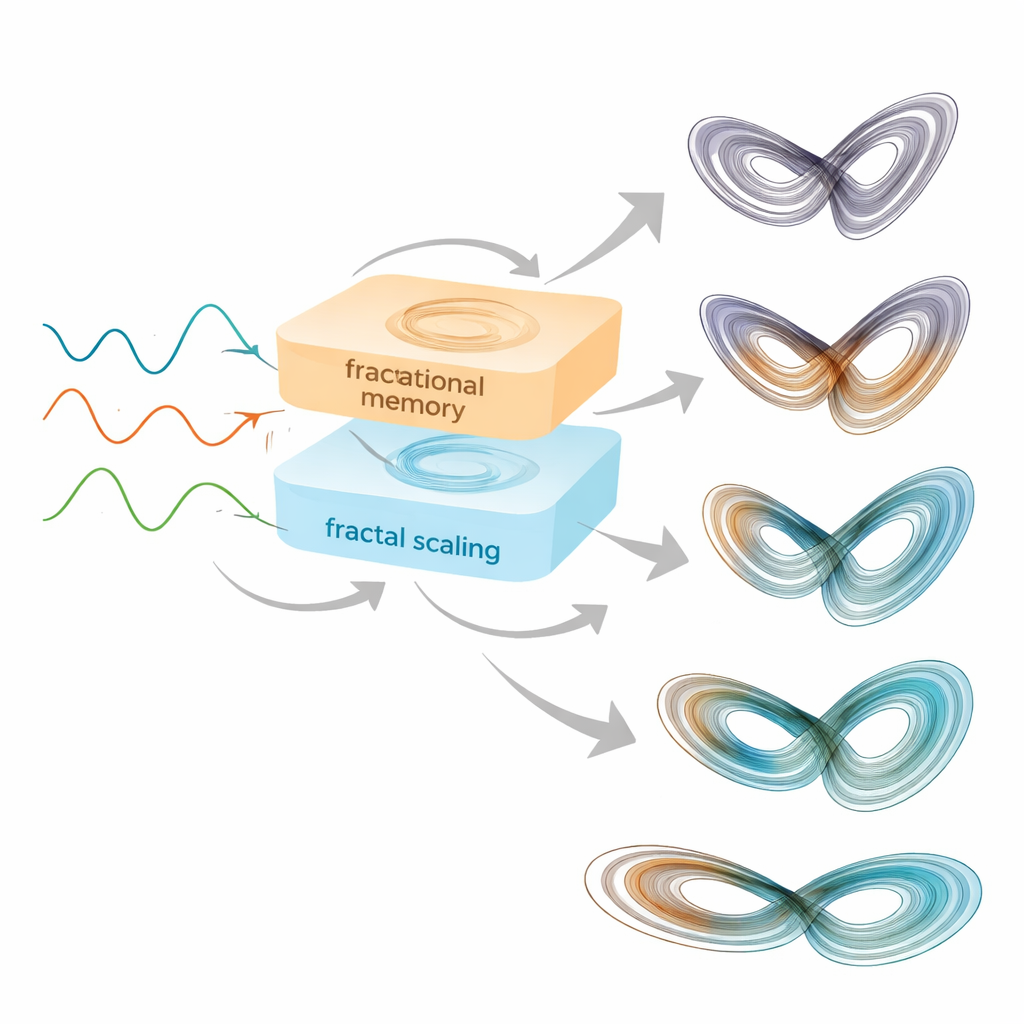
The authors go a step further by combining fractional memory with fractal geometry. Instead of assuming that time advances in uniform steps, they use a "fractal–fractional" approach in which time effectively stretches and compresses in a scale‑dependent way. Two knobs now shape the dynamics: one controls how strongly the past influences the present, and the other adjusts how irregular the time scale is. Within this framework, the team rewrites the Pehlivan equations using a version of the derivative (the Caputo form) that is well suited to physical systems and standard initial conditions.

Guaranteeing that the math behaves
Before running simulations, the authors prove that their extended system is mathematically sound. Using standard tools from analysis, they show that for reasonable choices of parameters and starting values, the equations admit at least one solution and in fact a unique one. They also study a notion called Ulam–Hyers stability, which asks: if the equations are slightly perturbed—for example by numerical errors or small noise—do the resulting solutions stay close to the true ones? Their results show that under clear conditions, small disturbances do not blow up, giving confidence that the model and its numerical solutions are robust.
Designing accurate schemes for long‑memory chaos
Because these equations incorporate memory over all past times, straightforward numerical methods would become painfully slow: each new step would have to revisit the entire history. The authors design specialized predictor–corrector schemes based on Newton and Lagrange interpolation polynomials to approximate the long‑range memory integrals efficiently. They derive explicit formulas for the error and show how it shrinks as the time‑step is reduced. They then benchmark their approach against a widely used fractional solver that exploits fast Fourier transforms, confirming that the expected high accuracy is reached and that advanced implementations can cut computing time dramatically for long simulations.
Seeing new shapes of chaos
With the numerical machinery in place, the team explores how changing the memory and fractal‑time parameters reshapes the Pehlivan attractor, the geometric object traced by the system’s motion in phase space. For certain combinations of the two parameters, the attractor forms single rings; for others it develops double‑sided, self‑similar ring structures reminiscent of fractals. As the parameters move closer to their classical values, the system recovers the familiar chaotic patterns of the original Pehlivan model. A separate study of how behavior changes with one of the system’s internal constants reveals transitions from orderly oscillations to fully chaotic regimes, including period‑doubling cascades, a classic route to chaos.
What this means for real‑world applications
To a non‑specialist, the key message is that chaos need not be purely random or uncontrollable. By allowing a chaotic circuit to remember its past and to evolve on an irregular time scale, this work uncovers a much richer palette of behaviors, yet shows that these behaviors remain mathematically well defined and numerically tractable. Such finely tunable chaos could be valuable in secure communication, signal processing, and cryptography, where complex but predictable patterns are an asset. More broadly, the study demonstrates that fractal–fractional calculus is a powerful lens for modeling systems where history and multi‑scale timing fundamentally shape the dynamics.
Citation: Vinoth, R., Jayalakshmi, M. A numerical framework for fractional and fractal-fractional analysis of the Pehlivan chaotic system using Caputo derivative. Sci Rep 16, 13669 (2026). https://doi.org/10.1038/s41598-026-42126-6
Keywords: chaotic systems, fractional calculus, fractal time, numerical simulation, secure communication