Clear Sky Science · en
Suppression of transgenerational lipid provisioning inhibits desiccation resistance, but not diapause, in the vector mosquito, Aedes albopictus
Why mosquito mothers matter for winter survival
Many mosquitoes survive winter as eggs, waiting for warmer days to hatch. For the invasive Asian tiger mosquito, Aedes albopictus, this pause in development, called diapause, helps the species endure cold climates and spread to new regions. This study asks a deceptively simple question: when a mother mosquito adjusts how much fat she packs into her eggs, does that not only change how tough those eggs are, but also whether they decide to enter this winter “sleep” in the first place?
Preparing for the cold season
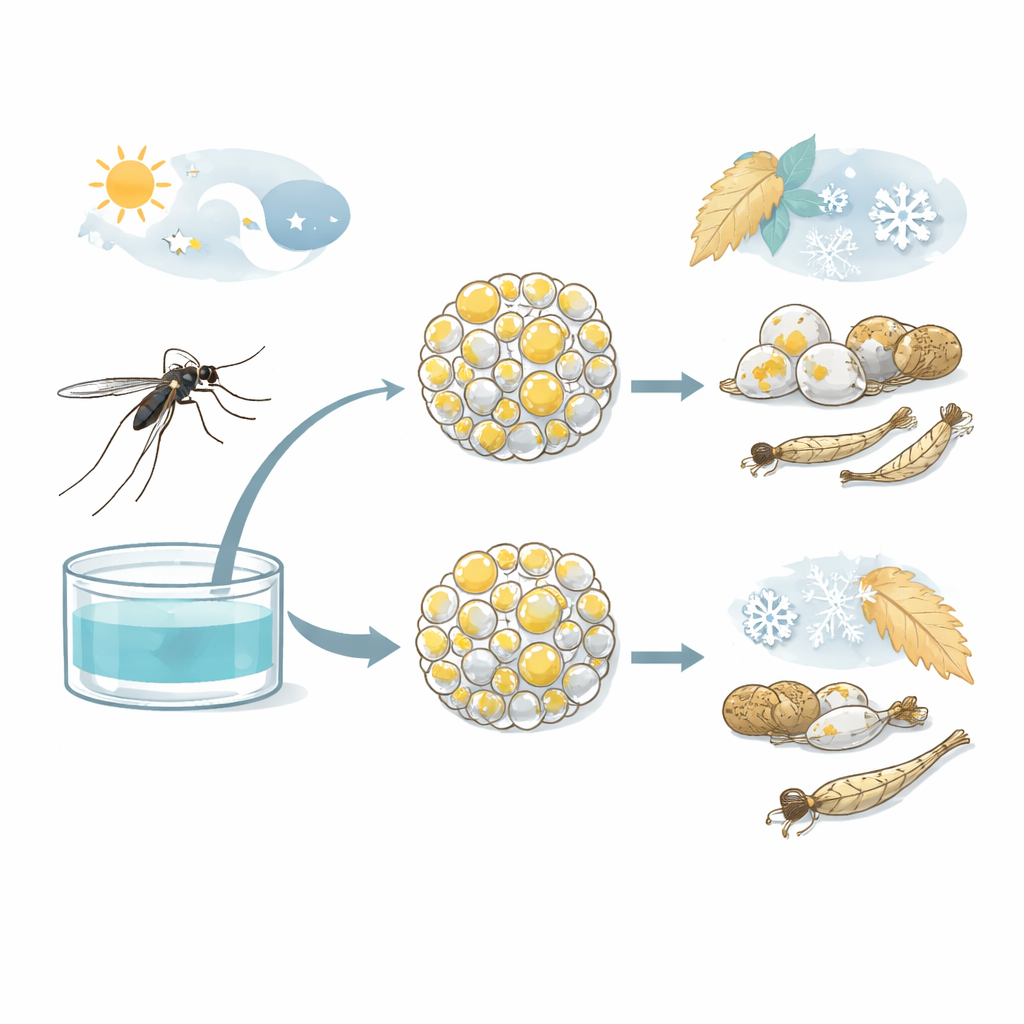
In temperate climates, insects often prepare for winter long before the first frost. Female Aedes albopictus sense shortening days at the end of summer and lay eggs that complete early development and then stop, remaining dormant inside the eggshell until spring. During this time, they do not eat, so they must rely entirely on stored energy, especially fats, to repair damage and stay alive. Earlier work showed that eggs destined for diapause typically contain more fats than ordinary eggs, suggesting that extra fat might be part of the signal that tells an embryo to shut down and wait out the cold. The authors set out to test whether changing how much fat a mother invests in her eggs could alter that decision.
Tweaking fat packaging in mosquito eggs
The researchers focused on two genes in mother mosquitoes that help manage fat. One, called lsd2, is involved in storing and protecting fat droplets inside cells. The other, dgat1, helps build the main storage form of fat, triglycerides. Using RNA interference, a technique that reduces specific gene messages, they temporarily dialed down each gene in blood-fed female mosquitoes and then examined the eggs those females laid under long-day (summer-like) and short-day (autumn-like) light schedules. They measured how much triglyceride fat the eggs contained, how long newly hatched larvae survived without food, how easily eggs dried out, and how well they endured a simulated winter.
Less fat, weaker offspring—but diapause stays on track
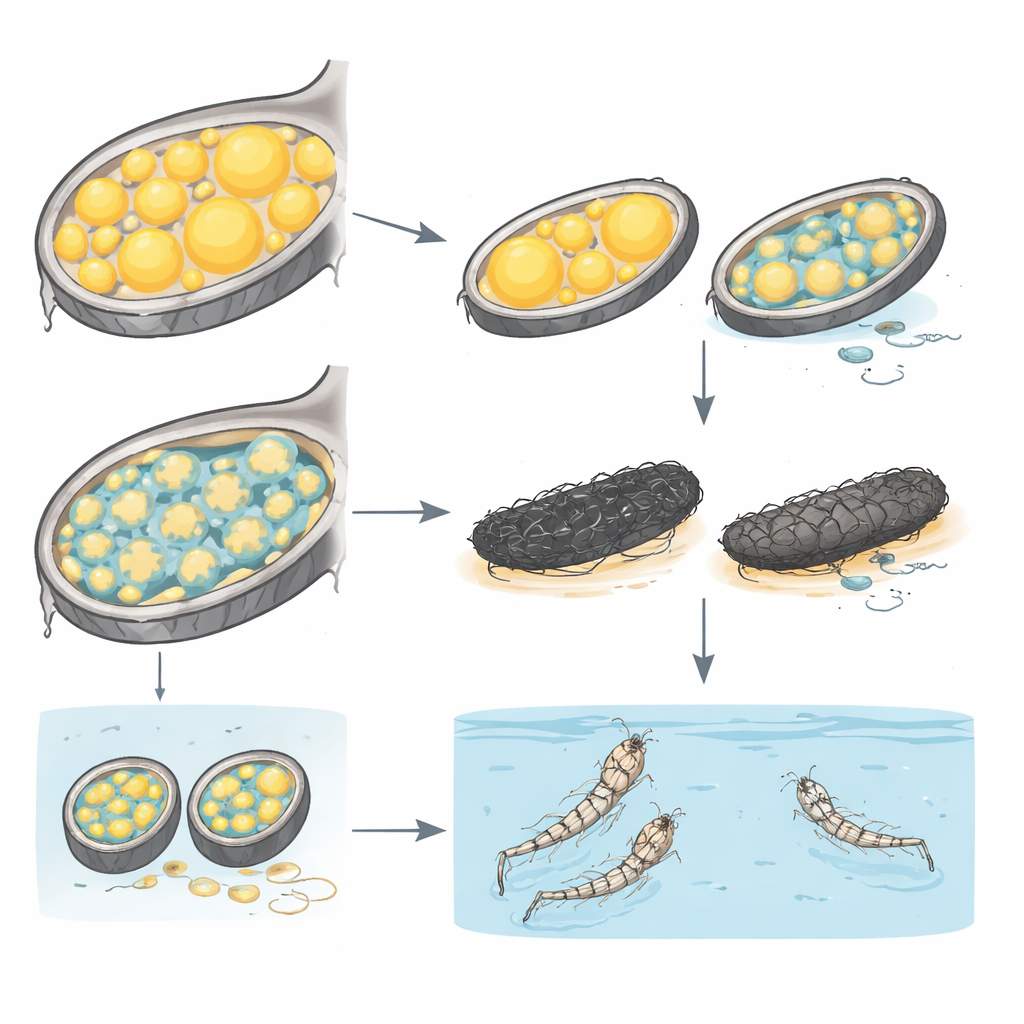
Shutting down lsd2 in mothers clearly reduced fat provisioning to eggs. Under both light conditions, eggs from lsd2-treated females had much lower triglyceride levels than eggs from control females, while reducing dgat1 had no detectable effect. The consequences of this leaner start were visible in the next generation. Larvae that hatched from low-fat eggs died of starvation earlier when kept in clean water with no food, indicating they had smaller energy reserves. Eggs from lsd2-treated mothers were also more likely to collapse when dried, showing that they had poorer resistance to water loss—an especially important trait for a species whose eggs often endure dry, exposed conditions during transport and winter. After a simulated winter, these low-fat eggs showed a modest tendency toward lower survival and produced larvae with reduced starvation tolerance, supporting the idea that stored fat helps fuel both overwinter survival and performance in early life.
Winter “sleep” is controlled by other signals
Surprisingly, despite these clear effects on energy stores and toughness, changing maternal fat provisioning did not alter whether embryos entered diapause or when they woke up. Under short days, almost all eggs went into diapause, regardless of their triglyceride levels, and under long days only a small fraction did so, just as in normal lab populations. The timing of diapause termination over several winter-like months also did not differ among treatment groups. In other words, embryos from low-fat, lsd2-treated mothers still followed the usual daylength-based program: they decided to go dormant and to wake up on schedule, even though their internal “fuel tanks” were partly empty. This indicates that while fats are crucial for surviving diapause, they are not the main cross-generational signal that flips the diapause switch in this mosquito.
What this means for mosquitoes and changing winters
This work shows that mosquito mothers strongly influence how well their offspring endure drying, cold, and food shortage by adjusting how much fat they pack into their eggs, but that the decision to enter and exit winter dormancy is governed by other cues, likely involving hormones, internal clocks, and epigenetic changes. In a warming world with more erratic winters and heat waves, shifts in energy use and fat storage could erode the safety margin that allows diapausing eggs to survive until spring. Understanding how maternal provisioning and diapause programming interact helps scientists better predict where invasive mosquitoes like Aedes albopictus can persist—and how climate change might alter their spread and the diseases they carry.
Citation: Heilig, M., Edwards, M.J. & Armbruster, P.A. Suppression of transgenerational lipid provisioning inhibits desiccation resistance, but not diapause, in the vector mosquito, Aedes albopictus. Sci Rep 16, 14003 (2026). https://doi.org/10.1038/s41598-026-42116-8
Keywords: mosquito diapause, maternal effects, lipid provisioning, overwinter survival, Aedes albopictus