Clear Sky Science · en
Cost-effective FRP solutions for enhancing strength and strain of sustainable concrete made with waste tyre rubber
Turning Old Tires into Stronger Buildings
Mountains of worn-out car tires are piling up worldwide, creating fire hazards and long‑lasting pollution. At the same time, the construction industry consumes huge amounts of sand and stone to make concrete. This study explores a way to tackle both problems at once: grinding waste tires into small pieces, mixing them into concrete, and then wrapping that concrete in a thin shell of glass fibers and resin. The result is a greener building material that can bend and absorb energy instead of breaking suddenly. 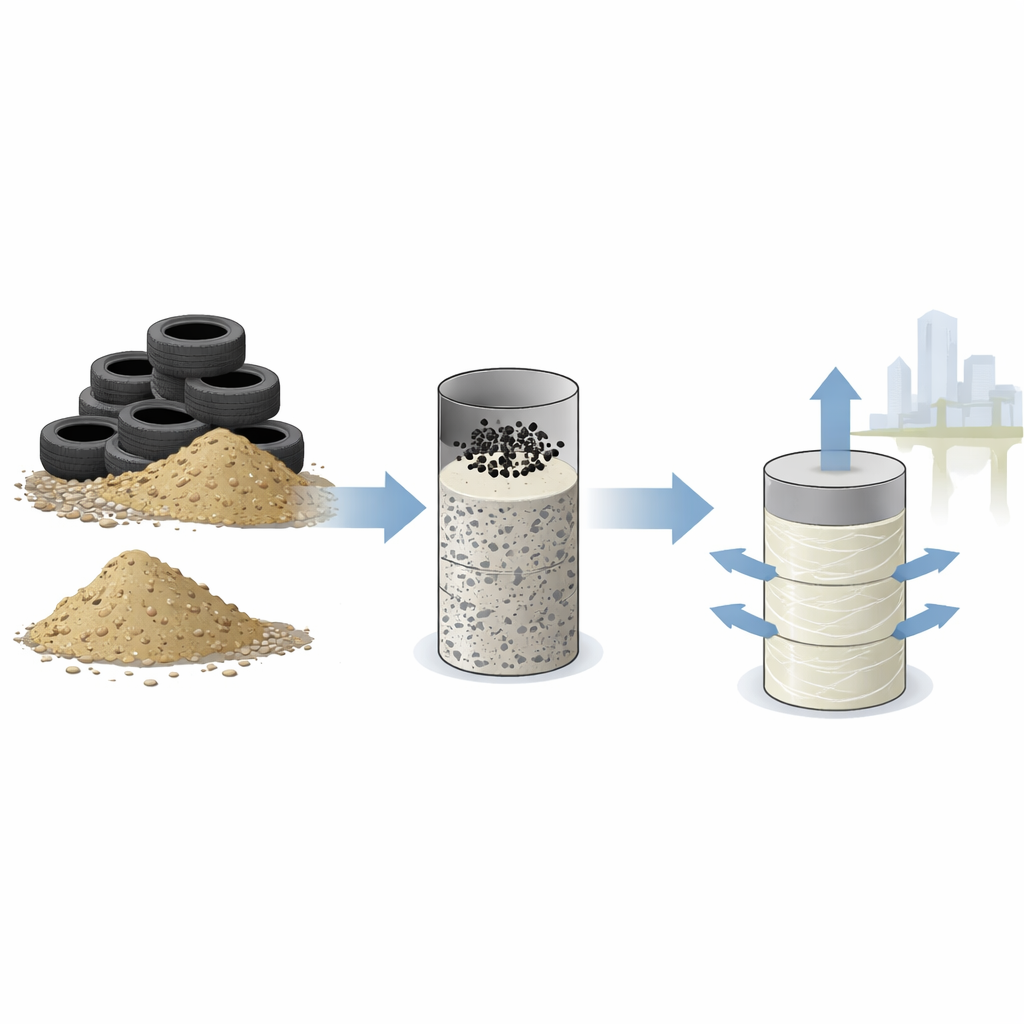
Why Mix Rubber into Concrete?
When old tires are shredded and used to replace part of the sand in concrete, the material becomes lighter and far better at soaking up impacts and vibrations—useful for highway barriers, rail lines, and earthquake‑resistant structures. But there is a catch: rubber does not bond well with the surrounding cement paste, and it is much softer than stone. As more rubber is added, the concrete usually loses strength and stiffness, which has limited its use in serious load‑bearing structures. This study focuses on a practical recipe: keeping the rubber content modest (20% of the fine aggregate by volume) but carefully controlling the size of the rubber particles to understand how they affect strength and how easily the concrete can be improved by external reinforcement.
Wrapping Concrete in a Glass Fiber Jacket
To rescue the mechanical performance of rubber‑rich concrete, the authors used jackets made of glass fiber‑reinforced polymer (GFRP). These jackets are thin sheets of woven glass fibers soaked in resin, wrapped around concrete cylinders, and left to harden. They are much lighter and more corrosion‑resistant than steel, and significantly cheaper than similar carbon fiber systems. In the tests, 42 concrete cylinders—some with normal stone aggregates and others with fine or coarse tire rubber—were cast and then either left unwrapped, fully wrapped from top to bottom, or wrapped only in spaced strips. By loading these cylinders in compression until failure, the team could see how the jackets changed the way the concrete cracked, carried load, and deformed. 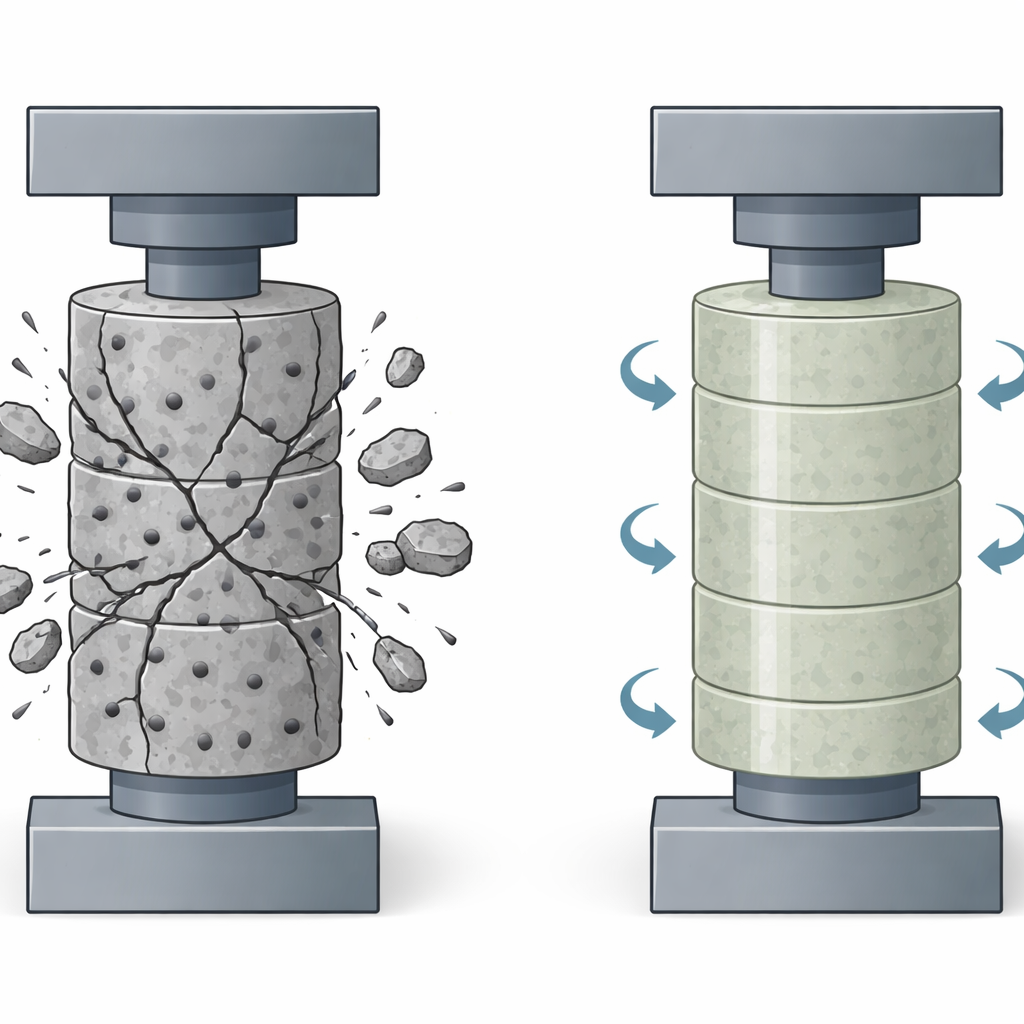
From Sudden Breakage to Gentle Failure
Unwrapped cylinders, whether made with or without rubber, behaved much like ordinary concrete: they carried load up to a peak and then failed abruptly with long vertical cracks and chunks breaking away. The GFRP‑wrapped specimens told a completely different story. Full jackets turned this brittle behavior into a slower, more controlled response. Cracks still formed inside, but the glass fiber shell held everything together and forced the concrete to bulge gradually instead of exploding. For normal concrete, full wrapping boosted strength by up to about 63% and increased the final crushing strain more than tenfold. Rubberized concrete showed even more dramatic gains in deformability: in the mix with very fine rubber particles, the ultimate strain increased by over 1300%. Strip wrapping, which leaves some regions bare, provided moderate but still significant improvements while using less material, illustrating a trade‑off between performance and cost.
What the Numbers and Models Reveal
Beyond the lab tests, the researchers built mathematical formulas to predict how confined concrete will behave, based on how strong it is without wrapping, how much rubber it contains, and how much inward pressure the GFRP jacket can provide. They fitted these formulas to the test data and showed that they can closely reproduce full stress‑strain curves—how the material stiffens, peaks, and softens under load—for both natural and rubberized concretes. The models worked best for the specific glass‑fiber system used here and for the studied rubber content and particle sizes. They are not meant to be applied blindly to different fibers or much higher rubber contents, but they offer design tools for engineers who want to specify these greener materials with confidence.
Greener Concrete with Practical Limits
To a non‑specialist, the key message is straightforward: old tires can be turned from a stubborn waste problem into part of safer, longer‑lasting structures, if the resulting rubberized concrete is given a thin glass‑fiber jacket. This combination not only restores much of the lost strength but also makes the material far more forgiving under heavy loads and impacts. Full wrapping offers the greatest safety margin, while strip wrapping can still yield large gains at lower cost. The authors note that their work focuses on short‑term compression tests and a single replacement level, so long‑term durability and other loading conditions still need study. Even so, the results point toward a future where bridges, columns, and protective barriers could quietly lock away tire waste while performing better than conventional concrete.
Citation: Saingam, P., Chatveera, B., Hussain, Q. et al. Cost-effective FRP solutions for enhancing strength and strain of sustainable concrete made with waste tyre rubber. Sci Rep 16, 13540 (2026). https://doi.org/10.1038/s41598-026-42110-0
Keywords: rubberized concrete, waste tyre recycling, GFRP confinement, sustainable construction, structural retrofitting