Clear Sky Science · en
Inverse multi-principal element alloys design via conditional wasserstein generative adversarial network
Designing Tough New Metals with Fewer Experiments
Modern technologies, from jet engines to medical implants, rely on metals that can survive intense heat, pressure, and wear. A promising class of materials, called multi-principal element alloys, mixes many different metals together and can outperform conventional steels or superalloys. But the number of possible mixtures is astronomical, and testing each one in the lab is slow and expensive. This paper shows how a kind of artificial intelligence can work backwards from desired properties, like hardness and stiffness, to suggest promising new metal recipes, helping engineers explore this vast design space far more efficiently.
Why These New Alloys Matter
Traditional alloys are built around one or two main elements—think iron in steel or nickel in many superalloys. Multi-principal element alloys break that rule by combining several elements in roughly comparable amounts. This unusual mix can produce metals that are very strong, resist wear, and stay stable at high temperatures. However, the sheer number of ways to combine multiple elements makes it impossible to rely on trial-and-error experiments alone. Researchers therefore need smart tools that can quickly connect a metal’s composition to how hard, stiff, or damage-resistant it will be, and then run that process in reverse: start from the desired performance and find the compositions likely to deliver it.
Teaching a Machine to Complete the Missing Pieces
To train any learning system, data are essential. Here, the authors combined two separate experimental collections of multi-principal element alloys: one that reported hardness (how resistant a material is to indentation) and another that reported elastic modulus (a measure of stiffness). Many alloys had one property measured but not the other. The team built several conventional machine-learning models to fill in the missing stiffness values, ultimately selecting a gradient boosting approach that best captured the relationship between composition and stiffness. They also distilled a large set of physical descriptors—such as average atomic size, melting point, and electron count—down to a smaller, more informative group, improving both accuracy and numerical stability. This unified dataset, with both hardness and stiffness available for each alloy, became the foundation for the generative model that follows.
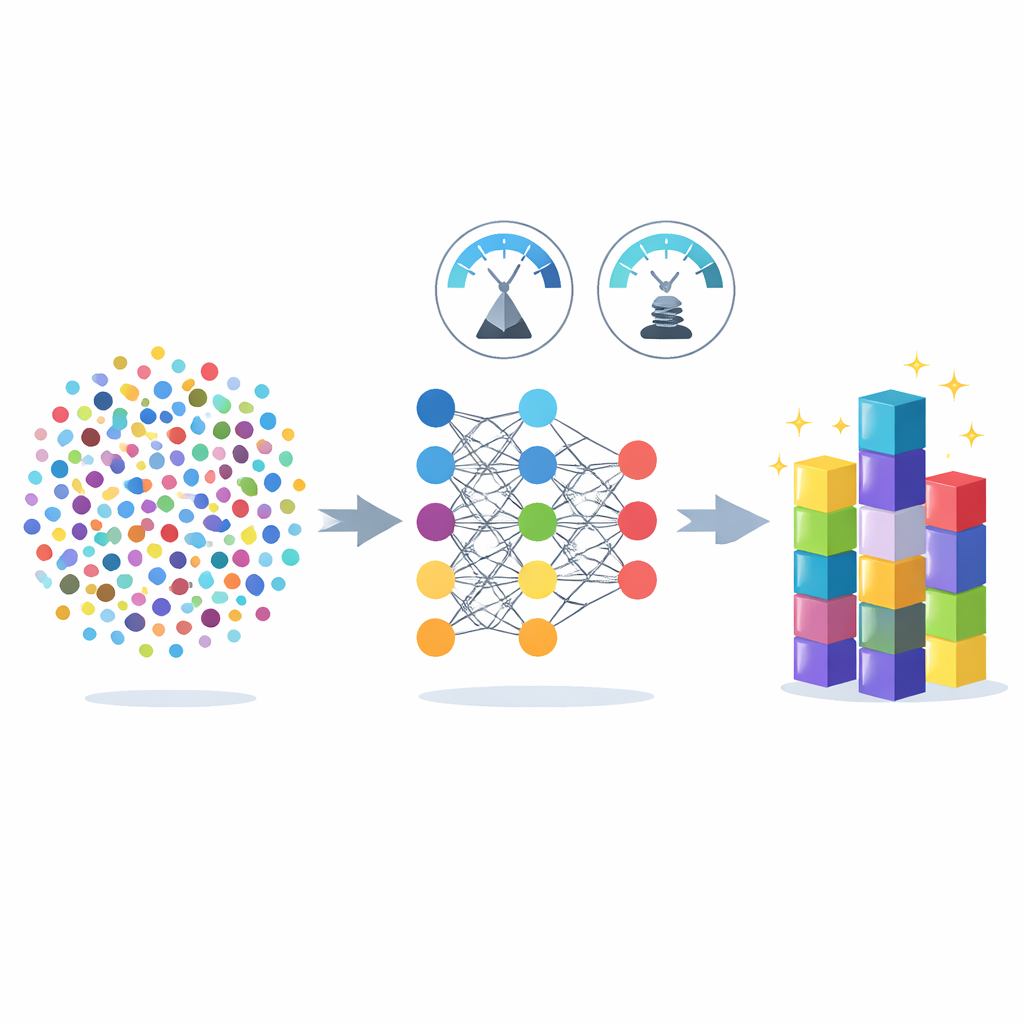
Letting a Generative Model Propose New Metal Recipes
The core of the study is a type of deep learning model called a conditional generative adversarial network. Instead of merely predicting properties from a known composition, this model is trained to invent entirely new compositions that match specified target properties. The authors compared a standard conditional GAN with a more advanced variant that uses a Wasserstein loss, which measures how similar two distributions are in a more stable way. During training, a “generator” network proposes alloy compositions, while a “critic” network judges how realistic they look compared with known data, given the same hardness and stiffness values. Over many rounds, the generator learns to produce compositions whose elemental mix, trends, and correlations closely resemble those of real alloys while satisfying the requested properties.
Checking That the Suggestions Are Physically Realistic
To test whether the system truly understood alloy behavior rather than simply memorizing examples, the researchers asked it to reconstruct alloys from a held-out test set using only their hardness and stiffness as inputs. They then compared the generated compositions with the real ones using several measures: overall difference across all elements, alignment of compositional trends, and how well statistical relationships between elements and properties were preserved. The conditional Wasserstein model consistently produced alloys that were closer to reality and more stable from run to run than the standard model. It reproduced the correct balance of key elements such as iron, chromium, and nickel and captured how elements tend to appear together or trade off against each other, reflecting underlying chemical rules. The team also used a statistical method to sample new, realistic pairs of hardness and stiffness values and showed that the model could generate alloys spanning this broader design space without collapsing to just a few simple recipes.
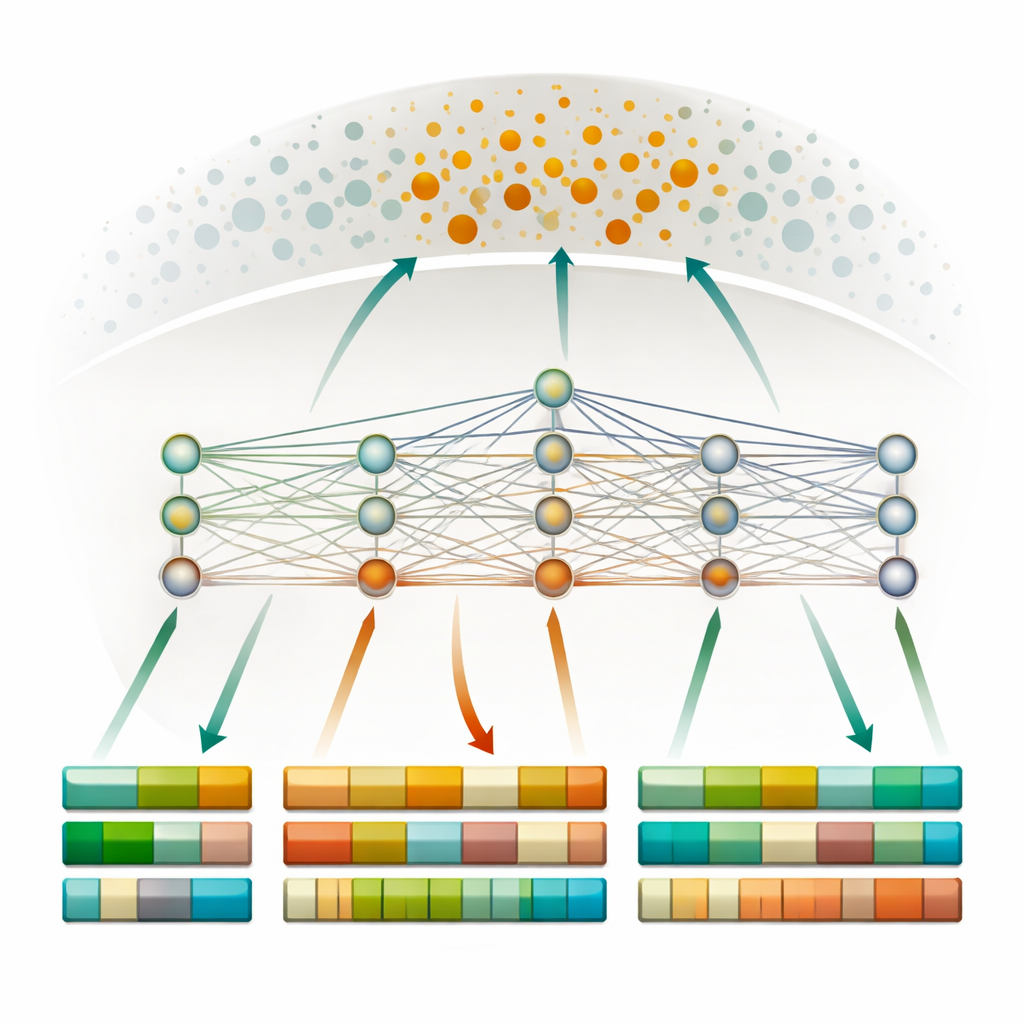
Targeting Alloys That Resist Cracks and Wear
Beyond individual properties, engineers often care about combined indicators that signal how a material will perform in service. Two such ratios—hardness divided by stiffness, and hardness cubed divided by stiffness squared—are widely used to gauge crack resistance and resistance to permanent deformation. The authors set threshold values for these indicators corresponding to especially tough and wear-resistant alloys and then asked their best model to generate compositions that meet or exceed those targets. The resulting suggestions not only matched the broad patterns of known high-performing alloys but also expanded into new, unexplored combinations that theory suggests should offer excellent performance. This demonstrates that the generative framework can be steered toward application-driven goals, such as designing coatings that last longer or structural parts that better resist damage.
What This Means for Future Materials Discovery
In everyday terms, this research shows that an AI system can act like a knowledgeable assistant in the metallurgy lab: given a wish list of mechanical behavior, it proposes specific multi-element metal mixtures that are statistically consistent with what we know and biased toward strong, damage-resistant performance. The conditional Wasserstein approach stands out as especially robust under limited data, making it realistic for fields where experiments are costly and sparse. As more measurements become available and as some of the AI-suggested alloys are verified experimentally, such tools could sharply reduce the time and resources needed to discover and refine advanced metals for demanding uses in aerospace, energy, and beyond.
Citation: Acquah Forson, C., Gerashi, E., Zhao, Y. et al. Inverse multi-principal element alloys design via conditional wasserstein generative adversarial network. Sci Rep 16, 13688 (2026). https://doi.org/10.1038/s41598-026-42102-0
Keywords: multi-principal element alloys, generative models, materials design, hardness and stiffness, wear-resistant metals