Clear Sky Science · en
Buffering and energy-absorbing characteristics of disc spring composite monomer under impact dynamic load
Why protecting mine tunnels from sudden shocks matters
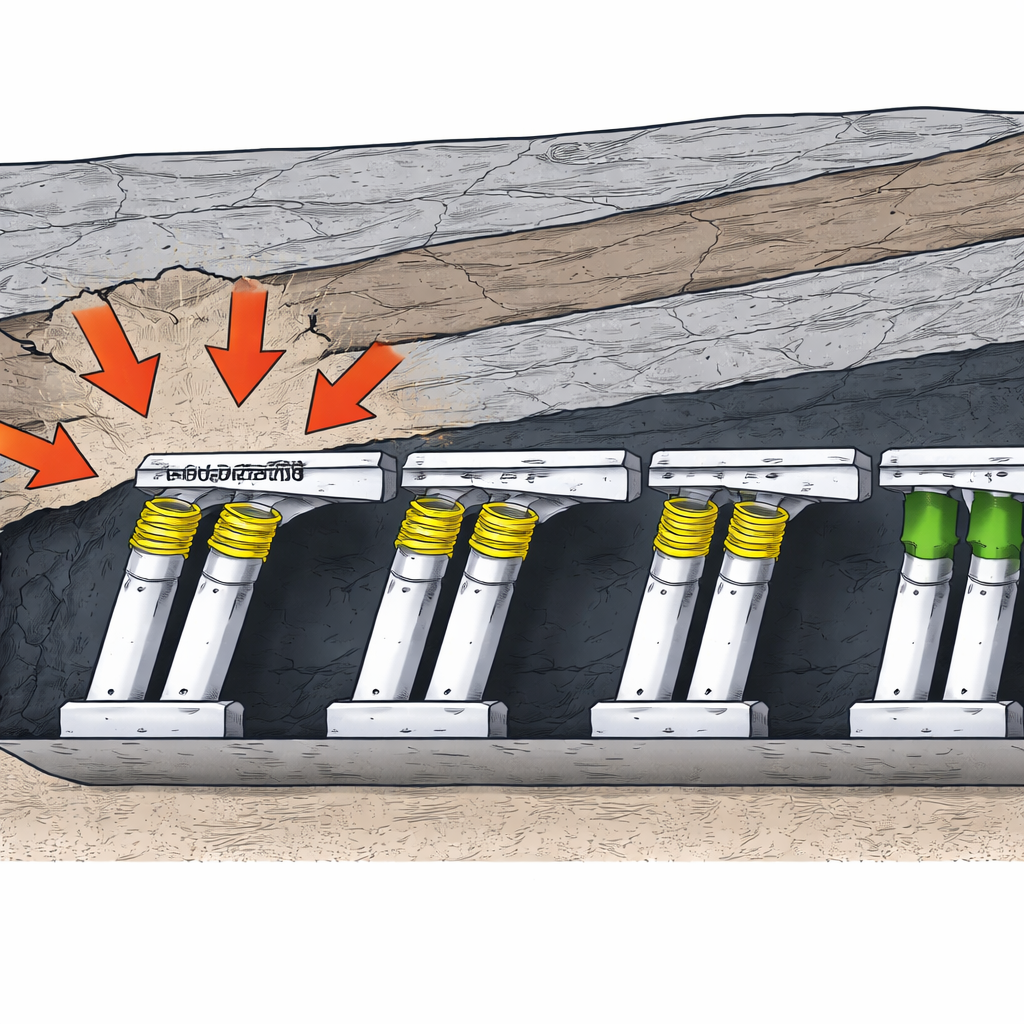
Deep coal mines are dangerous places not only because of dust and gas, but also because of violent rock bursts—sudden failures in the surrounding rock that hit support structures like a hammer blow. When these impacts overwhelm the steel frames and hydraulic props that hold up a roadway roof, tunnels can collapse, machinery can be destroyed, and workers’ lives put at risk. This study explores a new way to give those supports a kind of “shock absorber,” using cleverly arranged metal disc springs, so that deadly impact energy is safely cushioned before it can do serious damage.
A mechanical shock absorber for underground supports
The researchers designed a modular device built around a stack of metal disc springs—washer-like rings that flex under load. These disc spring composite monomers can be mounted on the top beams of hydraulic supports in mine roadways. When a rock burst drives the roof downward, the springs compress, absorbing energy and reducing the force that reaches the support columns and hydraulic cylinders. The device combines four larger and four smaller disc springs arranged in a series, so that the stack can respond gently to small impacts yet still carry very high loads without permanent damage. By tailoring the geometry and material of the springs, the team aimed to turn a rigid support into a more forgiving, energy-absorbing system.
Blending real impacts with virtual testing
To find out how well the new spring modules work, the team used two approaches in parallel. First, they built a drop-hammer test rig where a heavy plate is released by an electromagnet and allowed to fall onto a specimen containing the disc spring stack and force sensors. By changing the mass of an added load plate from 0 to 7500 kilograms, they simulated impacts of different severity and recorded how the forces evolved over time. Second, they constructed a detailed computer model in ADAMS dynamics software that reproduced the same geometry, materials, gravity, and contact conditions as the physical setup. By carefully matching the simulated peak forces to the experimental data—with errors of less than half a percent—they showed that the virtual model could reliably stand in for repeated, expensive physical tests.
How flexible springs tame violent impacts
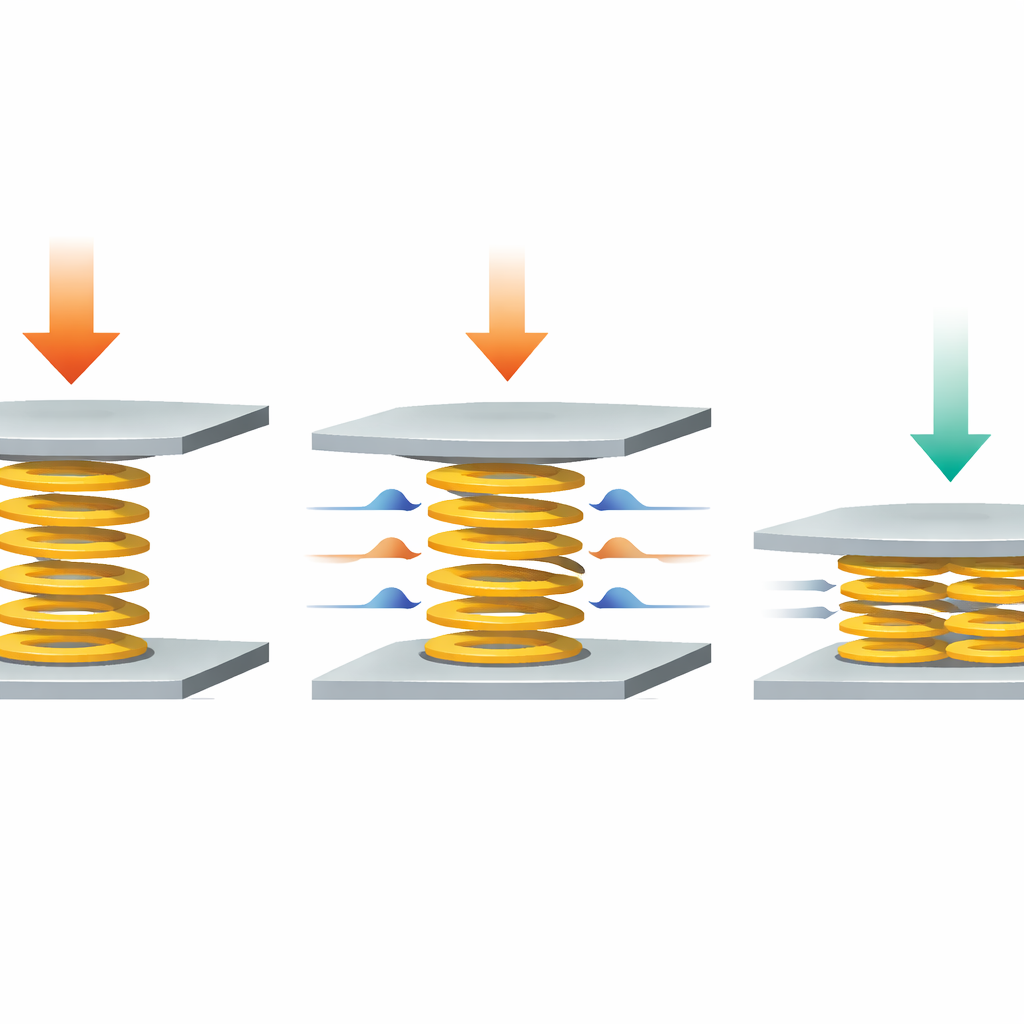
With the validated model, the researchers compared two extreme cases: a rigid version of the disc spring stack that cannot deform and a flexible version that behaves like real steel springs. Under identical impacts, the rigid stack transmitted sharp, high peaks of force and caused sudden changes in the motion of the top plate, followed by quick but violent rebounds. In contrast, the flexible stack compressed and rebounded over a longer period, stretching out the impact in time. This reduced the maximum support reaction by about 10 percent, raised the rebound height, and smoothed out the force curve, meaning fewer abrupt jolts to the surrounding structure. Importantly, even under the heaviest tested load, the springs stayed within their elastic range, so they could return to their original shape and be ready for repeated events.
How the springs respond as loads grow
By examining how much the spring stack shortened under different masses, the team found that deformation grows quickly at low loads but then increases more slowly as loads become very high. This “sub-linear” pattern means the system is highly sensitive and responsive to small impacts, giving good cushioning early on, but its stiffness rises as it approaches full compression, preventing runaway deformation or failure. Below about 4500 kilograms of added mass, the peak force and load are almost perfectly proportional, making the behavior easy to predict. Above that level, the relationship starts to level off as buckling effects and geometric limits stiffen the stack, which effectively caps further increases in peak force.
What this means for safer mining
For a layperson, the key message is that the authors have turned a simple stack of metal rings into a finely tuned safety component for deep mines. Their flexible disc spring modules act like car shock absorbers for tunnel supports, soaking up the worst of a sudden rock impact and lowering the highest forces the support must withstand. The work identifies an optimal load range—around 4500 kilograms—where energy absorption is especially efficient, and it shows that carefully designed flexible elements can protect heavy structures far better than rigid ones. In practical terms, integrating these disc spring units into roadway supports could reduce equipment breakage and the risk of catastrophic collapse when the rock around a mine suddenly and violently shifts.
Citation: Du, M., Wang, Z., Zhang, K. et al. Buffering and energy-absorbing characteristics of disc spring composite monomer under impact dynamic load. Sci Rep 16, 12498 (2026). https://doi.org/10.1038/s41598-026-42096-9
Keywords: rock burst protection, disc spring buffer, impact energy absorption, coal mine roadway support, dynamic load mitigation