Clear Sky Science · en
Bilingualism modulates functional connectivity induced by a domain-general artificial grammar learning task
Why juggling languages reshapes the brain
Anyone who has learned a second language knows it can feel like mental gymnastics: switching between vocabularies, suppressing the wrong words, and tracking subtle patterns in speech. This study asks a deeper question behind that everyday experience: does the constant practice of managing more than one language actually rewire how the brain connects and responds when we learn new patterns—even when those patterns are not linguistic at all? Using a highly controlled pattern-learning task and brain recordings, the researchers show that bilingual experience leaves a measurable trace on how brain regions talk to each other.
A puzzle made of simple symbols
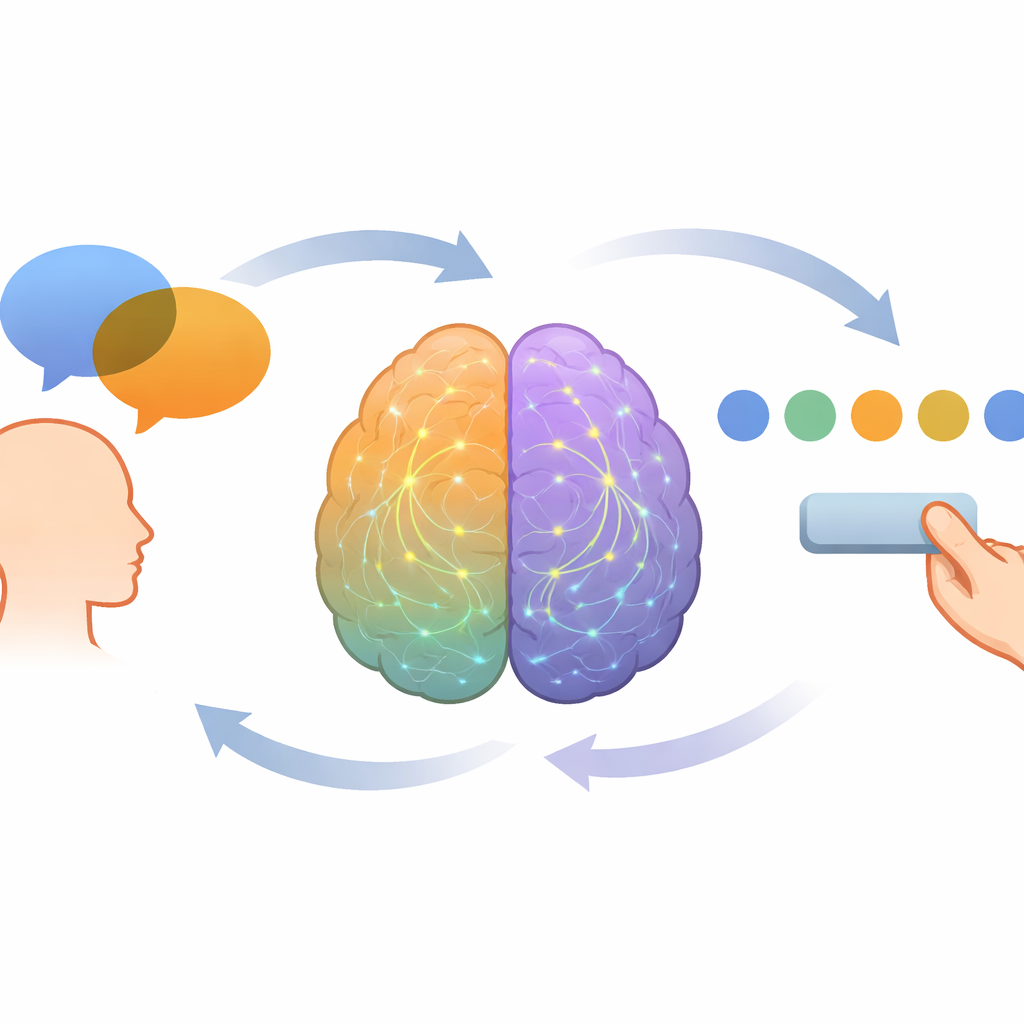
To probe pattern learning without using real words, the team turned to an "artificial grammar" based on a special type of rule system called a Fibonacci grammar. In the task, participants saw a long sequence of red and blue circles, each representing one of two symbols. Their only job was to press keys as quickly as possible to match the color they saw. Hidden underneath this stream of circles was a set of rules that generated structured, but not simply repeating, sequences. People tend to pick up such regularities without being told, gradually predicting what will come next. Here, those regularities were arranged in layers, so that learners could rely on simple next-step statistics or on deeper, more hierarchical chunks of the sequence.
How learning two languages might sharpen pattern skills
Years of research suggest that bilinguals sometimes differ from monolinguals in tasks that require attention, inhibition, or pattern detection, although findings have been mixed. Bilinguals constantly monitor which language fits the situation, suppressing the language they are not using and tracking structures across multiple linguistic systems. This study treated bilingualism not as an either–or trait but as a sliding scale, using a detailed questionnaire to quantify each person’s language experience. The central idea was that more extensive bilingual experience might fine-tune the brain systems that support domain-general abilities such as extracting patterns from sequences—abilities that matter not only for language, but for many kinds of learning.
Watching brain networks before and after the task
To see how the brain’s communication patterns shifted with the task, the researchers recorded electrical activity from the scalp using EEG while participants rested quietly with their eyes closed. They did this twice: once before the pattern-learning task and once after. Using a method that infers the direction of information flow between brain regions, they examined how strongly different areas influenced each other, focusing on broad regions over the frontal, central, temporal, parietal, and occipital (visual) parts of the brain. Crucially, they then asked how these connections varied along the continuum of bilingual experience, using flexible statistical models capable of capturing non-linear, "U-shaped" patterns rather than assuming simple straight-line relationships.
Faster responses and a shifting communication pattern
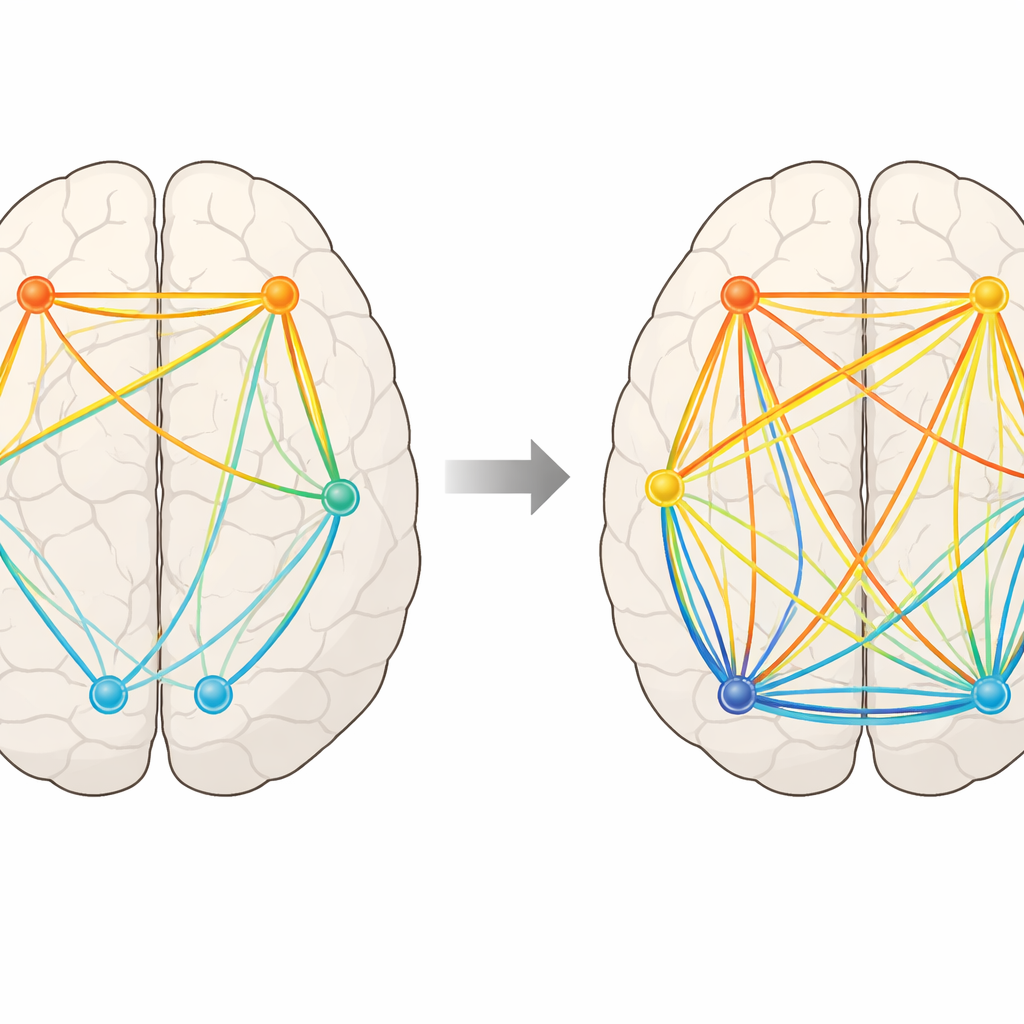
Behaviorally, participants became faster over time, indicating that they were learning and predicting the sequence. Those with higher bilingual experience tended to respond more quickly overall, particularly at points where deeper hierarchical structure mattered most. In the pre-task resting state, bilingual experience was linked to changes in long-distance connections spanning frontal, central, temporal, parietal, and visual regions, with especially interesting peaks in connectivity strength at mid and higher experience levels. After the task, the pattern reorganized: significant connections were now mostly in the left hemisphere and concentrated around frontal and central "hub" regions that projected strongly toward visual areas at the back of the brain. One key bridge between a frontal-central region and a right parietal region became notably stronger after the task, especially for people with intermediate bilingual experience, suggesting that the effort of building predictions from the sequence was reflected in this pathway.
What this means for everyday bilingual minds
For a non-specialist, the upshot is that bilingualism appears to do more than add vocabulary; it subtly tunes how the brain’s networks reconfigure themselves when faced with new learning demands. People with more bilingual experience not only reacted faster in a demanding pattern-learning task, they also showed distinct, experience-dependent shifts in how frontal control regions and posterior sensory regions coordinated after the task. These changes fit with a broader view that, over time, bilingual brains become more efficient, relying less on heavily taxed frontal systems and more on streamlined pathways that include visual and posterior regions. While the study relies on EEG, which is limited in pinpointing exact brain locations, it introduces a powerful way to link life-long language experience with short-term changes in brain connectivity, suggesting that the mental juggling act of using multiple languages can reshape how we learn far beyond language itself.
Citation: Sheehan, A., Saddy, D., Krivochen, D. et al. Bilingualism modulates functional connectivity induced by a domain-general artificial grammar learning task. Sci Rep 16, 12756 (2026). https://doi.org/10.1038/s41598-026-42094-x
Keywords: bilingualism, brain connectivity, pattern learning, artificial grammar, EEG