Clear Sky Science · en
Bayesian neural network-based policy effect prediction for green transformation of power business environment
Why smarter green rules matter for your power bill
Across the world, governments are rolling out new rules and incentives to clean up electricity. But turning political promises into real cuts in emissions—without driving up costs or risking blackouts—is hard. This study shows how a new kind of smart prediction tool can help officials choose greener power policies that deliver more benefit for each dollar spent, while keeping the lights on and the grid stable in one fast‑growing region of China.

Balancing clean air, cost, and reliable service
Electric utilities today must juggle three goals at once: cut pollution, control expenses, and maintain reliable service. Traditional forecasting tools in this sector rely heavily on simple economic formulas and past trends. Those methods struggle with the real world, where many different policies interact, markets shift, and technology advances at uneven speeds. They also tend to ignore a key question decision‑makers care about: how sure are we that a predicted outcome will actually happen?
A smarter way to handle uncertainty
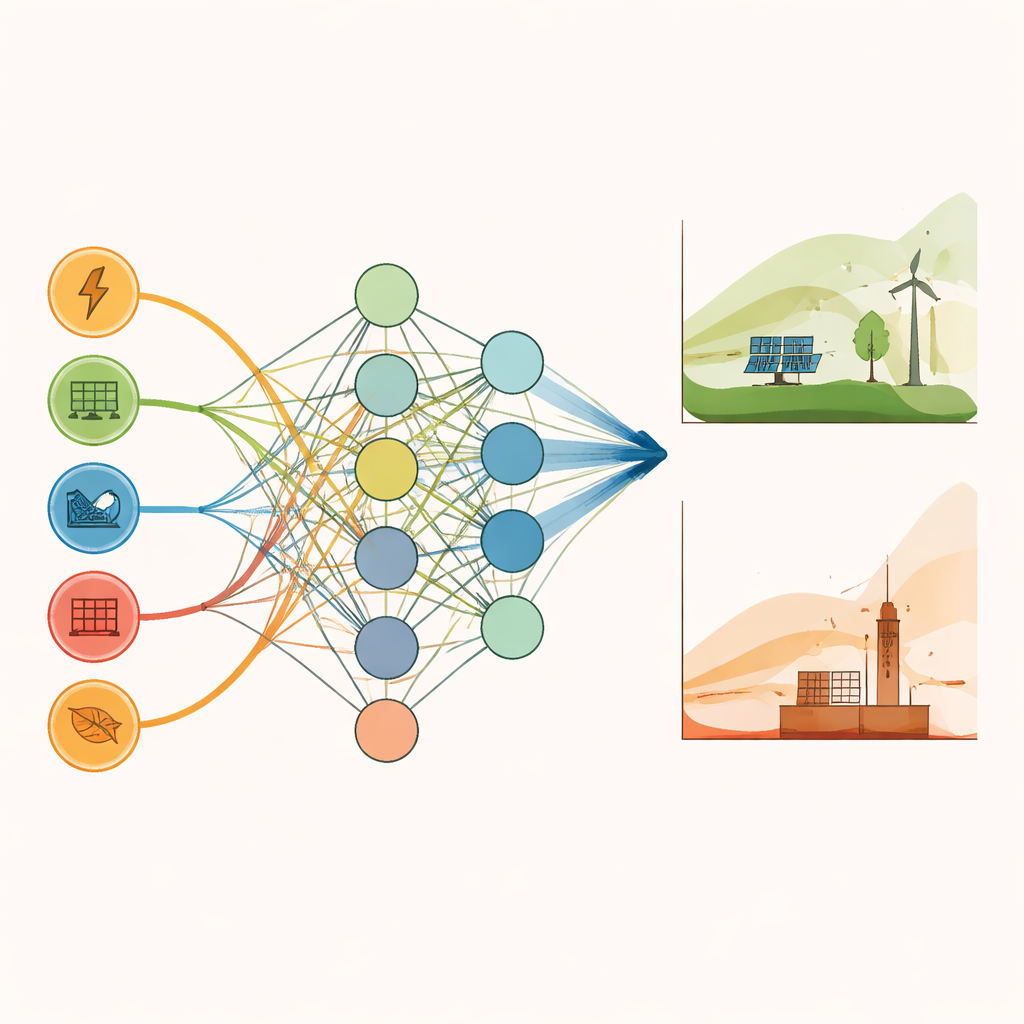
The researchers turn to Bayesian neural networks, a variant of modern artificial intelligence that treats the internal “weights” of a model not as fixed numbers, but as ranges of plausible values. Instead of producing a single sharp answer—say, how much emissions will drop under a new carbon price—the model produces both a best estimate and an honest indication of how uncertain that estimate is. This matters for policy because it can distinguish between situations where we have strong evidence that a plan will work and cases where the data are thin and the results more speculative.
Teaching the model the language of power policy
To make this approach useful in practice, the team custom‑fit the model to the real conditions of the Fujian power system between 2018 and 2024. They built an index of “green transformation” that blends many indicators people care about: carbon emissions per unit of electricity, the share of renewable power, energy efficiency, customer satisfaction, system reliability, and more. They also constructed a detailed picture of policy action—including renewable energy incentives, carbon pricing, efficiency standards, and enforcement strength—and fed in market and regional information so the model could learn how these forces play out over time.
Putting the tool to the test
After carefully cleaning and combining data from regulators, utilities, and environmental monitors, the authors trained their Bayesian neural network and compared it with a suite of common techniques, from simple linear regression to random forests and standard deep learning. Their tailored model achieved the best overall performance, improving prediction accuracy by roughly 4–5 percentage points over typical machine‑learning approaches and explaining nearly 90 percent of the variation in outcomes in held‑out years. Just as important, its uncertainty estimates were well‑calibrated: when the model claimed a 95 percent prediction band, real‑world results fell inside that band about nine times out of ten, giving users a realistic sense of risk rather than false confidence.
What the scenarios say about “how much is enough”
Armed with this tool, the team explored different mixes and strengths of green policies. They found that raising policy intensity—through stronger carbon prices, better renewable subsidies, and tighter enforcement—does improve green performance, but only up to a point. Beyond a moderate‑to‑high level, each extra notch of effort buys less extra benefit, a pattern known as diminishing returns. In Fujian, policies at about two‑thirds of the maximum intensity produced most of the achievable environmental gains, often more cost‑effectively than the most aggressive options. The analysis also highlighted three levers that matter most: incentives for renewable investment, the price placed on carbon emissions, and how consistently rules are enforced.
What this means for future power policy
For non‑specialists, the message is straightforward: when crafting green rules for the power sector, it is not always best to push every dial to the maximum. A carefully designed package of moderate‑to‑strong measures, focused on renewables, carbon pricing, and credible enforcement, can deliver nearly the same environmental benefits at lower cost and with more predictable results. While the numbers in this study are specific to one Chinese province, the method offers a template any region can adapt—combining modern AI with honest uncertainty estimates to design cleaner, smarter, and more reliable power systems.
Citation: Shen, Y., Chen, J., Wang, W. et al. Bayesian neural network-based policy effect prediction for green transformation of power business environment. Sci Rep 16, 12502 (2026). https://doi.org/10.1038/s41598-026-42092-z
Keywords: green energy policy, power grid transformation, Bayesian neural networks, renewable incentives, carbon pricing