Clear Sky Science · en
An IoT-enabled CRNN framework for secure wearable sensor-based activity recognition in physical education
Why Smarter Fitness Tracking Matters
Most of us now wear devices that count our steps, track our heart rate, and even estimate our sleep. But behind those friendly graphs lies a hard problem: how can a wristband or sensor-packed shirt reliably tell whether you are walking, sprinting, cycling, or playing a game? This paper explores a new way to read the streams of data from these gadgets so they can recognize physical activities much more accurately, with a special focus on how this could improve physical education and sports training.

From Simple Trackers to Connected Sports Classrooms
Wearable gadgets have moved far beyond basic pedometers. Today’s devices measure motion in three dimensions, body rotation, compass direction, skin temperature, and heart behavior, sending all of this through the Internet of Things (IoT) to powerful computers. In schools and training centers, that means coaches and teachers could, in principle, monitor many students at once, tracking how hard they are working and how they move. Yet most current systems still struggle with messy, real-world data and often mislabel complex activities, limiting their usefulness for fine-tuned coaching, fair assessment, or injury prevention.
A New Digital Eye on Movement
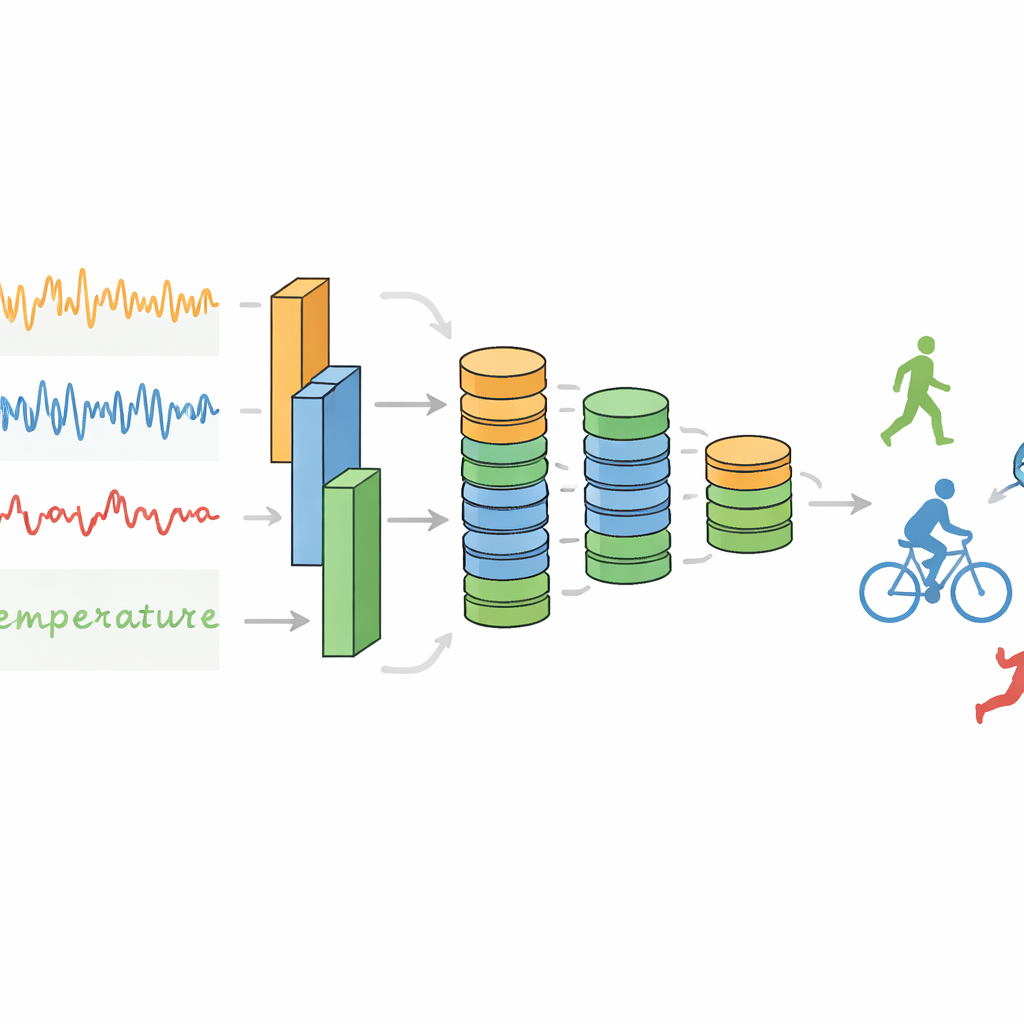
The authors propose an activity recognition framework that treats wearable data as both patterns in space and patterns in time. They build on a hybrid artificial intelligence design called a Convolutional Recurrent Neural Network, or CRNN. One part of this model looks for meaningful shapes across sensor channels at each moment—how accelerometer, gyroscope, and heart rate signals line up together. Another part looks along the time axis, learning how these patterns evolve over seconds as a person moves. By combining these two views, the system can tease apart activities that may look briefly similar but differ in how they unfold, such as a brisk walk versus an easy jog.
How the System Sees and Learns
In the proposed setup, students (or, in this study, people represented in a public dataset) wear multiple sensors on the body. These record heart rate, body temperature, acceleration, rotation, and magnetic orientation at dozens of measurements per second. The raw streams are cleaned to remove glitches, smoothed to reduce noise, and scaled so that no single sensor dominates the model. The data are then sliced into short time windows, each tagged with the main activity occurring during that interval. These windows form the training material for the CRNN, which automatically discovers useful features without human-crafted rules, and gradually learns to map each short segment of signals to an activity such as walking, running, cycling, or playing games.
Testing the Digital Coach
To judge whether their approach truly improves recognition, the authors test it on an openly available wearable-sensor dataset used by other researchers. They compare their CRNN with a range of alternatives, from classic methods like support vector machines and random forests to modern deep learning models that use only spatial patterns (convolutional networks) or only time patterns (recurrent networks and Transformers). Across a wide range of measures—overall accuracy, how often true activities are correctly detected, and how rarely the system raises false alarms—the CRNN comes out on top. It correctly recognizes the activity in more than 98 percent of test samples, maintains strong performance for each activity type, and does so without excessive computation time, making it plausible for near‑real‑time monitoring.
What This Means for Everyday Exercise and Teaching
The study suggests that carefully designed AI models can turn ordinary wearables into far more reliable observers of our movement. For physical education, that could mean objective, continuous records of how students participate, how intensely they exercise, and how their technique changes over time, all while data are securely handled through the IoT infrastructure. While the current results come from benchmark datasets rather than live classroom trials, they show that combining spatial and temporal learning is a powerful recipe for decoding human activity. With further testing in real schools and training centers, such systems could give coaches and educators a trustworthy digital assistant—quietly watching, learning, and offering data-driven insights to help people move better and stay healthier.
Citation: Yuan, J., Zhang, Y. & Chen, B. An IoT-enabled CRNN framework for secure wearable sensor-based activity recognition in physical education. Sci Rep 16, 11953 (2026). https://doi.org/10.1038/s41598-026-42082-1
Keywords: wearable activity recognition, Internet of Things, physical education technology, deep learning sensors, smart fitness monitoring